Key Takeaways
- Direct mail ROI = ((Revenue - Cost) / Cost) x 100. All four inputs (response rate, conversion rate, average order value, total cost) must be measured, not estimated.
- ANA 2023 benchmarks: 5.3% house-list response rate, 2.9% prospect response rate, 161% average ROI, and cost per acquisition of US$19 (house) vs. US$43 (prospect).
- Attribution requires a mechanism on every postcard. QR codes, call tracking numbers, dedicated landing pages, and promo codes each serve different audience behaviours.
- A 5,000-piece house-list campaign at CA$1.53 per piece with a 5.3% response rate and 25% conversion on a CA$400 average order produces roughly 245% ROI in this worked example.
- The biggest ROI levers are list quality (house vs. prospect), offer strength, repetition, personalization, and volume (which unlocks lower per-piece pricing).
- Measuring too early, counting unattributed revenue, and ignoring soft costs are the most common mistakes that produce misleading ROI figures.
- Lob 2025 data shows 88% of marketers find personalization improves response rates, and 84% rate direct mail as their highest-ROI channel per Lob 2024.
Direct mail still earns its place in the marketing budget, but only when you measure it properly. Without a clear formula and reliable attribution, campaigns that are quietly profitable get cut, and ones that are quietly losing money keep running. This guide walks through every number you need: the ROI formula, the inputs that feed it, industry benchmarks from the ANA 2023 Response Rate Report, the attribution methods that make tracking honest, and a worked example built on real Magic Mailer pricing. By the end you will know exactly how to score any campaign before and after it runs.
What the Direct Mail ROI Formula Actually Measures
ROI equals revenue generated by the campaign minus total campaign cost, divided by total campaign cost, expressed as a percentage. Written out: ROI = ((Revenue - Cost) / Cost) x 100. That single formula is the anchor for every other calculation in this guide, and every input must be measured, not guessed.
The formula looks deceptively clean, but two things commonly distort it. First, "revenue" must be attributed only to the campaign, not to sales that would have happened anyway. Second, "cost" must be fully loaded: design, printing, postage, list acquisition, and any tracking infrastructure. Leaving out costs inflates ROI; mis-attributing revenue does the same. Get both sides right and the number becomes a real decision tool.
The Four Inputs You Need Before You Calculate
Every direct mail ROI calculation rests on four measurable inputs. Track all four and you can build a reliable pre-campaign forecast as well as an accurate post-campaign report.
Response rate is the percentage of recipients who take any action, whether calling a number, scanning a QR code, or visiting a landing page. The ANA 2023 Response Rate Report puts the average postcard response rate at 5.3% for house lists (people who already know your business) and 2.9% for prospect lists (cold audiences).
Conversion rate is the percentage of responders who become paying customers. This number lives in your CRM or point-of-sale system. If 100 people respond and 20 buy, your conversion rate is 20%.
Average order value (or lifetime customer value) is the revenue per converted customer. For a one-time transaction use average order value. For repeat-purchase businesses, customer lifetime value gives a fuller picture and usually makes the ROI look stronger.
Total campaign cost is the fully loaded figure: per-piece price multiplied by volume, plus any creative, list, or tracking costs. With Magic Mailer, printing and postage are included in the per-piece price, so the math starts from CA$3.31 per piece for smaller runs or CA$1.53 per piece at 5,000 or more pieces.
Industry Benchmarks: What Good ROI Looks Like
Benchmarks give you a reality check before the campaign goes out. The ANA 2023 Response Rate Report is the most widely cited source in North American direct mail, and its numbers are worth knowing precisely.
House-list campaigns (mailing to existing customers or warm contacts) average a 5.3% response rate and a cost per acquisition of US$19. That same report measures the average house-list ROI at 161%, meaning every dollar spent returns CA$2.61. Prospect campaigns average a 2.9% response rate and a cost per acquisition of US$43, reflecting the additional spend needed to convert cold audiences.
The Lob 2024 State of Direct Mail found that 84% of marketers rate direct mail as their highest-ROI channel, with 85% citing it for best response rates and 84% for best conversion rates. Those figures reflect a channel that has matured rather than faded.
| Metric | House List | Prospect List | Source |
|---|---|---|---|
| Average response rate | 5.3% | 2.9% | ANA 2023 |
| Cost per acquisition | US$19 | US$43 | ANA 2023 |
| Average ROI | 161% | Not reported | ANA 2023 |
| Marketers rating DM highest-ROI | 84% | 84% | Lob 2024 |
These are averages across industries and list qualities. A well-targeted campaign to a clean house list can outperform them significantly. A poorly targeted prospect campaign to a stale list will fall short.
Ready to Reach the Right Prospect at the Right Moment?
Launch a self-serve campaign with Magic Mailer, or book a call for done-for-you timing-based mailers.
Try Magic Mailer FreeWant it set up in your CRM for you? book a meeting
Prefer to just describe it? build your whole campaign in one chat
Attribution Methods: Connecting Revenue to the Right Campaign
Attribution is where direct mail measurement most often breaks down. When a customer calls or walks in, there must be a mechanism that traces that action back to the postcard, or the revenue stays invisible in your spreadsheet.
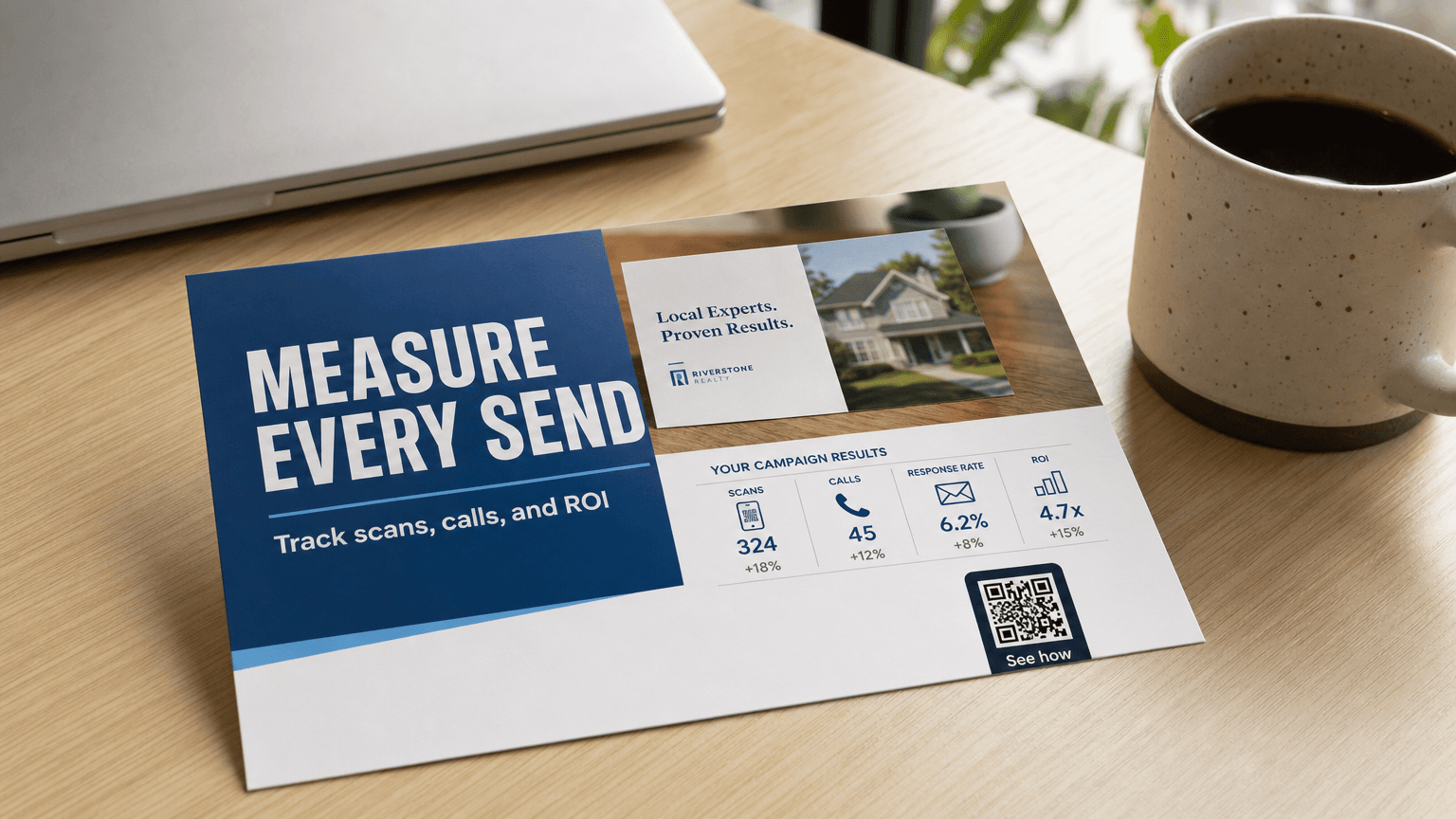
Unique QR codes are the most frictionless attribution method for 2024 and beyond. Print a unique QR code on the postcard that points to a dedicated landing page or URL parameter. Every scan is logged automatically. Magic Mailer postcards support QR codes to any URL, making this the default recommendation for any campaign targeting smartphone users. The scan data tells you response rate in real time.
Call tracking numbers assign a unique phone number to each campaign. When a prospect calls that number, the call is forwarded normally but logged against the campaign. This is the right choice for service businesses where the primary conversion path is a phone call rather than an online form.
Dedicated landing pages or promo codes serve audiences who are less likely to scan a QR code. A URL like yourbusiness.com/spring or a promo code POSTCARD25 lets you track web traffic and coupon redemptions back to the mailing. The downside is relying on the recipient to remember and type the URL, which reduces measurement completeness.
Match-back analysis compares your customer database against your mailing list after the campaign window closes. Anyone who received the postcard and then made a purchase is counted as an attributed conversion. This method captures customers who responded offline without using any tracking mechanism, but it requires clean CRM data and discipline about campaign windows.
For most campaigns, combining a QR code with a promo code gives you the best coverage: QR scans capture the digitally active responders, and promo codes capture those who prefer to call or walk in.
Worked Example: Calculating ROI with Magic Mailer Pricing
Here is a concrete example using both Magic Mailer price anchors so you can see how the numbers move at different scales.
Scenario A: 500-piece campaign at CA$3.31 per piece
- Total campaign cost: 500 x CA$3.31 = CA$1,655
- Response rate (ANA prospect benchmark): 2.9% = 14.5 responders, call it 14
- Conversion rate: 25% = 3.5 customers, call it 3
- Average order value: CA$400
- Revenue attributed: 3 x CA$400 = CA$1,200
- ROI: ((CA$1,200 - CA$1,655) / CA$1,655) x 100 = -27%
A negative result on a cold prospect campaign at this scale is common because 500 pieces rarely reaches the response volume needed to cover cost. The fix is either a warmer list (use a house list to lift response toward 5.3%) or scaling up to lower the per-piece cost.
Scenario B: 5,000-piece campaign at CA$1.53 per piece
- Total campaign cost: 5,000 x CA$1.53 = CA$7,650
- Response rate (ANA house benchmark): 5.3% = 265 responders
- Conversion rate: 25% = 66 customers
- Average order value: CA$400
- Revenue attributed: 66 x CA$400 = CA$26,400
- ROI: ((CA$26,400 - CA$7,650) / CA$7,650) x 100 = 245%
| Scenario | Pieces | Per-piece cost | Total cost | Responses | Customers | Revenue | ROI |
|---|---|---|---|---|---|---|---|
| A: Cold prospect | 500 | CA$3.31 | CA$1,655 | 14 | 3 | CA$1,200 | -27% |
| B: House list | 5,000 | CA$1.53 | CA$7,650 | 265 | 66 | CA$26,400 | 245% |
The difference between -27% and 245% comes from three levers working together: a better list (house vs. prospect), a higher volume that unlocks the lower per-piece rate, and the compounding effect of both. You can run your own numbers using the same formula before committing to a campaign.
For a full breakdown of how per-piece costs scale, see the postcard marketing cost guide.
Ready to Reach the Right Prospect at the Right Moment?
Launch a self-serve campaign with Magic Mailer, or book a call for done-for-you timing-based mailers.
Try Magic Mailer FreeWant it set up in your CRM for you? book a meeting
Prefer to just describe it? build your whole campaign in one chat
How to Improve Your Direct Mail ROI
Improving ROI means moving one or more of the four inputs in your favour. There are five high-leverage levers, and they can be applied independently or together.
Targeting: The single biggest ROI driver is mailing to the right people. A house list outperforms a cold prospect list by nearly 2x on response rate, according to the ANA 2023 data. Smart local targeting that matches your offer to the right geography and household type compounds this further. The more precisely you define who receives the postcard, the fewer wasted impressions and the lower your effective cost per acquisition.
Offer strength: Response rate is highly sensitive to the offer. A time-limited discount, a free consultation, or a clear first-order incentive gives the recipient a concrete reason to act. Vague brand-awareness campaigns produce vague results. The offer should be specific, credible, and tied to a clear call to action.
Repetition: A single mailing rarely performs as well as a sequence. Direct mail works through recall and familiarity, which build with repeated exposure. The USPS and Temple University research on physical mail found that physical media drives stronger memory encoding and emotional response than digital equivalents, meaning each touchpoint accumulates. A three-touch sequence typically outperforms three separate one-time campaigns at the same total budget.
Personalization: The Lob 2025 State of Direct Mail found that 88% of marketers say personalization improves direct mail response rates. Personalization ranges from first-name salutation to variable images based on the recipient's neighbourhood or purchase history. Even modest personalization lifts response meaningfully.
Scale: As the worked example above shows, scaling from 500 to 5,000 pieces drops the Magic Mailer per-piece price from CA$3.31 to CA$1.53. That cost reduction alone shifts a marginal campaign into profitable territory before you change anything else. When a small pilot campaign performs adequately, scaling it is often the fastest path to a strong ROI.
For the broader strategic context behind these levers, the direct mail marketing guide covers the full channel in depth.
Common Direct Mail ROI Measurement Mistakes
Most measurement errors fall into a small number of patterns. Knowing them in advance lets you avoid the ones that send campaigns in the wrong direction.
Measuring too early. Direct mail campaigns have a response tail that can stretch four to eight weeks. Pulling results at two weeks systematically understates performance, especially for high-consideration purchases like home services or professional services. Set your measurement window before the campaign goes out and stick to it.
Counting all revenue in the window, not attributed revenue. If your business runs ongoing promotions or has natural seasonal spikes, you need a control group or a baseline to isolate the postcard's contribution. Without a control, you risk crediting the campaign for revenue that would have come in anyway.
Using list size as the denominator instead of delivered pieces. Undeliverable addresses reduce your effective reach. If you mail 5,000 pieces and 400 are returned undeliverable, your true audience is 4,600. Response rates calculated against 5,000 will understate actual performance; cost per acquisition will be slightly understated too.
Forgetting soft costs. Staff time spent fulfilling postcard-driven inquiries, the cost of an introductory offer, and the overhead of building and cleaning the list are real costs. A fully loaded cost figure gives you a more honest ROI and a stronger foundation for the next budget conversation.
Abandoning campaigns before the learning curve completes. A first campaign is rarely the best version of a campaign. The data it generates, response by neighbourhood, offer, and design, informs the second campaign, which should outperform the first. Cutting a campaign after a single mediocre run forfeits the compounding benefit of iteration.
Avoiding these mistakes is as important as getting the formula right. Paired together, an accurate formula and disciplined attribution turn direct mail from a gut-feel spend into a measurable growth channel.
For businesses comparing direct mail against paid digital, the direct mail vs. digital ads comparison lays out the trade-offs in detail. And when you are ready to build a campaign that tracks from first send to final attribution, Magic Mailer handles the design, targeting, printing, and delivery in a single workflow.
Frequently Asked Questions
What is a good ROI for direct mail?+
The ANA 2023 Response Rate Report puts average house-list direct mail ROI at 161%. A campaign to a warm, well-targeted list with a strong offer can exceed that. Prospect campaigns typically produce lower initial ROI because response rates average 2.9% versus 5.3% for house lists, though the economics improve with repetition and list refinement.
How do I track where my direct mail responses are coming from?+
Use a unique QR code on the postcard linked to a campaign-specific URL, a dedicated call tracking number, or a promo code. Each method captures a different response path. For the broadest coverage, combine a QR code (for digital responders) with a promo code (for phone and in-store responders).
How long should I wait before measuring direct mail results?+
Set a measurement window of four to six weeks from the last delivery date. Response tails for high-consideration purchases can stretch beyond that. Pulling results at two weeks systematically understates campaign performance and can lead to premature cancellations.
Why is my direct mail ROI negative on small campaigns?+
Small-volume campaigns carry a higher per-piece cost, which raises the revenue threshold needed to break even. At 500 pieces and a 2.9% prospect response rate, you get roughly 14 responders. Even with a reasonable conversion rate, the revenue from 3 to 4 customers may not cover a CA$3.31 per-piece total. Scaling to 5,000 pieces at CA$1.53 per piece significantly lowers the break-even point.
Does personalization actually improve direct mail ROI?+
Yes. The Lob 2025 State of Direct Mail found that 88% of marketers say personalization improves response rates. Personalization ranges from first-name addressing to variable images or offers based on the recipient location or profile. Even basic personalization beyond a generic salutation tends to lift response.
Sources
- ANA 2023 Response Rate Report: house lists ~5.3% response; prospect lists ~2.9%; house-list ROI ~161%; cost per acquisition US$19 (house) vs US$43 (prospect). — ana.net
- Lob 2024 State of Direct Mail: 84% of marketers rate direct mail as their highest-ROI channel; 85% cite best response rates; 84% cite best conversion rates. — lob.com
- Lob 2025 State of Direct Mail: 88% of marketers say personalization improves direct mail response rates; 90% say direct mail enhances digital channel performance. — lob.com
- USPS OIG / Temple University, Enhancing the Value of Mail: The Human Response: physical mail drives stronger memory encoding, recall, and emotional response than digital. — uspsoig.gov
Ready to Reach the Right Prospect at the Right Moment?
Launch a self-serve campaign with Magic Mailer, or book a call for done-for-you timing-based mailers.
Try Magic Mailer FreeWant it set up in your CRM for you? book a meeting
Prefer to just describe it? build your whole campaign in one chat