Key Takeaways
- New movers represent a high-value audience: they are homeowners, in your target area, with no existing agent loyalty and an average resale horizon of 7 to 12 years.
- The optimal contact window is within 14 to 30 days of closing; after 60 days, early impressions have formed and the opportunity narrows significantly.
- A 3-touch welcome sequence across the first 90 days introduces the agent, establishes neighbourhood expertise, and delivers a soft valuation offer in a non-pushy register.
- New mover outreach integrates into a broader neighbourhood strategy: new buyers enter a dedicated welcome sequence, then graduate into the standard cadence.
- A 3-touch sequence costs roughly CA$10 to CA$15 per household through Magic Mailer, printing and postage included.
- Physical mail creates stronger memory encoding than digital at the same moment in a homeowner's journey, per USPS OIG and Temple University research.
Every home purchase creates a future seller. The new homeowner who just closed last month will, on average, sell within 7 to 12 years. They have no agent loyalty yet. They are forming their first impressions of the neighbourhood and the local market. The real estate agent who reaches them first, with the right message, at the right time, has a meaningful head start on every other agent in the area.
New mover direct mail is the strategy for capturing that window. This guide covers why new movers are worth targeting, how to identify and reach them, what to put on the postcard, how to structure a multi-touch welcome sequence, and how to layer new mover outreach into a broader neighbourhood strategy.
For the full direct mail toolkit across all audience types, the direct mail for realtors guide covers the complete picture.
Why New Movers Are a High-Value Audience
New movers are valuable for three compounding reasons: high future transaction probability, zero current agent relationship, and a receptive mindset in the weeks after purchase.
The transaction probability is well-established. Homeowners sell and buy again. The question is which agent will be top of mind when they are ready. An agent who makes a strong first impression in the weeks after purchase has years to reinforce that impression through a broader neighbourhood cadence. An agent who waits until the homeowner is ready to sell is competing against every other agent who has been nurturing that relationship.
The absence of an existing agent relationship is the strategic opening. A homeowner who just closed may have loved their buyer's agent, but buyer's agents and listing agents often operate in different niches. The seller relationship is up for grabs. A postcard arriving in that first month of ownership is not competing with an entrenched incumbent.
The receptive mindset is the timing advantage. New homeowners are in an active information-gathering phase. They want to know about the neighbourhood, local services, and community resources. A postcard that delivers useful local information alongside an agent introduction arrives when the homeowner is predisposed to engage with exactly that type of content.
Per the ANA 2023 Response Rate Report, the cost per acquisition for house lists is US$19, compared to US$43 for cold prospect lists. New movers reached within 30 days of purchase represent a warm audience: they are in the right geographic area, they are homeowners, and they have just engaged in a real estate transaction. That combination makes them far more responsive than a generic prospect.
How to Identify New Movers in Your Market
New mover data comes from public transfer records. Every property sale is recorded with the county or regional land registry, and that data flows into list vendors who make it available for direct mail targeting. The typical data lag is 2 to 4 weeks from closing date to list availability, which aligns well with the optimal contact window.
The practical approaches for sourcing new mover lists are:
List vendors with new mover data. National and regional list vendors aggregate transfer record data and allow targeting by postal code, date range, and property type. This is the standard approach for agents running new mover programmes at scale.
Smart local targeting through Magic Mailer. Post Timely's platform identifies recent purchase activity in the neighbourhoods you serve and builds the deliverable household list automatically. This removes the manual steps of sourcing, cleaning, and formatting a list from a vendor.
MLS-based monitoring. Agents who track closed transactions in the streets they work can maintain a running list of new owners and add them to a welcome sequence manually or through a CRM workflow.
The key constraint in any approach is speed. The value of reaching a new mover diminishes with each week past closing. Agents who can reach new homeowners within 14 to 30 days of closing are in the prime contact window. After 60 days, the homeowner has typically formed early impressions of the neighbourhood and the agent who got through first is likely already someone else.
Ready to Send Your First Campaign?
Magic Mailer uses AI to design, print, and mail professional postcards for your business in minutes, not weeks.
Try Magic Mailer FreeWant it set up in your CRM for you? book a meeting
Prefer to just describe it? build your whole campaign in one chat
What to Put on a New Mover Postcard
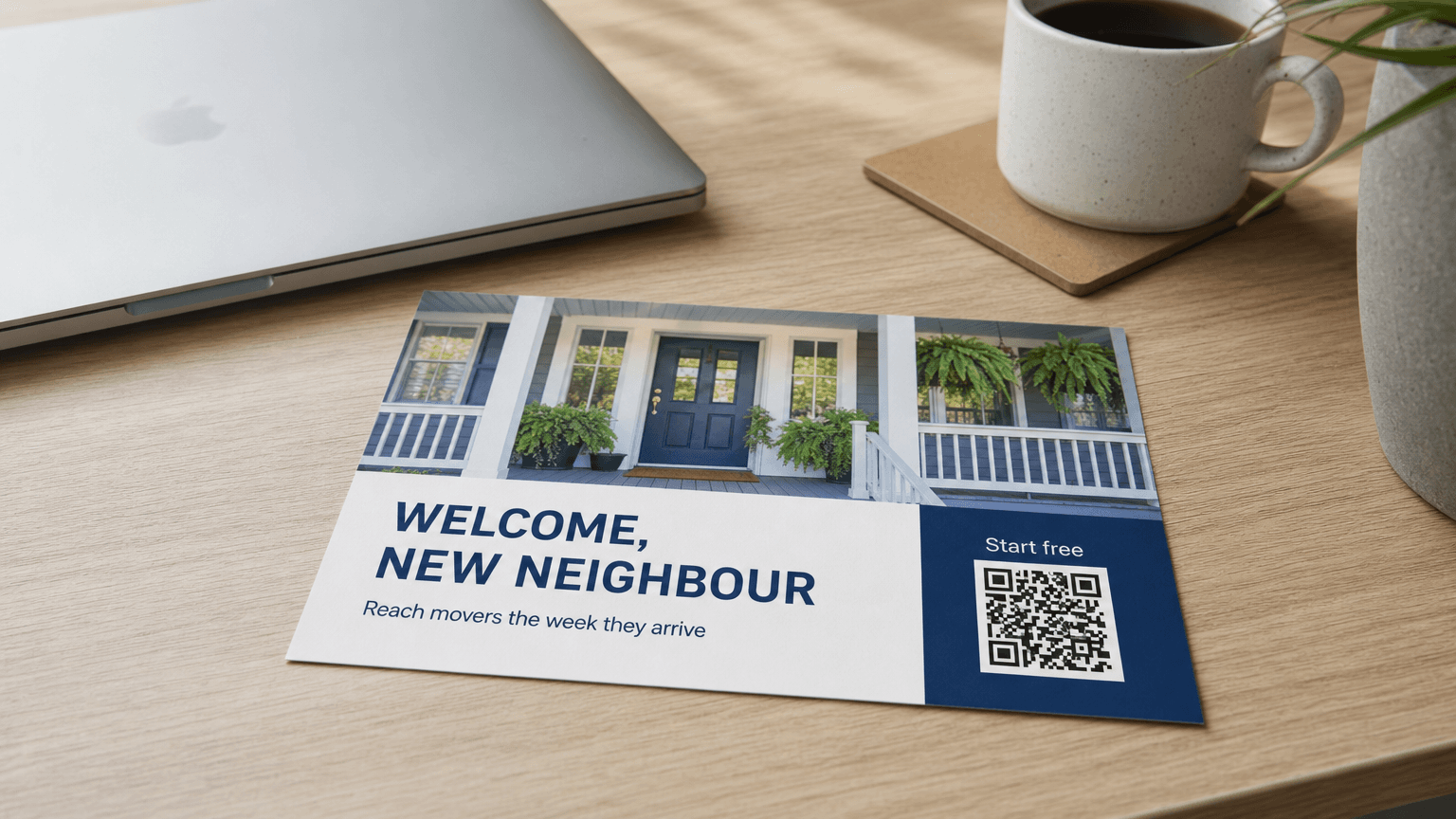
A new mover postcard is different from a transaction postcard. The homeowner is not yet thinking about selling. The goal is to introduce the agent, establish a helpful presence, and plant the seed that this agent knows the neighbourhood and will be the right call when the time comes.
The tone should be welcoming rather than transactional. A headline like "Welcome to the neighbourhood" sets the right register. The card body can offer something genuinely useful: a short list of local services, a QR code to a neighbourhood market report, or an invitation to connect for any questions about the area.
New mover postcard checklist:
- Welcoming headline referencing the neighbourhood or street name
- Agent headshot, name, direct contact number, and brokerage logo
- A useful local offering: neighbourhood market report, local services list, or community resource
- QR code to a landing page with neighbourhood information and a soft valuation offer
- A low-pressure call to action: "Questions about the area? Reach out any time."
- No hard ask for a listing or valuation in the first touch
The USPS OIG and Temple University research on physical mail found that physical formats are processed more deeply and recalled more readily than digital messages because the tactile experience activates memory encoding in ways screens do not. A well-designed welcome postcard arriving in the first weeks of homeownership creates a memory trace that a digital ad cannot replicate at the same moment in the homeowner's journey.
The 3-Touch Welcome Sequence
A single postcard is a single impression. A 3-touch welcome sequence builds a relationship. The structure over the first 90 days of a new homeowner's tenure looks like this:
Touch 1 (weeks 2-4 after closing): The welcome card. Introduction, neighbourhood focus, useful local content, low-pressure invitation to connect. This is the card described in the section above.
Touch 2 (weeks 6-8 after closing): The neighbourhood market update. A postcard with local sold prices from the past 90 days, average days on market, and a brief observation about demand in the area. This positions the agent as the neighbourhood data source without asking for anything. It also gives the homeowner a reference point for their own purchase price relative to recent sales.
Touch 3 (weeks 10-12 after closing): The soft valuation offer. A postcard with a brief market commentary and a clear offer to provide a no-obligation home valuation at any point. By the third touch, the agent's name has appeared three times in the homeowner's mailbox in a helpful, non-pushy register. The valuation offer here lands as a natural next step rather than a cold pitch.
After the initial 3-touch sequence, the new mover graduates into the agent's regular neighbourhood cadence, receiving the same market update, seasonal, and transaction cards as the rest of the area. The relationship has been initiated; the cadence maintains it.
The Lob 2025 State of Direct Mail found that 88% of marketers say personalization improves response rates. A new mover sequence that references the specific neighbourhood by name and uses locally relevant sold data is inherently personalized to that recipient in a way that a generic card is not.
Integrating New Mover Outreach Into Your Neighbourhood Strategy
New mover outreach is most powerful when it is layered into a broader neighbourhood strategy rather than run in isolation. The integration looks like this:
The service area defines your geographic focus. Within that area, every home purchase triggers a new mover sequence for the buyer. The rest of the neighbourhood receives the standard cadence. Over time, your service area contains two tiers: homeowners who have been receiving your cards for years and know your name, and recent purchasers who are being onboarded into that ecosystem with a dedicated welcome sequence.
This layered approach means no household in the neighbourhoods you serve is ever unreached. The standard cadence captures the long-term homeowners. The new mover sequence captures recent buyers at their most receptive moment. Together, they produce an area where the agent is the most visible local presence regardless of when a homeowner arrived.
Agents who add just listed and just sold postcards into the same neighbourhood create a third layer: event-triggered impressions that go to the surrounding streets whenever a transaction occurs. The combination of cadence, welcome sequence, and event triggers gives the agent three distinct types of touchpoints that each serve a different purpose in the homeowner relationship.
Ready to Send Your First Campaign?
Magic Mailer uses AI to design, print, and mail professional postcards for your business in minutes, not weeks.
Try Magic Mailer FreeWant it set up in your CRM for you? book a meeting
Prefer to just describe it? build your whole campaign in one chat
Pricing and How Magic Mailer Handles New Mover Campaigns
For Canadian real estate agents, new mover postcard pricing through Magic Mailer runs from CA$3.31 per piece for a single card down to CA$1.53 per piece at 5,000 or more pieces. Printing and postage are included at every tier.
A 3-touch welcome sequence to a single new mover household costs roughly CA$10 to CA$15 all in at single-piece pricing. For agents running 5 to 10 new mover sequences per month in an active area, the monthly spend is CA$50 to CA$150, a trivial investment relative to the long-term value of capturing a future seller relationship before any competing agent does.
Magic Mailer handles the full production workflow: AI-generated card design using the agent's branding, smart local targeting to identify new mover addresses, and end-to-end printing and delivery. The Starter plan is free and includes 1,000 build credits with no credit card required.
The New Listing Mailer is a related trigger-based product that reaches homeowners when new listings appear in their area, a moment of elevated seller intent. For agents who want to reach both new movers and active-market homeowners, both products can run simultaneously in the same area.
For agents ready to add new mover outreach to their programme, direct mail for real estate is the starting point, and Magic Mailer new listings covers the trigger-based complement. Browse all use cases at Post Timely Industries or reach out directly.
Frequently Asked Questions
How do I get a list of new movers in my area?+
New mover data comes from public transfer records that flow through list vendors with a typical 2 to 4 week lag from closing date. Magic Mailer can identify recent purchase activity in the neighbourhoods you serve and build the deliverable household list automatically, removing the manual sourcing and formatting step.
How soon should I mail a new mover postcard after closing?+
The optimal window is 14 to 30 days after closing. At that point the homeowner is settling in, actively exploring the neighbourhood, and has not yet formed a strong attachment to a local agent. Waiting beyond 60 days reduces the impact because early impressions of the area have already been formed.
What should the first new mover postcard say?+
The first touch should be a welcome message with a neighbourhood focus, not a sales pitch. Lead with the neighbourhood name, include something genuinely useful (a local services list, a QR code to a market report, or community resource information), and close with a low-pressure invitation to reach out with any questions. Save the valuation offer for the third touch.
How does new mover direct mail fit into a neighbourhood outreach strategy?+
New movers within your service area receive a dedicated 3-touch welcome sequence in their first 90 days, then graduate into the standard neighbourhood cadence alongside long-term homeowners. This ensures no household is unreached regardless of when they purchased, and it captures buyers at their most receptive moment before any other agent can establish a relationship.
How much does a new mover postcard campaign cost in Canada?+
Through Magic Mailer, a 3-touch welcome sequence to a single new mover household costs roughly CA$10 to CA$15 all in at single-piece pricing (CA$3.31 per piece), with printing and postage included. Agents running 5 to 10 new mover sequences per month typically spend CA$50 to CA$150 per month. The Starter plan is free with 1,000 build credits and no credit card required.
Sources
- ANA 2023 Response Rate Report: cost per acquisition for house lists is US$19 vs US$43 for cold prospect lists. — ana.net
- USPS OIG / Temple University: physical mail activates deeper memory encoding than digital formats. — uspsoig.gov
- Lob 2025 State of Direct Mail: 88% of marketers say personalization improves response rates. — lob.com
- Lob 2024 State of Direct Mail: 84% of marketers rank direct mail as their highest-ROI channel. — lob.com
Ready to Send Your First Campaign?
Magic Mailer uses AI to design, print, and mail professional postcards for your business in minutes, not weeks.
Try Magic Mailer FreeWant it set up in your CRM for you? book a meeting
Prefer to just describe it? build your whole campaign in one chat