Key Takeaways
- Local retail is built for postcard marketing because the target audience is already defined by geography: the households within a short walk or drive of the storefront are the customers who can become regulars.
- New movers are the highest-value cold segment for retail shops. They are actively forming local shopping habits and a timely postcard with a welcome offer reaches them before competitor loyalty is established.
- Four offer types drive the strongest in-store response: in-store-only discounts, new arrival or seasonal sale announcements, loyalty programme invitations, and event or trunk show invitations. Each should include a deadline.
- A QR code on every retail postcard links the physical mail to a trackable digital action, whether a landing page, online store, or redemption page, enabling clean attribution of visits and transactions back to the campaign.
- According to the ANA 2023 Response Rate Report, house-list direct mail averages a 5.3% response rate and 161% ROI. For a retail shop building a customer list over multiple campaigns, each successive send produces better returns as the house list grows.
- Magic Mailer postcard campaigns for retail run from CA$3.31 per piece at low volume to CA$1.53 per piece at 5,000 or more pieces, with printing, postage, and delivery included and no credit card required to start.
Running a retail shop, boutique, or specialty store means competing for the attention of the same households that walk or drive past your storefront every day. Social ads reach people across the city who may never visit. Search captures people already looking. A postcard lands on the kitchen counter of the household two blocks away and stays there until someone acts on it.
Retail direct mail marketing works because the audience is local by nature, the offer is tangible, and physical mail gets seen. This guide covers why local retail is built for postcard campaigns, how to build a catchment-area audience with smart local targeting, which offers drive store visits, how to time campaigns around seasons and holidays, and how to measure the results in real foot traffic and in-store redemptions. For the broader picture on postcard marketing costs, see postcard marketing cost.
Why Local Retail Thrives on Direct Mail
Local retail thrives on direct mail because the business model depends on repeat visits and word-of-mouth from a defined geographic catchment area. Unlike digital advertising that optimises for clicks from anywhere, a postcard campaign targets the households that can actually become regulars: the people who live within a few minutes' walk or a short drive from the front door.
Research commissioned by the USPS Office of Inspector General and conducted by Temple University found that physical mail drives stronger memory encoding, recall, and emotional response than digital equivalents. For a neighbourhood boutique competing with online retailers, that recall effect is significant: the postcard on the counter is what makes a household think of the shop when they need a gift, a seasonal wardrobe refresh, or a last-minute purchase.
The response rate data reinforces the channel. According to the ANA 2023 Response Rate Report, house lists average a 5.3% response rate with an ROI of 161%, and the average cost per acquisition runs US$19. The Lob 2024 State of Direct Mail found that 84% of marketers rate direct mail their highest-ROI channel, with 85% citing best response rates and 84% citing best conversion rates. For a shop owner weighing postcard spend against social ad budget, those figures are concrete.
The mechanism is straightforward: a nearby household receives a postcard with a specific in-store offer, keeps it on the fridge, and redeems it the next time they pass the store. That first visit converts a household from aware to customer, and from customer to repeat customer over time.
Reaching Nearby Households with Smart Local Targeting
Smart local targeting builds your postcard audience from the households within a defined radius of your store, ensuring every piece of mail goes to someone who can realistically walk in. Catchment-area reach is the core advantage retail has over almost any other business type in direct mail.
For most local shops, the relevant audience is the households within a 3-5 km radius. These residents pass the storefront regularly, they shop locally by habit or preference, and a compelling offer gives them a concrete reason to walk in. Broader geographic sweeps waste budget on households for whom the store is impractical. Tight radius targeting keeps cost per visit low and response rates high.
Smart local targeting also allows filtering by neighbourhood, postal code, or household type, which matters for a boutique whose merchandise skews toward a specific demographic. A children's clothing store, a wine shop, and a specialty kitchen retailer each have different ideal household profiles. Targeting built around that profile produces a list that converts, not a generic list that receives mail.
For a full overview of how postcard targeting works for local businesses, the small business direct mail guide covers audience building, campaign types, and measurement in more depth.
The New-Mover Opportunity for Retail Shops
New movers are the highest-value cold audience a local retailer can reach, because they are actively building new shopping habits in an unfamiliar neighbourhood. A new resident who receives a postcard from a nearby boutique before they have found a preferred shop is far more receptive than an established resident already loyal to a competitor.
New movers are exploring: they do not know the area's independent shops, farmers markets, or specialty retailers. A well-timed postcard with a welcome offer, a short description of what the store carries, and clear directions or a QR code to the online store gives that new household a reason to visit before habits form elsewhere.
The Lob 2025 State of Direct Mail found that 88% of marketers say personalisation improves response rates. A postcard addressed to a new mover that reads as a neighbourhood welcome, rather than a generic promotion, personalises the message in a way that registers. For a boutique or specialty retailer, this segment alone can justify a monthly or quarterly mailing.
For more on structuring and timing new-mover campaigns, see new mover direct mail.
Ready to Send Your First Campaign?
Magic Mailer uses AI to design, print, and mail professional postcards for your business in minutes, not weeks.
Try Magic Mailer FreeWant it set up in your CRM for you? book a meeting
Prefer to just describe it? build your whole campaign in one chat
Offers That Drive In-Store Visits
The best retail postcard offers create a specific reason to visit the store that cannot be replicated online. Generic discounts produce lower response rates than offers tied to an in-store experience or time-limited inventory.
Four offer types consistently drive foot traffic for local retail:
In-store-only discount. A percentage or dollar discount redeemable only at the physical location gives the postcard a clear reason to visit. "15% off your next in-store purchase" works because it cannot be used on a competitor's website. The recipient must come in to redeem it.
New arrival or seasonal sale. Announcing new inventory, a seasonal collection, or an end-of-season clearance event gives the postcard a news hook. Households who have visited before already know what the store carries; new inventory tells them there is something fresh to see.
Loyalty signup invitation. A postcard offering a one-time reward for joining the store's loyalty programme drives two outcomes: a first or return visit, and a long-term repeat-purchase relationship. The ANA 2023 Response Rate Report notes that house-list ROI averages 161%, reflecting precisely this compounding value of converting a new customer into a repeat one.
Event or trunk show. A private sale evening, a maker's market, a brand takeover event, or a seasonal trunk show gives nearby households a date and a reason to put the store on their calendar. Events create social sharing, extend the postcard's reach through word of mouth, and fill the store for a specific window rather than hoping for gradual traffic.
Each of these offers works best with a deadline. Open-ended promotions can be redeemed anytime, which means they can be redeemed never. A specific end date creates urgency without being aggressive.
Tying a QR Code to an Offer or Online Store
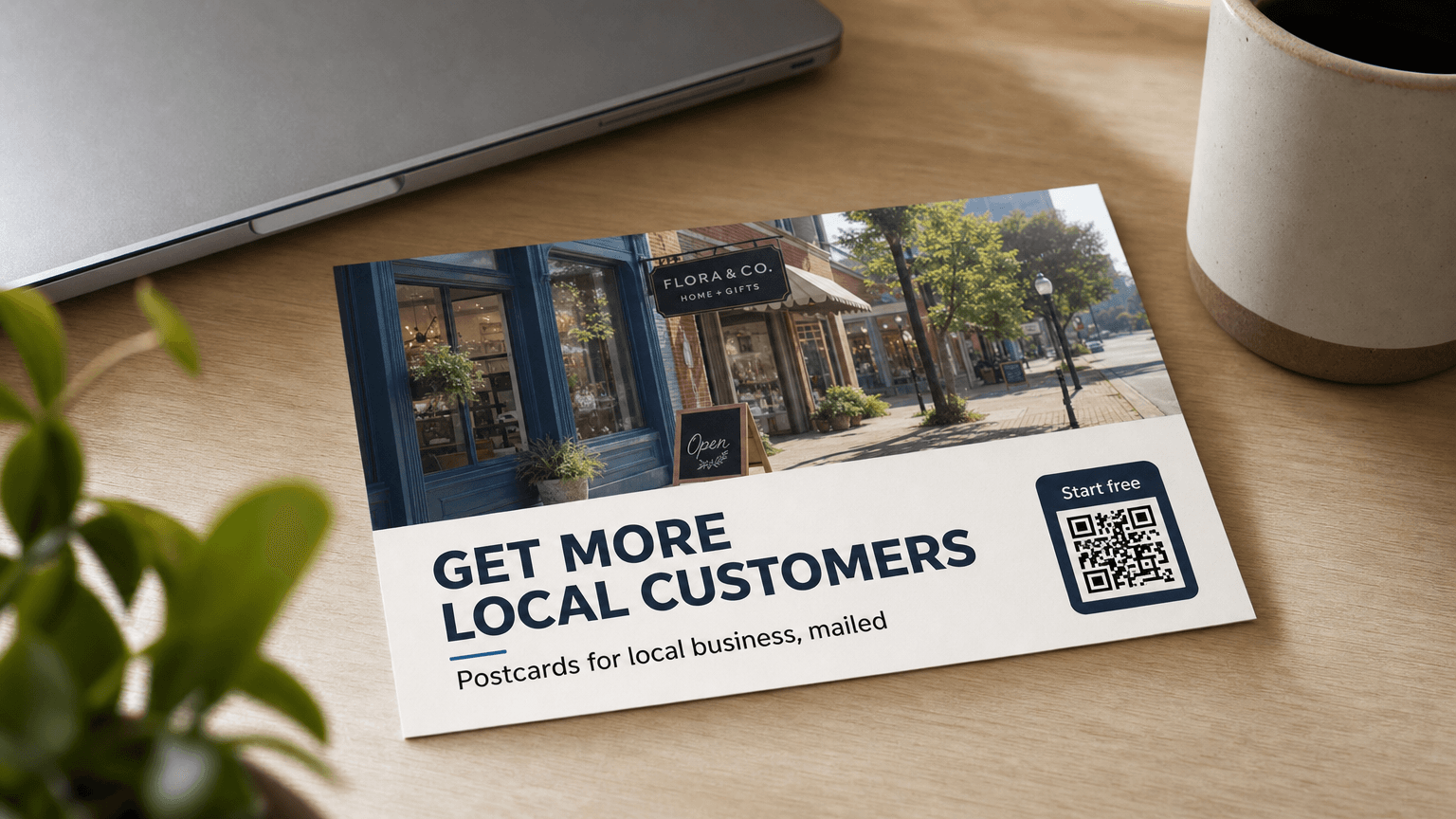
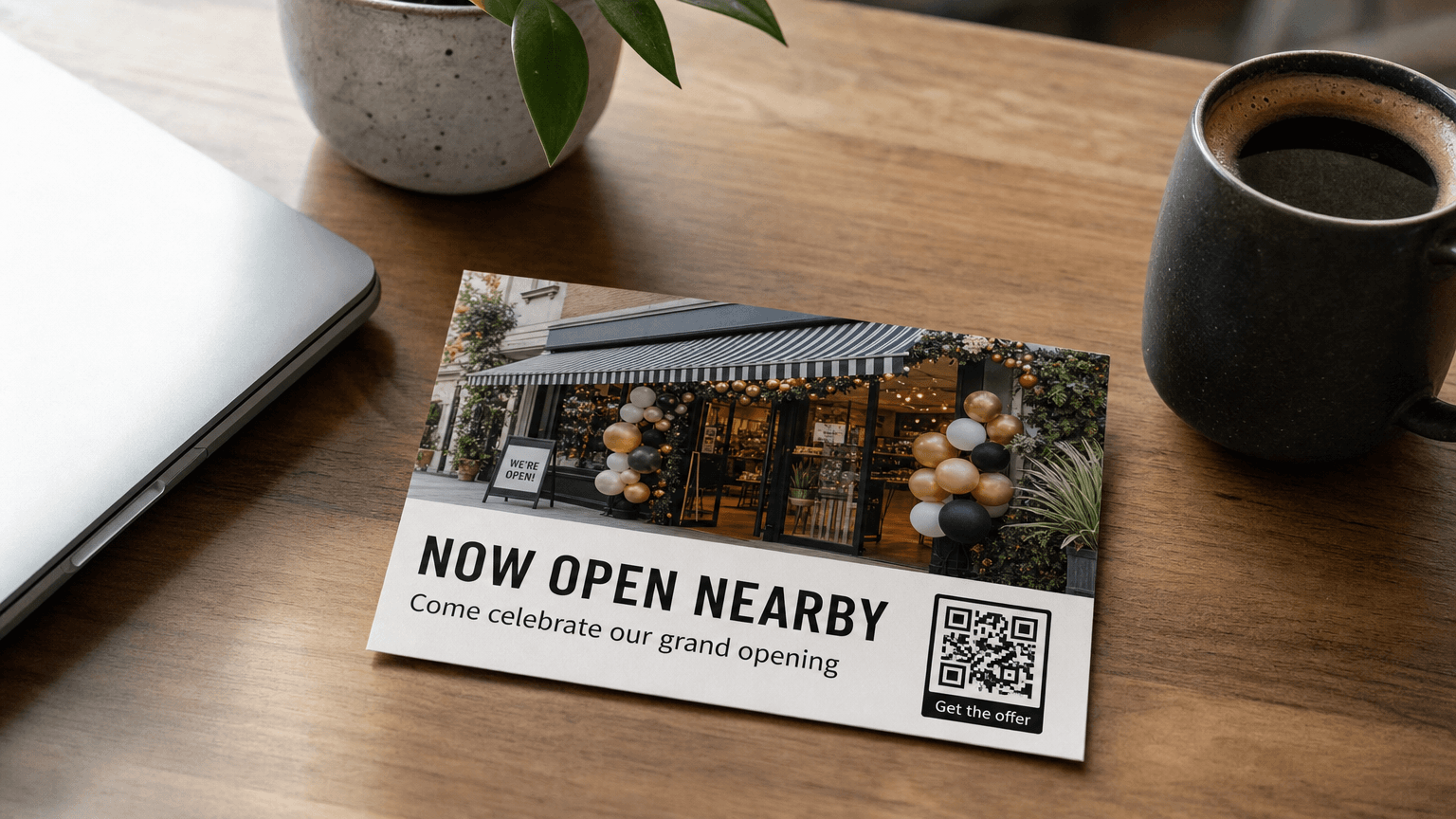
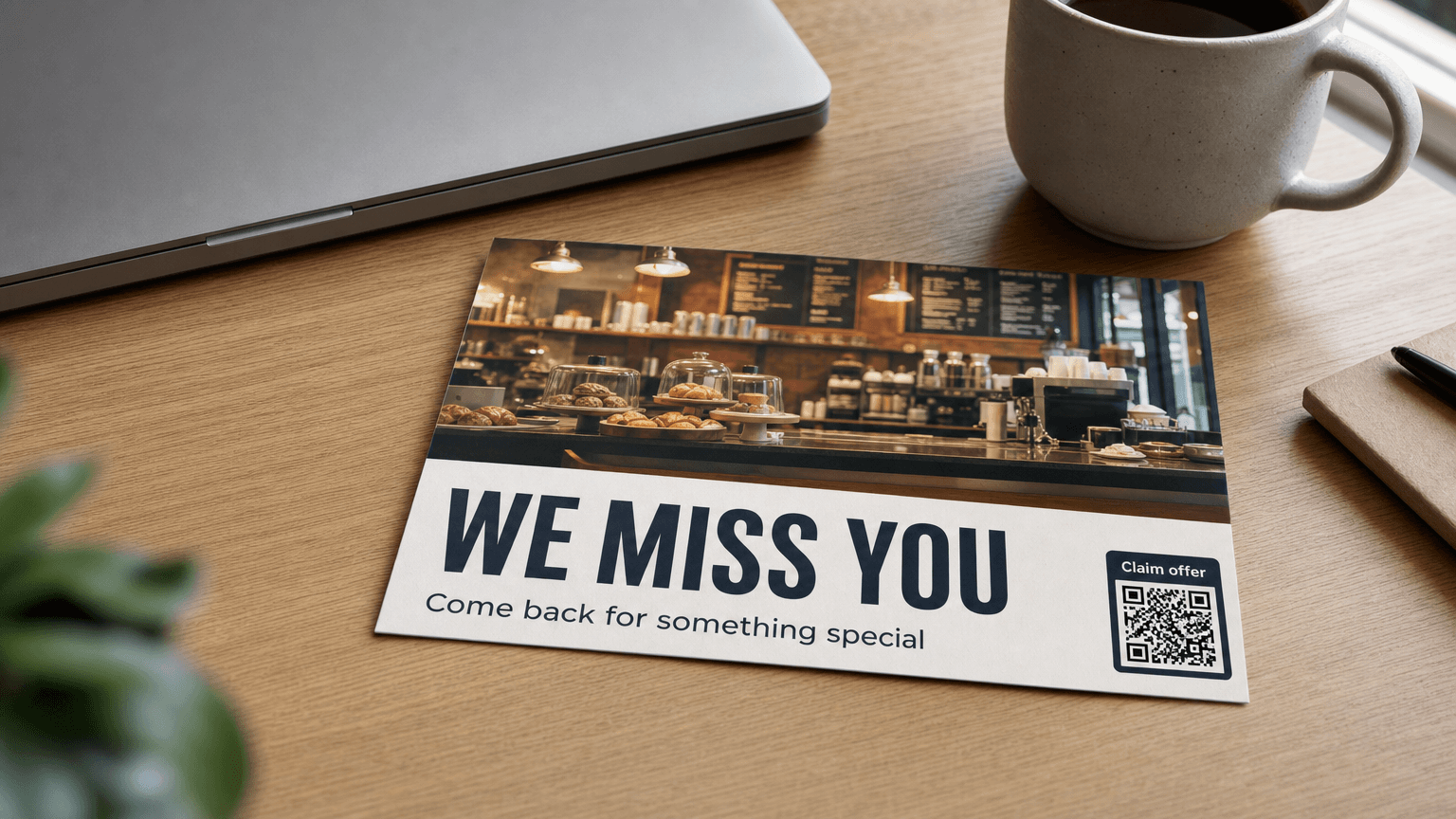
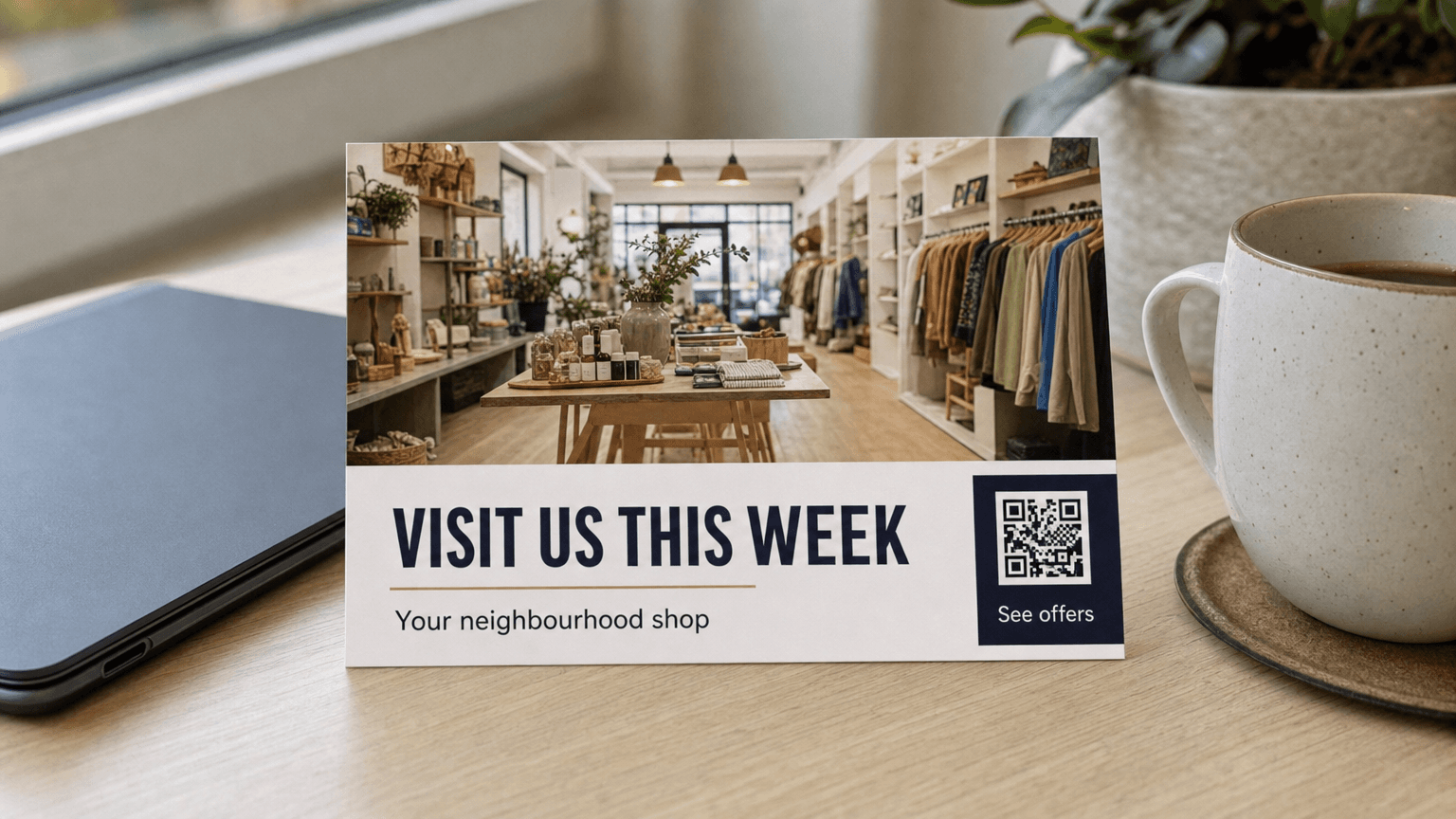
A QR code on a retail postcard closes the gap between the physical mailer and the digital action, whether that is browsing an online store, claiming a digital coupon, or booking a spot at an in-store event.
For a shop with an e-commerce component, the QR code can link directly to a new-arrivals page, a seasonal sale landing page, or a loyalty programme signup. The household who is not ready to visit immediately can browse online first and then come in, or complete a purchase and visit for pickup. The code tracks which households engaged digitally, giving the retailer attribution data even for visits that started online.
For purely in-store experiences, the QR code can link to a redemption page that captures the customer's name and email at the time of the visit, building the store's own list for future campaigns. According to the Lob 2025 State of Direct Mail, 90% of marketers say direct mail enhances digital channel performance. For retail, this shows up when the postcard drives a store visit that results in an email signup, a social follow, or a loyalty enrolment, each of which extends the relationship beyond the single transaction.
Magic Mailer lets you attach a QR code to any URL at the postcard design stage. No third-party tool is needed, and the code is unique to the campaign so scans are tracked separately from other traffic.
Timing Retail Postcard Campaigns Around Seasons and Holidays
Retail postcard timing is about landing in the household's hands at the moment when purchasing intent is highest, typically one to three weeks before a major shopping window.
The table below maps common retail mailing windows to the campaigns they support:
| Mailing Window | Campaign Type | Lead Time Before Event |
|---|---|---|
| Late October | Holiday gift guide / early shopping offer | 6-8 weeks before December |
| Mid-November | Black Friday or Small Business Saturday preview | 1-2 weeks before event |
| January | New Year clearance or new arrivals | Immediately post-holiday |
| March / April | Spring collection or Mother's Day preview | 3-4 weeks before event |
| Late August | Back-to-school or fall collection launch | 3-4 weeks before season shift |
| May / June | Father's Day or summer sale | 2-3 weeks before event |
| Any time | New mover welcome | Monthly or quarterly cadence |
Holiday campaigns for local retail carry an additional angle: competing against large-format and online retailers. A postcard that explicitly positions the shop as the local, personal, gift-worthy alternative to the box store or the online cart is a message that resonates with households who already prefer to shop locally but need a prompt to act on that preference.
For a general framework on building a postcard campaign for a small business across the year, the local business marketing page outlines how to structure a campaign calendar and choose targeting criteria.
Pricing: What Retail Postcard Campaigns Cost in Canada
Magic Mailer postcard campaigns for retail businesses run from CA$3.31 per piece at low volume down to CA$1.53 per piece at 5,000 or more pieces, with printing, postage, and delivery included in every send. There are no separate line items for printing, no postage account to manage, and no minimum volume requirements for a first send.
For a small boutique mailing 500 postcards to the surrounding neighbourhood at CA$3.31 per piece, the campaign cost is approximately CA$1,655. If even 2.9% of recipients respond (the ANA 2023 Response Rate Report's prospect-list benchmark), that is 14-15 store visits from a cold neighbourhood list. For a shop where the average transaction is CA$60-120, those visits cover the campaign cost in the first round before repeat purchases are counted.
At higher volumes, a 5,000-piece run targeting a broader catchment area at CA$1.53 per piece costs CA$7,650. The same 2.9% response rate at that scale produces approximately 145 visits, reducing the cost per visit substantially. A Free Starter plan includes 1,000 build credits with no credit card required, allowing a retailer to build the campaign, preview the audience size, and review AI-generated postcard designs before committing.
Ready to Send Your First Campaign?
Magic Mailer uses AI to design, print, and mail professional postcards for your business in minutes, not weeks.
Try Magic Mailer FreeWant it set up in your CRM for you? book a meeting
Prefer to just describe it? build your whole campaign in one chat
Measuring Results: Foot Traffic, Redemptions, and Cost Per Visit
Direct mail measurement for retail is more straightforward than most shop owners expect. The goal is to connect the postcard send to a physical store visit or in-store redemption with a short, auditable chain.
Four measurement approaches work well for local retail:
QR scans. Each campaign's unique QR code tracks digital engagement from the postcard. Scans are attributed to the mailing date and audience, giving the retailer a floor estimate of how many households engaged even before entering the store.
In-store redemptions. Offers with a specific code, coupon, or digital voucher produce a direct count of postcard-driven visits. Staff record the redemption at the point of sale, and the retailer sees exactly how many of the mailed households converted.
Foot traffic lift. Retailers with a traffic counter can compare the weeks following a mailing against baseline weeks with no campaign activity. The lift above baseline attributable to the campaign window is a conservative estimate of the postcard's impact.
Cost per visit. Dividing total campaign spend by the number of attributable visits gives a cost-per-visit figure. For most retail campaigns, this figure improves with each send as the house list grows and response rates from known customers outperform cold prospect response rates. The ANA 2023 Response Rate Report confirms this pattern: house-list response rates average 5.3% versus 2.9% for prospects, and house-list ROI averages 161%.
For retailers running a QR code campaign alongside a search or social retargeting effort, the Lob 2025 State of Direct Mail finding that 90% of marketers say direct mail enhances digital channel performance reflects exactly how the two channels compound: the postcard builds awareness, the digital retargeting reinforces it, and the store visit that follows is more likely than either channel would have produced alone.
See Magic Mailer for local businesses to explore how the platform handles targeting, design, and campaign tracking for retail postcard sends.
Frequently Asked Questions
Does direct mail marketing work for retail stores?+
Yes, particularly for local shops and boutiques whose customers come from a defined neighbourhood catchment area. The ANA 2023 Response Rate Report benchmarks prospect-list response rates at 2.9% and house-list rates at 5.3%, with house-list ROI averaging 161%. The Lob 2024 State of Direct Mail found that 84% of marketers rate direct mail their highest-ROI channel. For retail, the mechanism is straightforward: a nearby household receives a postcard with a specific in-store offer, visits to redeem it, and becomes a repeat customer.
What kind of offer should a retail postcard include?+
The most effective retail postcard offers are specific and tied to a physical store visit: an in-store-only discount redeemable at the register, a new arrival or seasonal sale announcement, a loyalty programme signup reward, or an invitation to an in-store event or trunk show. Every offer should include a deadline to create urgency. Open-ended promotions with no expiry produce lower redemption rates than time-limited ones.
How do I target nearby households for a retail postcard campaign?+
Smart local targeting builds your audience from households within a defined radius of the store, typically 3-5 km for most retail businesses. The audience can be filtered by neighbourhood, postal code, or household profile depending on the store's target customer. New movers in the area are a particularly valuable segment because they are actively forming new shopping habits and have not yet established loyalty to local competitors.
How do I measure the ROI of a retail postcard campaign?+
Four measurement approaches work well: tracking QR code scans from the campaign's unique code, counting in-store redemptions of the postcard offer, comparing foot traffic in the weeks following the mailing against baseline weeks, and calculating cost per visit by dividing campaign spend by attributable store visits. Over multiple campaigns, the house-list response rate (averaging 5.3% per the ANA 2023 Response Rate Report) outperforms cold prospect rates, improving cost per visit over time.
How much does a retail postcard campaign cost in Canada?+
Magic Mailer postcard campaigns run from CA$3.31 per piece at low volume down to CA$1.53 per piece at 5,000 or more pieces, with printing, postage, and delivery included. A Free Starter plan includes 1,000 build credits with no credit card required, so a retailer can build the campaign and preview designs before committing to a send.
Sources
- ANA 2023 Response Rate Report: direct mail to house lists averages a 5.3% response rate; prospect lists average 2.9%; postcards used by 76% of marketers mailing house lists; house-list ROI averages 161%; cost per acquisition US$19 (house) vs US$43 (prospect). — ana.net
- USPS Office of Inspector General / Temple University, Enhancing the Value of Mail: The Human Response: physical mail drives stronger memory encoding, recall, and emotional response than digital equivalents. — uspsoig.gov
- Lob 2024 State of Direct Mail: 84% of marketers rate direct mail their highest-ROI channel; 85% cite it for best response rates; 84% for best conversion rates. — lob.com
- Lob 2025 State of Direct Mail: 88% say personalisation improves response rates; 90% say direct mail enhances digital channel performance. — lob.com
Ready to Send Your First Campaign?
Magic Mailer uses AI to design, print, and mail professional postcards for your business in minutes, not weeks.
Try Magic Mailer FreeWant it set up in your CRM for you? book a meeting
Prefer to just describe it? build your whole campaign in one chat