Key Takeaways
- A three-drop postcard sequence (save-the-date, opening week, follow-up offer) outperforms a single mailing for grand opening campaigns by building awareness before you open and converting first-time visitors after.
- Smart local targeting lets you reach every household in your catchment area without needing an existing customer list, making postcards uniquely effective for a brand-new business.
- New movers are a high-value segment: they are actively forming new local habits and have not yet bonded with your competitors.
- Self-serve postcard pricing in Canada runs from CA$3.31 per piece down to CA$1.53 per piece at volume, with printing and postage included, and no design fees when using AI-powered tools.
- A unique QR code on each card version lets you track redemptions and scans separately from other traffic, giving you clean attribution for the campaign.
- The follow-up drop sent two to three weeks after opening is the most overlooked step and the one most likely to produce long-term customers rather than one-time visitors.
- Physical mail drives stronger memory encoding and emotional response than digital messages, according to USPS and Temple University research, making it especially effective for first impressions.
You have one shot at a grand opening, and the neighbourhood has no idea you exist yet. A grand opening postcard sequence solves that problem: it gets your name, address, and opening offer into real mailboxes before a single social post can reach beyond your existing followers. For a new shop, cafe, salon, studio, or service business, postcards are the fastest way to introduce yourself to the households that will become your regulars.
This guide walks you through the entire approach: who to reach, what sequence to run, what to put on each card, how to time your drops, what it costs in Canada, and how to measure whether it worked.
Why a Neighbourhood Announcement Beats Digital-Only for a Launch
Physical mail reaches people who have never heard of you before, in a format they handle and remember. Research from the USPS Office of Inspector General and Temple University found that physical mail drives stronger memory encoding, recall, and emotional response than digital messages, making it uniquely effective for building awareness among people who have not searched for you yet. Digital ads and organic posts only reach audiences that already exist: your followers, your email list, or people who happened to search the right terms. On launch day, none of those audiences is large enough. The Lob 2024 State of Direct Mail found that 84% of marketers rate direct mail as their highest-ROI channel, and 85% report the best response rates from it. A postcard campaign to the households within your delivery zone, your walking catchment, or your target neighbourhoods builds that audience from scratch, before you open.
For a new business, this matters even more. You cannot retarget website visitors you do not have yet. You cannot email a list that does not exist. You can, however, target every household within a kilometre or two of your front door and make sure they know your name, your opening date, and why they should come in.
Ready to Send Your First Campaign?
Magic Mailer uses AI to design, print, and mail professional postcards for your business in minutes, not weeks.
Try Magic Mailer FreeWant it set up in your CRM for you? book a meeting
Prefer to just describe it? build your whole campaign in one chat
Who to Mail: Building Your Opening Audience
For most local businesses, the best starting audience is every household within a defined radius of your location. Smart local targeting lets you draw a boundary around your catchment area and reach all residential addresses inside it, without needing an existing customer list. This is the core of a grand opening campaign: you are introducing yourself to everyone who could reasonably walk, bike, or drive to your door.
Two segments deserve special attention.
New movers are among the highest-value households you can reach at launch. Families and individuals who just moved into the neighbourhood are actively forming new habits: new favourite coffee shop, new salon, new gym, new dentist. They have not bonded with your competitors yet. Reaching new movers with a welcome offer at the moment they arrive is a compounding advantage that continues to pay off for months. You can layer a new-mover targeting list on top of your neighbourhood send so that these households receive your postcard as soon as they settle in.
Repeat sends to the same catchment are also worth planning for after opening. The ANA 2023 Response Rate Report found that house-list response rates (people who have already engaged with you) run around 5.3%, compared with 2.9% for cold prospect lists. Your opening sequence starts with cold prospects, but the follow-up drops begin converting those contacts into a warm house list.
For most local businesses, the radius will be somewhere between 1 and 5 kilometres depending on whether you rely on foot traffic or drive-to business. A neighbourhood cafe might target a tight 750-metre radius. A service business with a vehicle might target a 10-kilometre zone. Smart local targeting handles either shape.
The Three-Drop Grand Opening Sequence
One postcard is better than zero, but a three-drop sequence is what turns curiosity into opening-day traffic. Each drop serves a different job.
| Drop | Timing | Message focus | Goal |
|---|---|---|---|
| Save the Date | 3-4 weeks before opening | Name, location, opening date, teaser offer | Plant the name early, build anticipation |
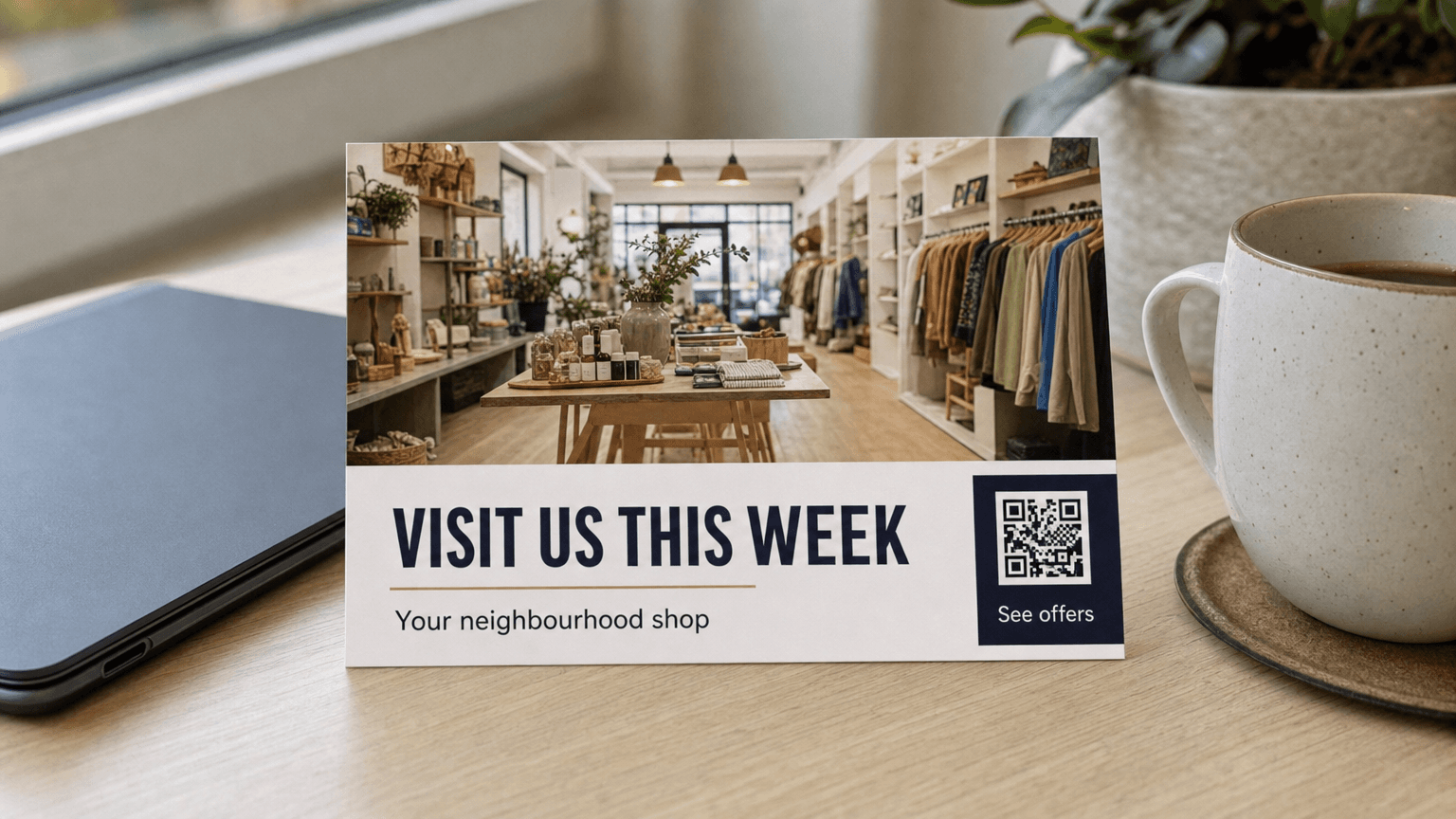
| Opening Week | 1-2 days before opening | Grand opening date, hours, offer or event | Drive first visits during opening week |
| Follow-Up Offer | 2-3 weeks after opening | Thank-you or second-visit offer, loyalty hook | Convert one-time visitors to regulars |
The save-the-date drop is your introduction. Keep it clean: your name, what you do, where you are, when you open, and a single teaser line about the grand opening offer. You are not trying to explain everything about your business yet. You are trying to make sure your name is familiar before you open.
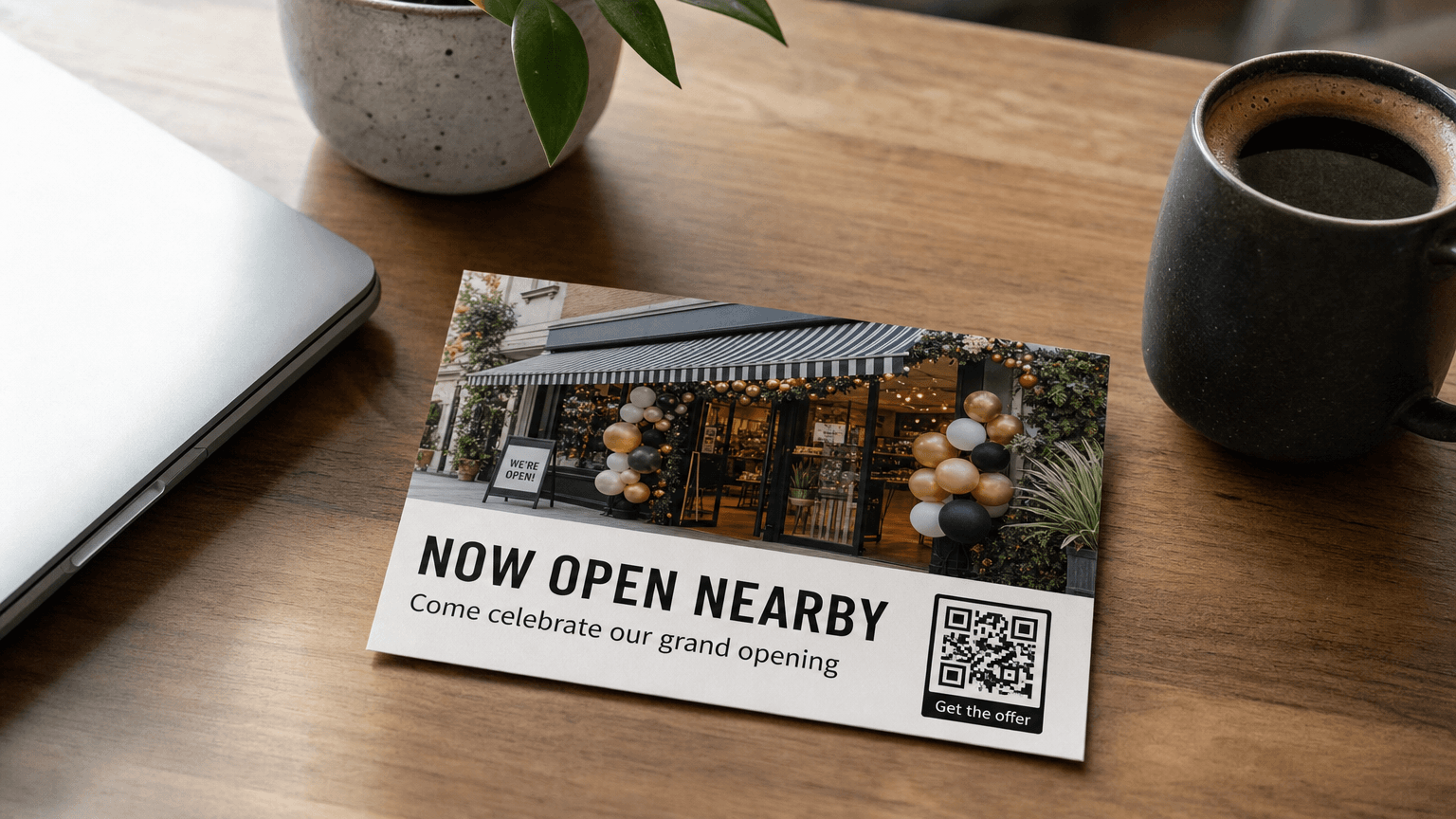
The opening-week drop is your call to action. This is where you put the specific offer (free item with purchase, percentage off, gift-with-first-visit), the exact hours, a map or address callout, and a QR code that links to your reservation or RSVP page, a special landing page, or the offer redemption. Timing this to arrive one or two days before your opening is important: you want it in hand when the excitement peaks, not two weeks before when it will be forgotten.
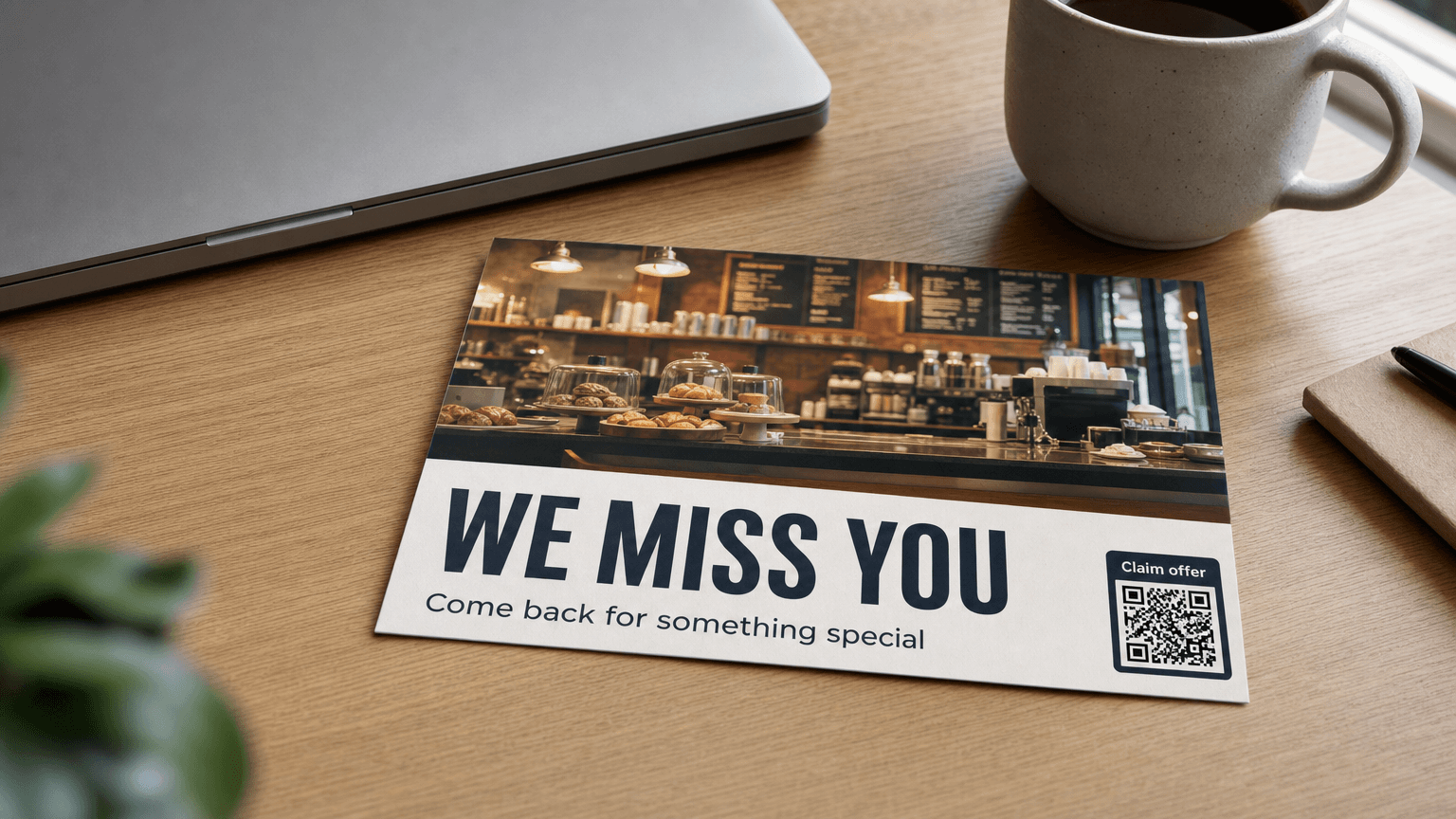
The follow-up drop, sent two to three weeks after opening, is the most overlooked step. People who visited and enjoyed their experience need a reason to come back before a new habit fully forms. A second-visit offer or a loyalty card announcement at this stage converts a first-time visitor into a returning customer. People who received the first two drops but have not come in yet get a second chance.
What to Put on the Card
A grand opening postcard needs to answer four questions in two seconds: who you are, where you are, when you open, and why someone should come. Everything else is secondary.
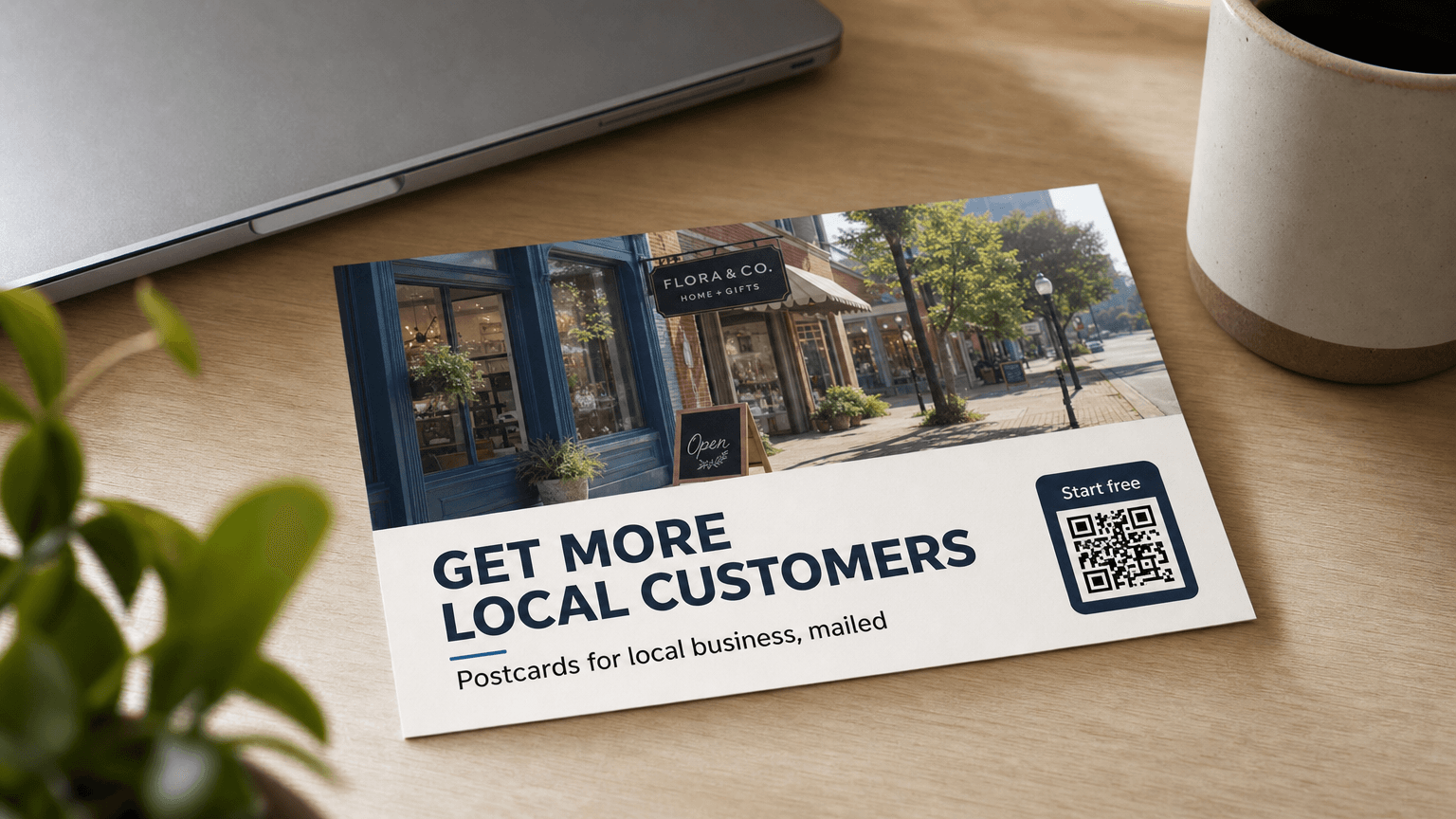
The front of the card should lead with a clear, visual identity: your logo, your business name, and a bold headline that states the event (Grand Opening, Now Open, Opening [Month]). A photograph of your space, product, or service helps people picture what they are coming to. Colour and design should match your brand so that when people walk past your sign, they connect it to the card.
The back of the card carries the operational details: your address with a small map graphic, your opening date and hours, your grand opening offer, a QR code linking to your website or a specific landing page, and your social handles if you want to grow your following in parallel. Keep the copy concise. Long paragraphs get skipped. Short, scannable lines get read.
For the opening-week drop specifically, the offer should be concrete and time-limited. A specific discount or free item tied to the first week creates urgency. Vague offers like "come check us out" have lower pull than "free pastry with any drink purchase, opening week only."
For design, see the postcard design guide for layout and copy principles that work across formats and sizes.
Ready to Send Your First Campaign?
Magic Mailer uses AI to design, print, and mail professional postcards for your business in minutes, not weeks.
Try Magic Mailer FreeWant it set up in your CRM for you? book a meeting
Prefer to just describe it? build your whole campaign in one chat
Timing Your Drops: The Delivery Calendar
Postcard delivery timing depends on your print-and-mail lead time. With a modern automated service like Magic Mailer, you can go from design to print-ready in under an hour. Build at least 10-14 days of lead time into each drop to account for production and Canada Post delivery windows. For a drop you need to arrive on a specific day, work backward from that date.
If your grand opening is set for the first Saturday of the month, your opening-week drop should be submitted roughly 12-15 days before that Saturday so it lands in mailboxes on the Wednesday or Thursday just before. Your save-the-date drop should be submitted about five to six weeks before opening. Your follow-up drop gets submitted the week after opening for delivery two to three weeks out.
Running a new-mover list in parallel works on a rolling basis: as new households appear in the area, they get a version of your opening postcard (or a welcome offer after opening). This is a set-and-sustain tactic rather than a one-time drop.
What It Costs in Canada
Magic Mailer's self-serve pricing for Canada runs from CA$3.31 per piece for small runs down to CA$1.53 per piece at 5,000 or more pieces, with printing and postage included. For a neighbourhood campaign of 500 households across three drops, that is roughly CA$1,655 for the full sequence at the single-piece rate, or meaningfully less at volume. The ANA 2023 Response Rate Report pegs the average cost per new customer acquisition at US$43 for a cold prospect list. Postcard campaigns to a well-targeted local audience often come in well below that benchmark when the offer is strong and the sequence is run properly.
There is no need to estimate design or agency costs separately: the AI-powered design in Magic Mailer pulls your logo, colours, and business details automatically, producing a print-ready card in about 60 seconds. The Free Starter plan at Magic Mailer for Local Business Marketing gives you 1,000 build credits and requires no credit card to start. See postcard marketing cost for a deeper breakdown of volume pricing and how to budget a campaign.
Measuring Your Grand Opening Results
For a grand opening campaign, measurement starts before the doors open. Set a baseline target: how many people do you want through the door on opening day? In the first week? What does a successful opening look like?
The simplest measurement mechanism is a unique QR code on each card version that leads to a tracking URL or a landing page specific to the campaign. You can then see how many scans came from postcard recipients versus other traffic sources in your analytics platform.
For offer-based campaigns, staff redemption tracking is reliable and low-tech: count how many customers mention the postcard, present it at the counter, or redeem the opening offer. Compare your first-week redemption rate against the Lob 2025 State of Direct Mail finding that 88% of marketers see improved response when postcards are personalized, as a benchmark for what a well-targeted local campaign can achieve.
Beyond opening week, track new customers retained after 30 and 60 days. A follow-up drop that converts one-time visitors to repeat customers is measurable by return visit rate. Linking your loyalty program (if you have one) to postcard redeemers gives you a clean cohort to follow.
The most important metric is total new customers acquired per dollar spent across the full three-drop sequence. Grand openings that run a proper follow-up drop consistently report better long-term returns than those that stop after the opening-day push.
Bringing It Together: Your Grand Opening Plan
A successful grand opening postcard campaign is straightforward to execute. Identify your catchment radius. Build your neighbourhood targeting list and a new-mover layer. Design three cards with clear, time-specific messages. Schedule your drops against your opening date. Add a trackable QR code to each version. Redeem and count on opening day. Send the follow-up, and start converting visitors into regulars.
The direct mail for small business hub has the broader context for how postcards fit into an ongoing local marketing strategy after your launch. For retail businesses specifically, retail store direct mail marketing covers how to adapt postcard campaigns for seasonal promotions, clearance events, and loyalty drives once you are up and running.
Your neighbourhood is ready to hear from you. Get your cards in the mail before you open, and opening day will not be a mystery.
Frequently Asked Questions
How far in advance should I send grand opening postcards?+
Send your save-the-date drop three to four weeks before opening. Your opening-week drop should be timed to arrive one or two days before your doors open, which means submitting it about 12-15 days in advance to allow for production and Canada Post delivery. The follow-up drop goes out the week after opening.
How many households should I mail for a grand opening?+
It depends on your catchment area and business type. A foot-traffic business like a cafe or salon might mail 500-2,000 households within a tight radius. A service business that covers a wider area might mail 3,000-10,000 addresses. Start with the realistic area your customers will come from, and use smart local targeting to build that list.
What offer should I put on a grand opening postcard?+
Concrete, time-limited offers outperform vague ones. A free item with a purchase, a percentage off on opening week, or a gift-with-first-visit tied to a specific date window all give recipients a clear reason to act. Pair the offer with a QR code so you can track how many people redeem it.
Can I target new movers specifically with grand opening postcards?+
Yes. A new-mover list can be layered on top of your neighbourhood send so that households who recently moved into your catchment area receive a postcard as soon as they arrive. Because new movers are actively discovering local businesses and have not formed habits with your competitors yet, they are among the most responsive recipients for a welcome or grand opening offer.
How much do grand opening postcards cost in Canada?+
With Magic Mailer, self-serve postcard pricing runs from CA$3.31 per piece for small runs down to CA$1.53 per piece at 5,000 or more pieces, with printing and postage included. A Free Starter plan provides 1,000 build credits with no credit card required, so you can design and estimate your campaign before committing.
Sources
- USPS Office of Inspector General and Temple University, Enhancing the Value of Mail: The Human Response - physical mail drives stronger memory encoding, recall, and emotional response than digital messages. — uspsoig.gov
- Lob 2024 State of Direct Mail - 84% of marketers rate direct mail as their highest-ROI channel; 85% report best response rates; 84% report best conversion rates. — lob.com
- ANA 2023 Response Rate Report - house-list response rate ~5.3%; prospect-list response rate ~2.9%; average cost per acquisition US$19 (house list) vs US$43 (prospect list). — ana.net
- Lob 2025 State of Direct Mail - 88% say personalization improves response rates; 90% say direct mail enhances digital channel performance. — lob.com
Ready to Send Your First Campaign?
Magic Mailer uses AI to design, print, and mail professional postcards for your business in minutes, not weeks.
Try Magic Mailer FreeWant it set up in your CRM for you? book a meeting
Prefer to just describe it? build your whole campaign in one chat