Key Takeaways
- The highest-value direct mail moment for a moving company is the instant a home is listed: the owner is a confirmed future mover who has not yet hired anyone.
- Post Timely's triggered new-listing service uses real-time listing data to mail every new listing in your area automatically, the day it hits the market.
- Neighbourhood saturation drops build brand recall before a need arises; self-serve Magic Mailer pricing starts at CA$3.31 per piece, down to CA$1.53 at 5,000+ pieces.
- The ANA 2023 Response Rate Report benchmarks house-list direct mail at 5.3% average response and 161% ROI, with a US$19 cost per acquisition.
- New-mover outreach and realtor referral campaigns extend the revenue opportunity beyond the initial move date.
- Measure ROI by tracking dedicated phone numbers, unique URLs, or QR codes per campaign, and calculate cost per booked move against average job value.
- Post Timely's Free Starter plan includes 1,000 build credits with no credit card required, making neighbourhood saturation accessible at any budget level.
Moving companies win or lose business on a single variable: timing. A homeowner who listed their home this morning will hire a mover within weeks. A homeowner who sold six months ago already has one. Direct mail is uniquely suited to that timing constraint because it lands in the physical world, where buying decisions for high-stakes services like moving get made. According to the Lob 2024 State of Direct Mail, 84% of marketers rate direct mail the highest-ROI channel, with 85% reporting the best response rates and 84% citing the best conversion rates. The question is not whether to mail, but when and to whom.
This guide covers every major direct mail play available to moving companies, from triggered outreach tied to new property listings, to neighbourhood saturation drops, to new-mover follow-up and realtor referral campaigns. By the end, you will have a clear picture of which campaign fits which goal, how to measure results, and how to get started with Post Timely.
Why Direct Mail Works Exceptionally Well for Movers
Direct mail reaches people at the moment of a high-stakes physical life event, moving home, and physical mail is neurologically better suited to driving action than digital ads in those moments. The USPS Office of Inspector General, in partnership with Temple University, found in "Enhancing the Value of Mail: The Human Response" that physical mail drives stronger memory encoding, emotional response, and recall than digital messages. For a service as emotionally loaded as moving, that matters. According to the ANA 2023 Response Rate Report, house-list direct mail achieves an average response rate of 5.3%, compared with sub-1% norms for most digital display channels. House-list campaigns deliver an average ROI of 161% with a cost per acquisition of US$19. Prospect-list campaigns land at 2.9% response and US$43 CPA, still highly competitive against paid digital in most Canadian markets.
The physical format also keeps working after the first read. A postcard stuck to the fridge or a letter on the kitchen counter stays in the consideration set for weeks, which matches the multi-week timeline of a home sale perfectly.
The Signature Play: Triggered Outreach to New Listings
The single most powerful direct mail campaign for a moving company is one that fires the moment a property hits the market. When a homeowner lists their home, two things are almost certainly true: they have not hired a mover yet, and they will need one within the next 30 to 90 days. That window is narrow and the opportunity is real.
Post Timely's triggered new-listing service uses real-time listing data to identify every new listing in your target area and mail a postcard or letter to that address automatically, the same day it hits the market. There is no manual list-building, no batch scheduling, and no guesswork. You set your coverage area, we do the rest. Explore how the triggered new-listing campaign works or book a meeting to get a custom quote for your market.
Triggered campaigns win because they combine the three ingredients that define high-response direct mail: the right person (a confirmed future mover), the right message (you are available, local, and ready), and the right moment (before any competitor has mailed them).
The Four Main Campaign Types for Moving Companies
Not every goal calls for a triggered campaign. The table below maps campaign types to their ideal timing and primary objective, so you can build the right mix for your business.
| Campaign | Trigger or Timing | Primary Goal |
|---|---|---|
| Triggered new-listing outreach | Property listed (real-time) | Book a move before competitors |
| Neighbourhood saturation drop | Scheduled, area-wide | Brand awareness & inbound calls |
| New-mover welcome mail | 30-90 days after move-in | Storage, unpacking, referrals |
| Realtor referral outreach | Ongoing, agent-targeted | Build a referral partnership pipeline |
Each of these campaigns has a different audience, a different job to do, and a different cost structure. The best-performing moving companies run at least two of them simultaneously.
Ready to Reach the Right Prospect at the Right Moment?
Launch a self-serve campaign with Magic Mailer, or book a call for done-for-you timing-based mailers.
Try Magic Mailer FreeWant it set up in your CRM for you? book a meeting
Prefer to just describe it? build your whole campaign in one chat
Neighbourhood Saturation: Building Brand Awareness Before the Need Arises
Neighbourhood saturation campaigns mail to every household in a defined geographic area, whether or not those residents are actively planning a move. The logic is straightforward: in any neighbourhood, a meaningful percentage of households will move in the next 12 months. When they start thinking about movers, you want your name already lodged in memory. The Lob 2025 State of Direct Mail found that 88% of marketers say personalization improves response rates, and 90% say direct mail enhances the performance of their digital channels. A saturation drop that includes a personalized line and reinforces a brand running local digital ads is substantially more effective than either channel alone.
Post Timely's self-serve Magic Mailer handles neighbourhood saturation without needing a designer or a list broker. AI builds an on-brand postcard in about 60 seconds by pulling your company logo, colours, and service details. Smart local targeting then builds the household audience within the neighbourhoods you select. Print, postage, and delivery are bundled at a single per-piece price: from CA$3.31 per piece on a single run down to CA$1.53 per piece at 5,000 or more pieces, printing and postage included. A Free Starter plan includes 1,000 build credits with no credit card required.
For moving companies, the most effective saturation campaigns target neighbourhoods with high average home values (because moves from those areas tend to have larger shipments and higher margins) and areas within your preferred service radius.
New-Mover Outreach: The Underused Revenue Stream
New movers are a second high-value audience that most moving companies overlook because the obvious moment, the move itself, has already passed. But recent movers have ongoing needs that direct mail can address: storage units for overflow items, unpacking assistance, furniture assembly, and eventually a second move when they discover the new home is not quite right. They also become referral sources faster than almost any other customer segment, because moving comes up in conversation within weeks of a move-in.
New-mover direct mail typically mails 30 to 90 days after a confirmed move-in, which puts it in the window when new residents are settling in and making decisions about local service providers. The ANA 2023 Response Rate Report notes that house-list campaigns, of which new-mover lists are a prime example, achieve 5.3% average response, exactly the kind of efficiency that makes a follow-up program sustainable.
Realtor Referral Partnerships: Systematic, Not Accidental
Real estate agents are in constant contact with people who are about to move. A single productive realtor relationship can generate a steady stream of referrals for years. Most moving companies pursue these relationships informally, through cold calls or chance encounters at open houses. A targeted direct mail campaign to a curated list of active agents in your market is a systematic alternative.
A realtor-targeted postcard or letter works best when it offers something specific: a referral fee structure, a priority-booking guarantee for the agent's clients, or a co-branded value proposition the agent can pass along. This is a lower-volume campaign (the agent audience is smaller than a neighbourhood drop) but the downstream value per converted relationship is very high.
Smart Local Targeting: How the Audience Gets Built
The quality of any direct mail campaign is bounded by the quality of the audience. For triggered campaigns, Post Timely's real-time listing data does the targeting automatically: every new listing in your coverage area enters the queue the day it hits the market. For neighbourhood saturation, smart local targeting builds the household audience from the geographic areas you specify, with no manual list-building required.
For both campaign types, you stay in control of the coverage area. You can define your service radius, exclude postal codes you do not serve, and set daily or weekly volume caps. This keeps campaigns aligned with your actual capacity: there is no point generating more leads than your crews can handle.
Postcard Design Principles That Drive Response
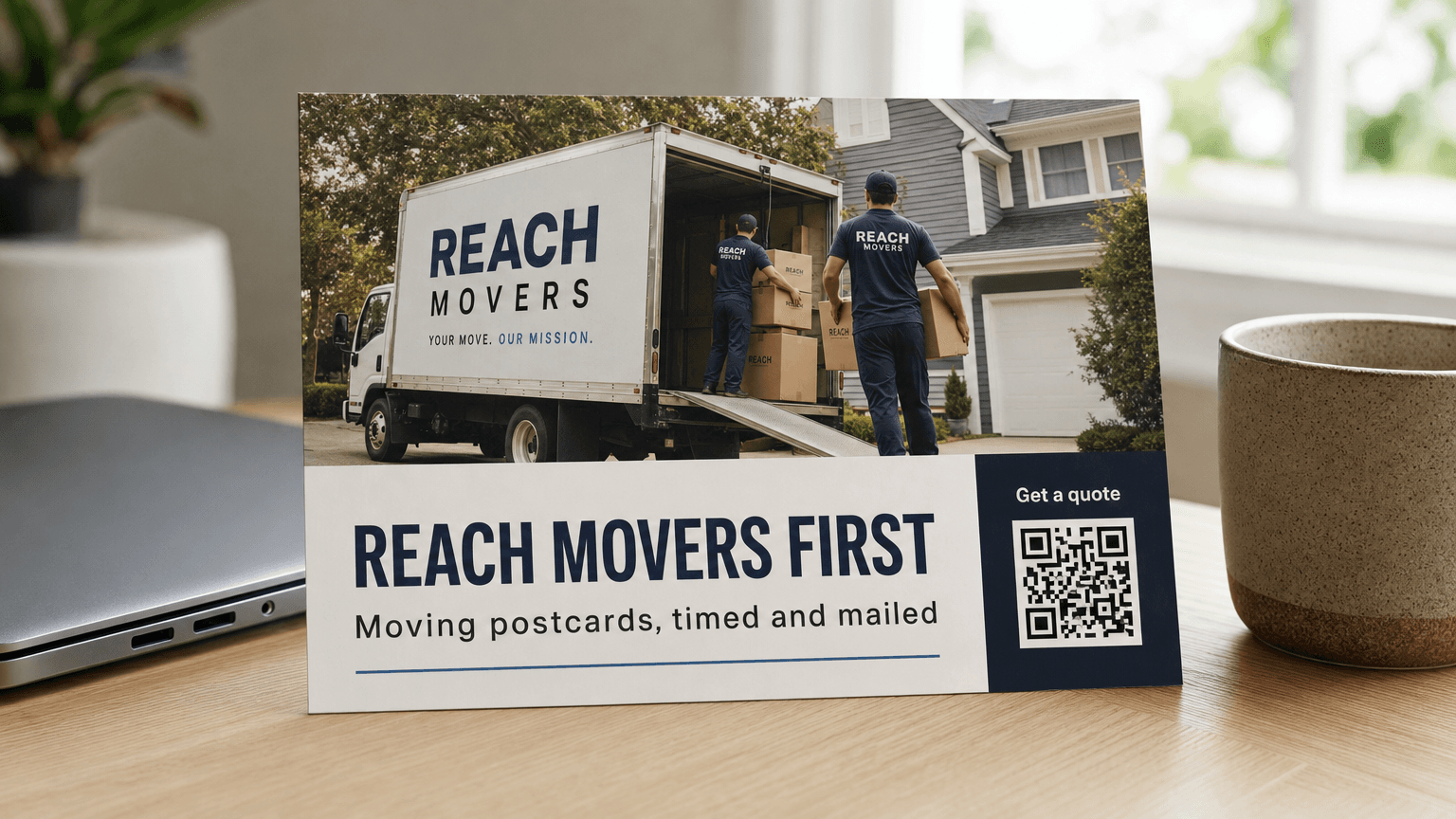
For moving company direct mail, postcard design needs to accomplish three things quickly: establish who you are, establish that you serve this area, and give the recipient a clear reason to act now. Given that postcards are read in seconds, hierarchy matters more than density.
The elements that consistently outperform in moving-category mail are: a strong headline that references the recipient's situation (listing, moving, new to the neighbourhood), a single clear call to action (a phone number, a URL, or a QR code), proof of local presence (a neighbourhood name, a service area list, or a recent local customer reference), and a limited-time offer if one is available. Colour consistency with your brand signals professionalism, which is especially important in a category where trust and reliability are the primary purchase criteria.
Post Timely's AI postcard builder handles brand consistency automatically. It generates postcard designs from your existing brand assets and applies them to a layout optimized for the moving-company category. You review and approve before anything goes to print.
Ready to Reach the Right Prospect at the Right Moment?
Launch a self-serve campaign with Magic Mailer, or book a call for done-for-you timing-based mailers.
Try Magic Mailer FreeWant it set up in your CRM for you? book a meeting
Prefer to just describe it? build your whole campaign in one chat
How to Measure ROI on Moving Company Direct Mail
ROI measurement for direct mail comes down to tracking which inbound inquiries originated from a mail campaign. The most reliable methods are: dedicated phone tracking numbers printed on campaign-specific postcards, unique landing page URLs or QR codes per campaign, and asking new callers directly how they heard about you. For triggered new-listing campaigns, you can also compare the list of mailed addresses against booked moves to calculate a direct conversion rate.
The ANA 2023 Response Rate Report benchmarks are a useful starting point: 5.3% response on house lists and 2.9% on prospect lists. For moving companies running triggered new-listing campaigns, response rates above benchmark are achievable because the timing precision of the trigger narrows the audience to confirmed future movers rather than the broader category of "might move someday."
Track cost per booked move, not cost per response. A campaign that generates 20 calls and converts 4 of them into moves at an average job value of CA$2,000 has produced CA$8,000 in revenue from the campaign spend. That is the number that matters.
How to Get Started
Post Timely offers two entry points depending on your goals:
Triggered new-listing service: This is the done-for-you campaign that mails automatically to every new listing in your area. Pricing is custom based on your market and volume. Book a meeting or get a quote at /moving-companies to see what coverage looks like in your area.
Self-serve neighbourhood drops: If you want to run saturation campaigns on your own schedule, the Magic Mailer is the fastest path. The Free Starter plan includes 1,000 build credits and no credit card is required. Design a postcard, select your target area, and set a send date in one session.
For a deeper look at specific campaign types, see the related guides in this cluster: turning just-listed properties into moving leads, moving company postcard design, and summer moving season marketing.
Frequently Asked Questions
When is the best time to mail a postcard to someone who is about to move?+
The best time is the day their home is listed. At that moment they are a confirmed future mover, they have not hired a mover yet, and no competitor has reached them by mail. Post Timely's triggered new-listing service fires automatically on the day a property hits the market in your area.
How much does direct mail for moving companies cost with Post Timely?+
Self-serve neighbourhood saturation postcards through Magic Mailer start at CA$3.31 per piece (single run) and drop to CA$1.53 per piece at 5,000+ pieces, with printing and postage included. The triggered new-listing service is custom-priced based on your market and volume, book a meeting at /moving-companies for a quote.
What response rate should a moving company expect from direct mail?+
The ANA 2023 Response Rate Report puts average house-list direct mail response at 5.3%. Triggered campaigns that mail to confirmed new listings tend to outperform that benchmark because the audience is narrowed to people who are actively preparing to move, not a general population sample.
Do I need a designer to create a moving company postcard?+
No. Post Timely's AI postcard builder generates an on-brand postcard design in about 60 seconds by pulling your company logo, colours, and service details. You review and approve the design before anything goes to print.
What is the difference between triggered new-listing mail and neighbourhood saturation mail?+
Triggered new-listing mail fires the moment a specific property is listed, targeting a confirmed future mover at the best possible moment. Neighbourhood saturation mail goes to every household in a defined area on a scheduled basis, building brand awareness across a broader audience before a moving need arises. Both are available through Post Timely.
Sources
- ANA 2023 Response Rate Report: direct mail to house lists ~5.3% response; prospect lists ~2.9%; house-list ROI ~161%; cost per acquisition US$19 (house) vs US$43 (prospect). — ana.net
- USPS OIG / Temple University, "Enhancing the Value of Mail: The Human Response": physical mail drives stronger memory encoding, recall, and emotional response than digital. — uspsoig.gov
- Lob 2024 State of Direct Mail: 84% rate direct mail highest-ROI channel; 85% report best response rates; 84% cite best conversion rates. — lob.com
- Lob 2025 State of Direct Mail: 88% say personalization improves response; 90% say direct mail enhances digital channel performance. — lob.com
Ready to Reach the Right Prospect at the Right Moment?
Launch a self-serve campaign with Magic Mailer, or book a call for done-for-you timing-based mailers.
Try Magic Mailer FreeWant it set up in your CRM for you? book a meeting
Prefer to just describe it? build your whole campaign in one chat