Key Takeaways
- House lists achieve a 5.3% response rate and 161% ROI according to the ANA 2023 Response Rate Report, significantly outperforming cold prospect lists.
- The four highest-performing retention campaign types are loyalty rewards, VIP early-access invites, birthday and anniversary cards, and win-back offers for lapsed customers.
- Physical mail builds stronger emotional connection and brand recall than digital messages, according to USPS and Temple University research.
- Personalization improves direct mail response rates for 88% of marketers, per the Lob 2025 State of Direct Mail.
- A practical retention cadence of four to eight sends per year, anchored to meaningful customer moments, keeps you top of mind without overcrowding the mailbox.
- Canada pricing runs from CA$3.31 per piece (single) to CA$1.53 per piece at 5,000 or more pieces, with printing and postage included.
- QR codes on postcards connect offline mail to online analytics so you can measure redemption rate, reactivation rate, and customer lifetime value precisely.
Winning a new customer costs significantly more than keeping one you already have. Yet most small businesses spend the bulk of their marketing budget on acquisition, broadcasting into the neighbourhood while overlooking the people who have already walked through the door, paid you money, and left happy. Your existing customer list is the single most valuable asset your business owns, and physical direct mail is one of the most powerful ways to activate it.
This guide covers how local businesses, from boutique retailers to neighbourhood service providers, use targeted postcards to build genuine loyalty, reward their best customers, and bring lapsed buyers back before they forget you entirely. If you are new to the channel, start with the overview at Direct Mail for Small Business, then come back here for the retention-specific playbook.
Why Retention Mail Outperforms Acquisition Mail on ROI
Retention mail beats acquisition mail because it reaches people who already trust you, so the threshold for action is much lower. The ANA 2023 Response Rate Report found that house lists (your own customers) achieve a 5.3% response rate and a 161% ROI, compared to 2.9% response and a cost per acquisition of US$43 for cold prospect lists. House-list cost per acquisition drops to US$19. That gap compounds with every campaign you send.
Those numbers matter for practical budget planning. When you mail your own customers, you need far fewer pieces to generate meaningful revenue, which means you can afford more targeted, more personal, and more frequent campaigns without blowing your marketing budget. A focused 200-piece birthday postcard run to recent buyers is almost always more profitable than a 2,000-piece cold drop into a postal walk you have never tested.
The Lob 2024 State of Direct Mail found that 84% of marketers rate direct mail their highest-ROI channel, with 85% reporting the best response rates and 84% the best conversion rates of any medium they use. Those marketers are not mailing cold. They are mailing lists they own.
The strategic takeaway: build your house list deliberately, protect it carefully, and mail it consistently. The ROI compounds over time. See the full breakdown of what drives these numbers in our guide to direct mail ROI.
Ready to Send Your First Campaign?
Magic Mailer uses AI to design, print, and mail professional postcards for your business in minutes, not weeks.
Try Magic Mailer FreeWant it set up in your CRM for you? book a meeting
Prefer to just describe it? build your whole campaign in one chat
What to Actually Send Your Customers
Retention mail works best when it arrives at a meaningful moment, either a milestone in the customer relationship or a behavioural trigger that signals the customer is ready to buy again. There are four campaign archetypes that consistently perform for local businesses.
| Campaign Type | Trigger | Offer or Message |
|---|---|---|
| Loyalty reward | Purchase milestone (e.g., 5th visit) | Discount or gift on next visit |
| VIP early access | Seasonal collection or sale launch | Shop 48 hours before general public |
| Birthday or anniversary | Customer's birthday / first-purchase anniversary | Personalized greeting + exclusive offer |
| Win-back | 60-90 days since last purchase | "We miss you" + a compelling reason to return |
Each of these works because it arrives at the right moment with the right message, not because it is a generic standalone offer. The specificity is what converts.
Loyalty rewards
A postcard arriving after a customer's fifth purchase or tenth visit reinforces the relationship without requiring a digital loyalty app. It says you noticed, you are grateful, and there is something waiting for them when they return. Keep the offer clear and the expiry date prominent so the postcard stays on the fridge rather than going in the recycling.
VIP early-access invites
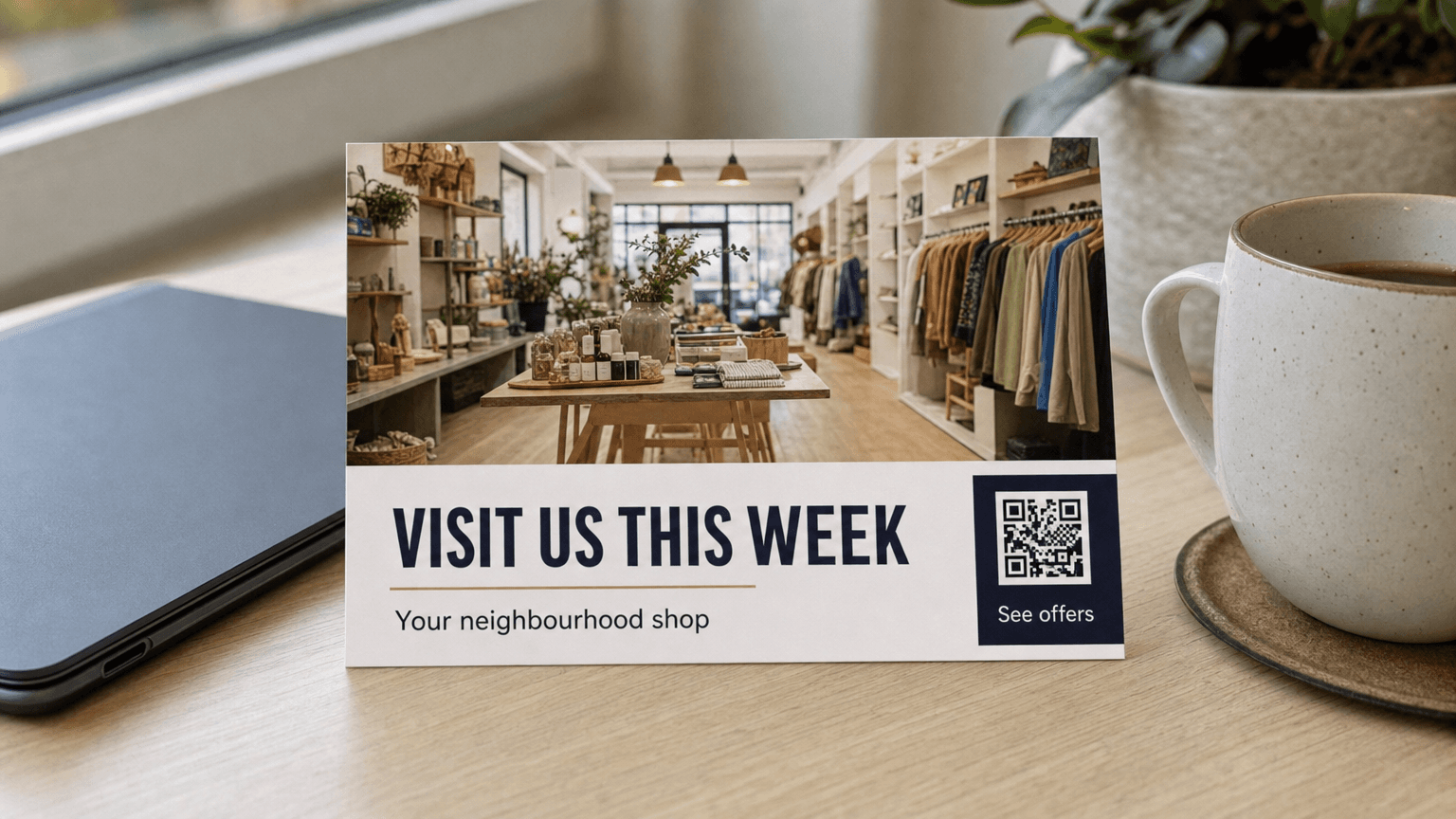
Mailing your best customers before a sale or product launch opens gives them a feeling of belonging to something. A boutique sending a printed invite to its top 150 buyers the week before a seasonal collection drops creates anticipation and foot traffic on day one. The offer does not need to be deep. Priority access carries its own value.
Birthday and anniversary cards
Birthday mail is the most personal form of retention marketing available to a local business. A printed card with the customer's first name and a small reward lands in a moment of genuine celebration. The USPS and Temple University study on the human response to mail found that physical pieces drive stronger emotional connection and recall than digital messages, and nowhere is that more true than a piece tied to a personal occasion.
First-purchase anniversaries work on the same principle. A card marking one year since someone first visited your shop reminds them of a positive experience and gives them a reason to re-create it.
Win-back campaigns for lapsed customers
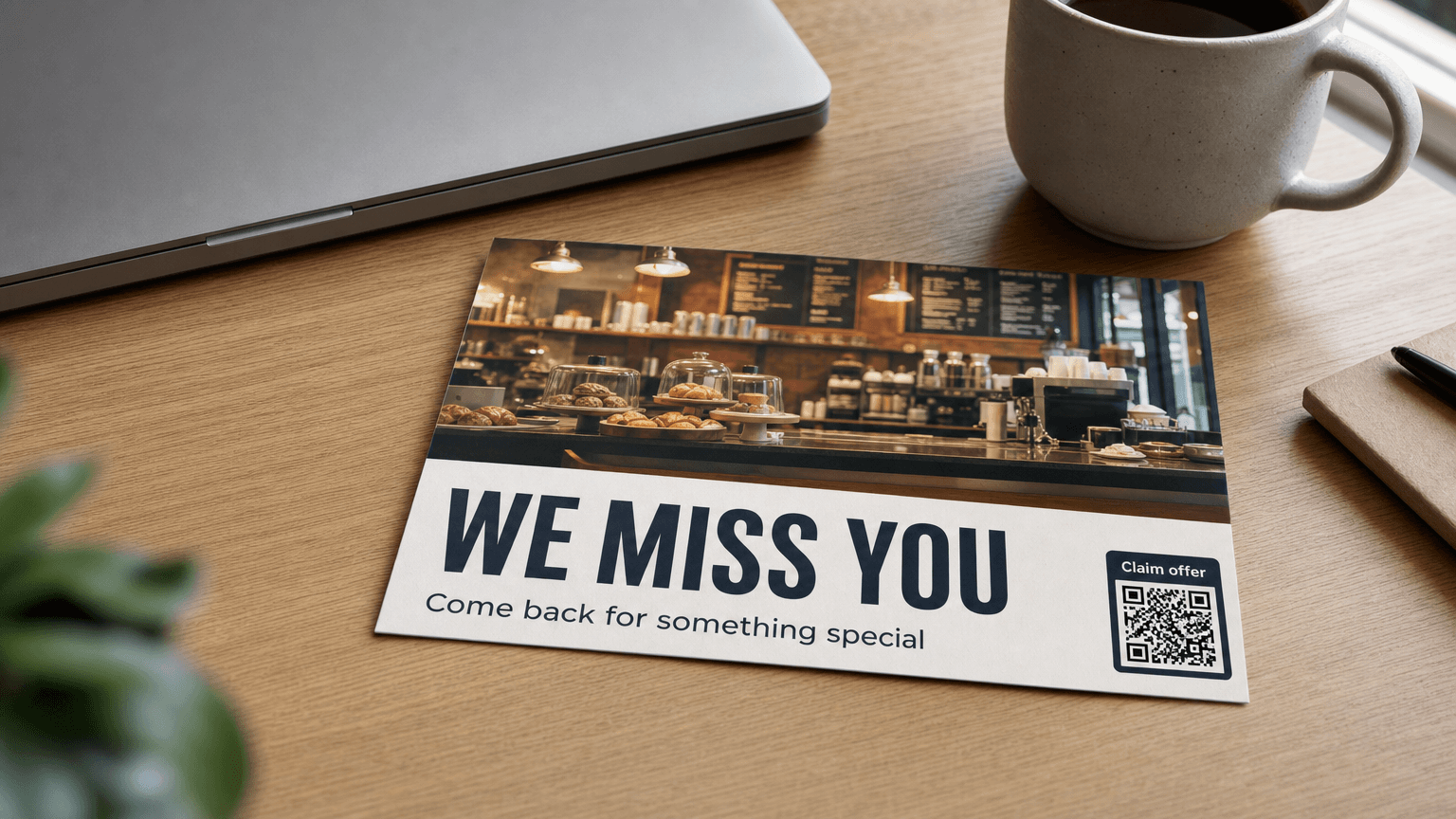
A customer who bought from you six months ago and has gone quiet is not lost. They are distracted. A well-timed postcard arriving at the 60-90 day mark of inactivity, featuring a personalized note and a clear offer, reactivates a meaningful percentage of lapsed buyers at a fraction of the cost of finding a new one. The ANA data confirms this: house-list economics make win-back mail dramatically more cost-efficient than acquisition.
For more campaign ideas that pair retention mail with broader local outreach, see postcard marketing for small business.
How Physical Mail Builds the Emotional Connection That Keeps Customers
Physical mail builds emotional connection by engaging the senses in ways a push notification cannot replicate. A well-designed postcard is held, read slowly, and often kept. Research from USPS and Temple University confirmed that physical mail activates stronger memory encoding, emotional engagement, and brand recall than equivalent digital messages. Customers are more likely to remember your business and feel warmly toward it after holding a piece of your mail than after seeing your name in an inbox.
For local businesses competing with larger brands that have bigger digital budgets, this is a genuine advantage. You can create a tangible, memorable brand experience at a per-piece cost that fits a small-business budget. The physical object represents care and intentionality in a way that a five-second digital ad cannot match.
Personalization amplifies this effect. The Lob 2025 State of Direct Mail found that 88% of marketers say personalization improves direct mail response rates. At minimum, use the customer's first name in the headline. Where your data allows, reference the specific product category they purchased or the neighbourhood they live in. Even small touches in the copy significantly lift engagement.
Ready to Send Your First Campaign?
Magic Mailer uses AI to design, print, and mail professional postcards for your business in minutes, not weeks.
Try Magic Mailer FreeWant it set up in your CRM for you? book a meeting
Prefer to just describe it? build your whole campaign in one chat
Cadence: How Often to Mail Your Customer List
For most local businesses, the right cadence for customer retention mail is four to eight sends per year, anchored to meaningful moments rather than a fixed calendar. Mailing too infrequently means customers forget you between purchases. Mailing too often without a clear reason erodes the sense of occasion that makes each piece feel worthwhile.
A practical starting framework for a retail shop or service business looks like this. Send a welcome postcard within the first week after someone becomes a customer. Follow up at the 30-day mark if they have not returned. Queue the birthday card to arrive the week of their birthday. Plan seasonal campaigns for your highest-traffic periods, whether that is a December gift-giving push, a spring service reminder, or a back-to-school promotion. Add a win-back trigger at 60-90 days of silence.
This cadence totals five to seven touches per year for an active customer, each arriving with a purpose. That is enough to stay top of mind without overcrowding the mailbox.
The Lob 2025 State of Direct Mail also found that 90% of marketers say direct mail enhances the performance of their digital channels. Pairing a postcard with a follow-up email or a social post the same week as the mail drop consistently lifts overall campaign response. The postcard primes attention; the digital channel catches the follow-through.
Pricing and What to Expect
Magic Mailer handles design, printing, postage, and delivery end to end. Canada pricing runs from CA$3.31 per piece for a single postcard down to CA$1.53 per piece at 5,000 or more pieces, with everything included. For most retention campaigns targeting a house list of a few hundred to a few thousand customers, you are mailing at a cost that a single recovered lapsed customer easily justifies.
For a 300-piece win-back campaign at CA$3.31 per piece, total cost is roughly CA$993. If your average customer lifetime value is CA$500 and the campaign reactivates even 5% of recipients, that is 15 customers returning with a combined value of CA$7,500. The numbers work decisively in your favour.
Learn more about postcard costs and what drives per-piece pricing in the guide to postcard marketing cost.
Measuring Retention Campaign Performance
Tracking retention mail is more direct than measuring awareness campaigns. The metrics that matter are: redemption rate (what share of postcard recipients used the offer), repeat purchase rate (did mailed customers buy again within 90 days), reactivation rate (for win-back campaigns, the share of lapsed customers who returned), and customer lifetime value trend (are average CLV figures rising for your mailed segment vs. your unmailed segment over six months).
A QR code on every postcard is the fastest way to connect offline mail to online behaviour. Point the QR code to a landing page, a booking link, or a product page, and your analytics platform will show you exactly how many recipients scanned and what they did next. Track the redemption code or QR parameter separately for each campaign batch so you can compare performance across campaign types and improve over time.
Start with a single campaign, mail a defined segment of your house list, measure the response, and iterate. Retention direct mail is a channel where small, deliberate experiments compound into meaningful revenue over a season.
Getting Started with Customer Retention Mail
You do not need a large budget or a complex setup to mail your house list. Magic Mailer lets you design a professional, on-brand postcard in about 60 seconds, pulling your logo, colours, and business details automatically. Upload your customer list, set your targeting, and Magic Mailer handles printing, postage, and delivery. A Free Starter plan includes 1,000 build credits with no credit card required.
The highest-ROI use of your marketing budget is almost always the customers who already know you. Start there.
For a broader look at how local businesses build integrated direct mail strategies, visit the hub at Direct Mail for Small Business or explore targeted acquisition campaigns at local business marketing.
Frequently Asked Questions
What response rate can I expect from mailing my own customer list?+
The ANA 2023 Response Rate Report found that house lists achieve an average 5.3% response rate, compared to 2.9% for cold prospect lists. Your actual rate will vary by offer strength, personalization, and how recently customers purchased, but house lists consistently outperform cold outreach.
How long after a customer goes quiet should I send a win-back postcard?+
A 60-to-90-day window after the last purchase is the most effective trigger for win-back mail. Waiting longer risks the customer forming a competing habit. Acting sooner can feel premature. At 60-90 days, the customer likely misses you but has not actively replaced you.
Do I need a big customer list to make retention mail worthwhile?+
No. Even a list of 200-400 customers can generate strong ROI with targeted retention campaigns. Because you are mailing people who already trust you, the revenue per piece sent is much higher than with cold outreach. A 300-piece win-back campaign at CA$3.31 per piece costs under CA$1,000 and can return multiples of that with a modest reactivation rate.
How do I track whether a postcard actually brought someone back?+
Add a QR code to each postcard pointing to a dedicated landing page or booking link. Your analytics platform records each scan. You can also use a unique redemption code per campaign so your point-of-sale system captures in-store redemptions. Tracking both gives you a complete picture of response.
How often should I mail my customer list?+
Four to eight times per year is the right range for most local businesses. The key is anchoring each send to a meaningful moment, such as a purchase milestone, birthday, seasonal campaign, or win-back trigger, rather than mailing on a rigid calendar. Each piece should arrive with a clear purpose.
Sources
- ANA 2023 Response Rate Report: house lists achieve 5.3% response rate, 161% ROI, and US$19 cost per acquisition; prospect lists achieve 2.9% response rate and US$43 cost per acquisition; 76% of marketers mailing house lists use postcards. — ana.net
- USPS OIG / Temple University, Enhancing the Value of Mail: The Human Response: physical mail drives stronger memory encoding, recall, and emotional response than digital communications. — uspsoig.gov
- Lob 2024 State of Direct Mail: 84% of marketers rate direct mail their highest-ROI channel; 85% report best response rates; 84% report best conversion rates. — lob.com
- Lob 2025 State of Direct Mail: 88% of marketers say personalization improves direct mail response rates; 90% say direct mail enhances digital channel performance. — lob.com
Ready to Send Your First Campaign?
Magic Mailer uses AI to design, print, and mail professional postcards for your business in minutes, not weeks.
Try Magic Mailer FreeWant it set up in your CRM for you? book a meeting
Prefer to just describe it? build your whole campaign in one chat