Key Takeaways
- Most patients choose a dentist within a few kilometres of home, making smart local targeting the most efficient way to reach prospective patients.
- New movers are the highest-value acquisition segment: they have no existing dentist and are actively choosing local providers in the first weeks after a move.
- New-patient exam specials, no-insurance membership plans, and free-whitening-with-exam offers are the three strongest converting dental postcard offers.
- Reactivation campaigns mailed to lapsed patients achieve higher response rates (around 5.3% per ANA data) than cold-prospect campaigns because the relationship already exists.
- Magic Mailer pricing runs from CA$3.31 per piece down to CA$1.53 at 5,000+ pieces, printing and postage included, with a Free Starter plan requiring no credit card.
- Measure results via QR code scan tracking, new-patient source attribution at the front desk, and cost per new patient compared to patient lifetime value.
- Postcard design and copy must comply with provincial dental advertising guidelines: no guaranteed clinical outcomes, no results promises.
Dentistry is a neighbourhood business. Most patients choose a dentist within a few kilometres of home, which means the households surrounding your practice are your most valuable, most reachable market. Direct mail postcards land in that exact catchment area, introduce your practice before the next toothache strikes, and give prospective patients a concrete reason to book. This guide covers the strategies, offers, compliance considerations, and measurement methods that make dental direct mail one of the highest-return growth channels available to practices of any size.
If you are new to direct mail fundamentals, the direct mail marketing guide covers channel basics and typical response benchmarks.
Why Proximity Drives Dental Choice
Location is the single biggest factor in patient acquisition for dental practices: a household within two to three kilometres of your office is dramatically more likely to become a patient than one across the city. Because of this, smart local targeting that maps your physical catchment area and mails only households inside it produces far more relevant reach than broad digital advertising. The ANA 2023 Response Rate Report found that house-list direct mail achieves a 5.3% average response rate and a 161% ROI, figures that reflect campaigns mailed to genuinely relevant, geographically filtered audiences rather than untargeted broadcast lists.
Physical mail also carries a distinct trust signal. Research from USPS and Temple University found that physical mail drives stronger memory encoding, recall, and emotional response than digital touchpoints. A well-designed dental postcard pinned to the fridge becomes a standing reminder until the household is ready to book.
Ready to Send Your First Campaign?
Magic Mailer uses AI to design, print, and mail professional postcards for your business in minutes, not weeks.
Try Magic Mailer FreeWant it set up in your CRM for you? book a meeting
Prefer to just describe it? build your whole campaign in one chat
The New-Mover Opportunity: Mail Them Before They Settle
A household that has recently moved into your catchment area has an immediate, urgent need: they have no dentist yet. That window, the first four to eight weeks after a move, is when loyalty to your practice is easiest to earn because there is no competing relationship to displace. New movers represent a high-intent segment that is actively searching for local providers across every category, from family doctors to vets to accountants (see the new-mover direct mail guide for the full cross-category picture).
A triggered postcard that reaches a new household within weeks of their move, carrying a clear new-patient welcome offer, converts at rates that far outperform standard prospect campaigns. Magic Mailer's new-mover capability identifies recently moved households in your neighbourhood automatically, so your welcome postcard can arrive before a competitor's digital ad.
Effective new-mover angles for dental practices include:
- Welcome to the neighbourhood headline with a new-patient comprehensive exam and cleaning special.
- A QR code linking to an online booking page so the recipient can schedule in seconds.
- A brief, friendly introduction to the dentist and team to humanise the practice before the first visit.
Offers That Drive New-Patient Bookings
The right offer turns a postcard recipient into a booked appointment. Dental practices have several proven offer structures, each targeting a different patient segment.
New-patient exam and cleaning special. A discounted or clearly priced first-visit package (exam, X-rays, and cleaning) lowers the barrier for patients without an existing dental relationship. This is the workhorse offer for most acquisition campaigns.
No-insurance membership plan. Many households lack dental coverage. An in-house membership plan, promoted on a postcard, speaks directly to the uninsured segment and removes the "I don't have insurance" objection before it arises.
Free whitening with a comprehensive exam. Cosmetically motivated patients respond well to this offer. It attracts a segment that is often looking for a new dentist anyway and tends toward higher case acceptance.
Compliance note: direct mail for dental practices should avoid any language that implies guaranteed clinical outcomes or specific medical results. Keep offer copy factual, e.g., "Complimentary whitening kit included with your first comprehensive exam" rather than any outcome promise.
Reactivating Lapsed Patients
Reactivation campaigns target existing patients who have not visited in 18 months or more. This is a house-list strategy, mailing to people who already chose your practice, which is why the ANA 2023 Response Rate Report benchmarks house-list response at 5.3% versus 2.9% for cold prospects. Lapsed patients know your team, trust the practice, and often need only a reminder and a mild incentive to rebook.
An effective reactivation postcard:
- Acknowledges the gap without blame ("It's been a while since we've seen you").
- Offers a clear call to action, such as a complimentary fluoride treatment with any cleaning.
- Includes a QR code to an online booking link and a phone number for patients who prefer to call.
- Uses a slightly warmer, more personal tone than a cold-acquisition piece.
Because the audience is smaller and warmer, reactivation campaigns can run profitably at lower volumes, making them accessible even for practices mailing a few hundred pieces.
Postcard Design and Compliance Tone
Dental postcards must balance visual warmth with professional credibility. A few design principles that matter:
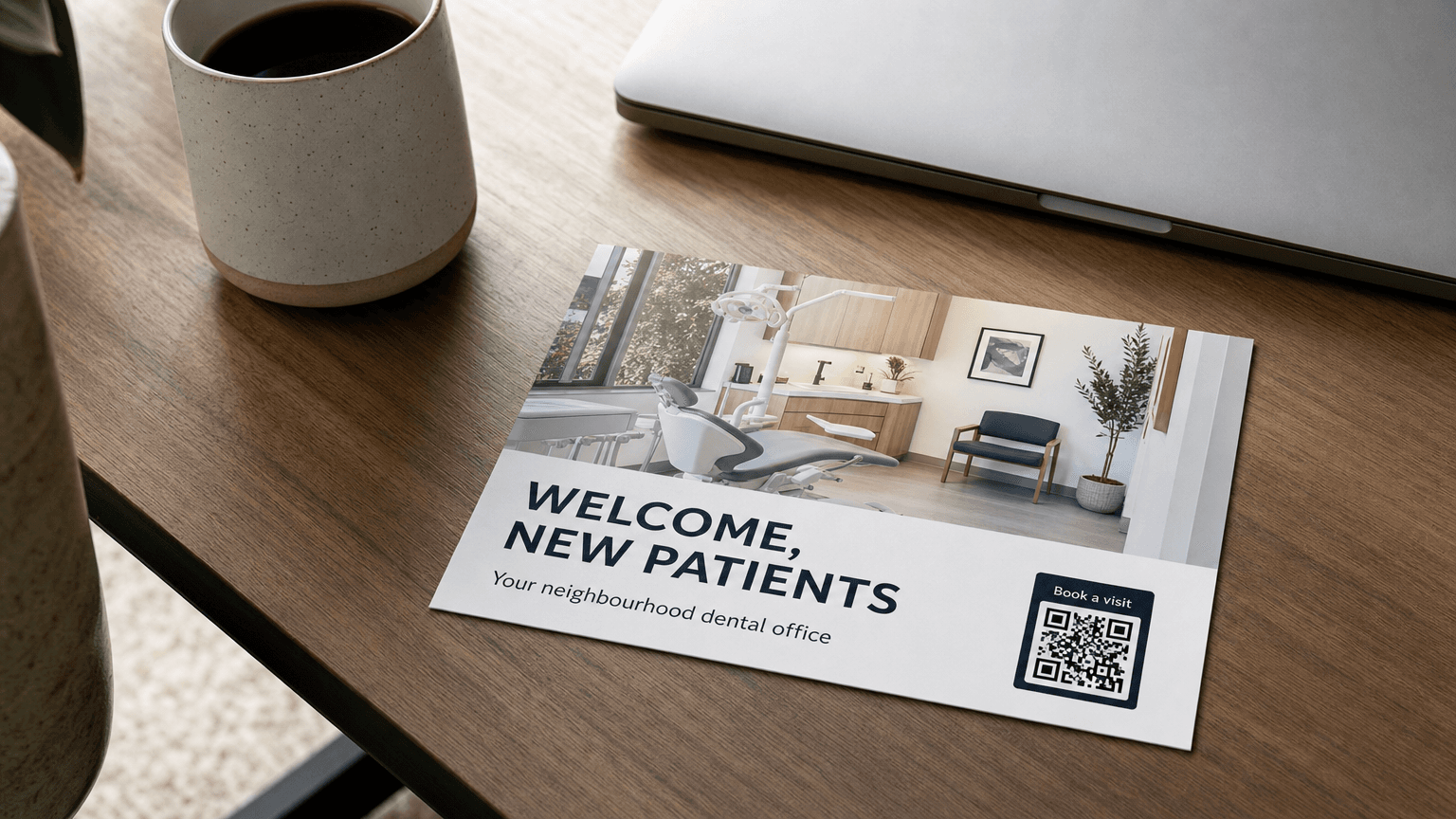
- Clean, clinical-adjacent aesthetic. White or soft-blue backgrounds, legible serif or sans-serif fonts, and a friendly photo of the dentist or team convey trustworthiness.
- One primary offer, one call to action. Crowded postcards underperform. State the offer clearly, then direct the reader to a QR code or phone number.
- Practice name and contact details prominent. Recipients should be able to identify and contact you without hunting.
- Regulatory compliance. Follow your provincial dental regulatory body's advertising guidelines. Avoid testimonials that imply specific outcomes, and do not describe treatments as "painless" or make any clinical guarantee.
Magic Mailer generates postcard designs using your practice's logo, colours, and details in about 60 seconds. The AI layout engine follows professional direct-mail composition principles so the final piece looks polished without requiring a graphic designer.
Ready to Send Your First Campaign?
Magic Mailer uses AI to design, print, and mail professional postcards for your business in minutes, not weeks.
Try Magic Mailer FreeWant it set up in your CRM for you? book a meeting
Prefer to just describe it? build your whole campaign in one chat
Smart Local Targeting: Reaching the Right Households
Targeting is where most dental outreach goes wrong. Practices that broadcast to an entire city waste budget on households that are too far away to convert. Smart local targeting draws a geographic boundary around your practice and builds a mailing audience from households inside that catchment area, so every piece you spend reaches someone who could realistically walk through your door.
You can refine the audience further by demographic filters such as household type (families with children for pediatric-friendly practices) or household tenure (recent movers for new-patient acquisition). The direct mail for professional services hub covers how this targeting logic applies across healthcare, legal, and financial practices.
For dental practices, a typical catchment radius is two to five kilometres in urban areas, wider in suburban or rural markets. Magic Mailer's smart local targeting builds that radius automatically from your practice address and lets you adjust it before launch.
Pricing and Volume Planning
Direct mail for dental practices is priced per piece, with printing and postage included. Magic Mailer's Canada pricing runs from CA$3.31 per piece at low volumes down to CA$1.53 per piece at 5,000 or more pieces. The Free Starter plan includes 1,000 build credits with no credit card required, so you can design and price a campaign before committing.
The table below shows how volume interacts with per-piece cost and illustrates the economics of a typical new-patient acquisition scenario.
| Volume | Price per Piece | Total Spend | Est. New Patients (2.9% response, 50% conversion) | Cost per New Patient |
|---|---|---|---|---|
| 500 | CA$3.31 | CA$1,655 | 7 | CA$237 |
| 1,000 | CA$3.31 | CA$3,310 | 15 | CA$221 |
| 5,000 | CA$1.53 | CA$7,650 | 73 | CA$105 |
A new patient's lifetime value typically far exceeds the cost of acquiring them. A cost per new patient in the CA$100-CA$240 range is a strongly positive return on a single campaign cycle, before accounting for referrals.
For a deeper look at how per-piece costs compare across channels and volume tiers, see the postcard marketing cost guide.
Measuring Results: From QR Scans to Patient LTV
Tracking dental direct mail is straightforward when you set up measurement before the campaign launches.
QR code scans. Assign a unique URL (e.g., your-practice.com/welcome or a booking link with source tracking) to the postcard's QR code. Every scan is a tracked response you can tie directly to the mail drop.
New-patient source tracking. Train your front desk to ask every new patient how they heard about the practice. Tag responses in your practice management software. Over a 90-day window after a mail drop, new patients who say "I got a postcard" or "I found you in the mail" are attributed to that campaign.
Call tracking. If you use a dedicated phone number on the postcard, every call from that number is a direct mail response. Many practice management platforms or basic telephony tools support call tracking numbers at low cost.
Cost per new patient vs. LTV. Divide total campaign spend by confirmed new patients from that campaign to get your cost per new patient. Compare this to your practice's average lifetime value to calculate campaign ROI. The Lob 2024 State of Direct Mail found that 84% of marketers rate direct mail their highest-ROI channel, a figure consistent with the patient acquisition economics dental practices typically observe.
For reactivation campaigns, measure differently: track how many lapsed patients booked within 60 days of the mail drop and calculate revenue recovered versus campaign cost.
Getting Started with Magic Mailer
Dental practices can launch a neighbourhood postcard campaign through Magic Mailer for professional services in a few steps. Enter your practice address, set your catchment radius, upload your logo, and the AI generates a professional postcard design in about 60 seconds. Review the offer copy, add your QR code or booking link, and the platform handles printing, postage, and delivery. The Free Starter plan includes 1,000 build credits so you can explore the tool and price your first campaign without a credit card.
Direct mail reaches the households that are already closest to your chair. Smart local targeting, a compelling new-patient offer, and consistent follow-up cadence are the three levers that convert a neighbourhood mailing into a full appointment book.
Frequently Asked Questions
How far should a dental direct mail campaign reach?+
In urban and suburban markets, two to five kilometres from the practice covers the realistic patient catchment area. Rural practices may extend wider. Smart local targeting in Magic Mailer lets you set the radius from your practice address and preview the household count before committing to a volume.
What is the best offer for a dental new-patient postcard?+
A new-patient comprehensive exam and cleaning special is the most broadly effective offer because it speaks to anyone without an existing dentist. For practices with a cosmetic focus, free whitening with a first exam attracts motivated, higher-value patients. For markets with low insurance penetration, highlighting an in-house membership plan removes a common barrier.
How much does dental direct mail cost in Canada?+
Magic Mailer's all-in pricing (printing and postage included) starts at CA$3.31 per piece for low volumes and drops to CA$1.53 per piece at 5,000 or more pieces. A 500-piece neighbourhood campaign costs roughly CA$1,655 all-in. The Free Starter plan includes 1,000 build credits with no credit card required.
Can I mail postcards to households that recently moved into my area?+
Yes. Magic Mailer includes a new-mover targeting capability that identifies households that have recently relocated into your catchment area. Reaching these households in the first four to eight weeks after their move, before they establish a relationship with another practice, is one of the highest-converting dental direct mail strategies available.
How do I measure whether my dental postcard campaign worked?+
The three primary measurement methods are: (1) a unique QR code URL on the postcard tracked in your website analytics or booking platform, (2) front-desk source attribution asking every new patient how they heard about the practice, and (3) a dedicated call-tracking number printed on the card. Divide total campaign spend by attributed new patients to calculate cost per new patient and compare it to your average patient lifetime value.
Sources
- ANA 2023 Response Rate Report: house lists ~5.3% response; prospect lists ~2.9%; house-list ROI ~161%; cost per acquisition US$19 (house) vs US$43 (prospect). — ana.net
- USPS OIG / Temple University, Enhancing the Value of Mail: The Human Response: physical mail drives stronger memory encoding, recall, and emotional response than digital. — uspsoig.gov
- Lob 2024 State of Direct Mail: 84% of marketers rate direct mail their highest-ROI channel; 85% report best response rates; 84% best conversion rates. — lob.com
Ready to Send Your First Campaign?
Magic Mailer uses AI to design, print, and mail professional postcards for your business in minutes, not weeks.
Try Magic Mailer FreeWant it set up in your CRM for you? book a meeting
Prefer to just describe it? build your whole campaign in one chat