Key Takeaways
- Professional service practices draw from nearby households, making local direct mail one of the most cost-efficient acquisition channels available. The ANA 2023 Response Rate Report benchmarks house-list response rates at 5.3% and ROI at 161%.
- New movers are the highest-value segment for professional services postcards: households that have recently relocated need a new dentist, doctor, lawyer, accountant, and vet all at once and are actively looking to fill those gaps.
- Five campaign types cover most professional services direct mail needs: new-patient/new-client acquisition, new-mover welcome, reactivation of lapsed patients or clients, seasonal campaigns (tax season, back to school, flu season), and community awareness.
- Professional services postcards must stay compliant: no guaranteed outcomes for medical or legal results, no promises that violate financial advertising standards. Lead with the offer of a consultation or introduction and let the practice's credentials do the conversion work.
- Magic Mailer AI-generates on-brand postcard designs in about 60 seconds, then handles printing, postage, and delivery from CA$3.31 per piece down to CA$1.53 per piece at 5,000+ pieces, with a Free Starter plan that requires no credit card.
Professional service practices grow on trust, and trust is built locally. A dentist draws almost entirely from households within a few kilometres of the clinic. A family lawyer's referral network lives in the same community. A veterinary clinic's clients are the pet owners on nearby streets. The potential patients and clients who matter most are already geographically close, and a well-designed postcard landing on their kitchen counter reaches them in a way that a search ad or social post rarely does.
Direct mail for professional services works because the audience is defined by proximity, the relationship is high-value and recurring, and physical mail reinforces the sense of credibility that trust-based practices depend on. This guide covers why direct mail belongs in a professional practice marketing plan, who the real audiences are, which campaign types produce results across different practice types, how to target and measure effectively, and how Magic Mailer handles the whole process end to end.
Why Direct Mail Works for Trust-Based Local Practices
Direct mail works for professional practices because the decision to choose a dentist, lawyer, accountant, or veterinarian is a high-consideration, locally anchored decision. Proximity and credibility both matter. A postcard from a practice two streets away signals availability and community presence in a way a digital ad cannot.
Research commissioned by the USPS Office of Inspector General and conducted at Temple University found that physical mail drives stronger memory encoding, recall, and emotional response than digital alternatives. A postcard is not skipped past or filtered into a promotions folder. It is handled, seen, and often placed somewhere visible in the home. That physical presence builds the low-level familiarity that precedes a booking call.
The aggregate data is consistent. According to the Lob 2024 State of Direct Mail, 84% of marketers rate direct mail their highest-ROI channel, 85% cite it for best response rates, and 84% for best conversion rates. The ANA 2023 Response Rate Report benchmarks average response rates at 5.3% for house lists and 2.9% for prospect lists, with house-list ROI averaging 161% and cost per acquisition at US$19 for house lists and US$43 for prospect lists.
For a practice where a single new patient or client relationship is worth hundreds or thousands of dollars annually, those acquisition numbers make direct mail the most capital-efficient channel in the mix.
The High Value of New Movers
New movers are the highest-value segment in professional services direct mail. A household that has recently relocated to the area has no existing dentist, no established GP or family clinic, no accountant who knows their file, no vet who knows the dog. Every practice relationship they need is up for grabs, and they are actively looking to fill those gaps in the first weeks and months after moving.
According to the Lob 2025 State of Direct Mail, 88% of marketers say personalisation improves response rates. A postcard that reaches a new mover household with a warm, welcoming message, a clear new-patient or new-client offer, and a QR code to book an appointment is precisely the right content at the right moment. The new-mover direct mail guide covers this targeting approach in depth.
Who the Audience Is for Professional Services Postcards
The primary audience for professional services direct mail is nearby households: the residents who live within a realistic travel distance of the practice and are the most likely source of new patients and clients. For most practices, that radius is 3-8 km, though it varies by practice type and urban density.
Within that household audience, new movers are a distinct and especially responsive segment. New-resident households need to establish relationships with every local service provider at once, making them significantly more open to switching than settled households with existing provider relationships.
For some practice types, notably accounting firms, business law firms, and financial advisors, nearby businesses and their owners are a legitimate secondary audience. An accountant targeting small business owners within a commercial district, or a commercial law firm reaching local business owners, can run a separate campaign with a business-framed message alongside the primary household campaign. The industries page shows the full range of audience types Magic Mailer can reach.
Practice Audiences at a Glance
| Practice Type | Primary Audience | Best Campaign Type |
|---|---|---|
| Dental clinic | Households in 3-5 km radius; new movers | New-patient welcome, new-mover offer |
| Medical / health clinic | Households in 5-8 km radius; new movers | New-patient welcome, seasonal health reminders |
| Law firm (family / personal) | Households in 5-10 km radius | Community awareness, new-mover introduction |
| Accounting & tax firm | Households + nearby small businesses | Tax season campaign, year-end planning |
| Financial advisor | Households (35+ demographic); local business owners | Educational offer, retirement / planning intro |
| Veterinary clinic | Pet-owner households in 3-5 km radius; new movers | New-patient welcome, seasonal wellness reminder |
Ready to Send Your First Campaign?
Magic Mailer uses AI to design, print, and mail professional postcards for your business in minutes, not weeks.
Try Magic Mailer FreeWant it set up in your CRM for you? book a meeting
Prefer to just describe it? build your whole campaign in one chat
Campaign Types That Work Across Professional Practices
Professional practices run several distinct campaign types depending on their goals. New-patient and new-client acquisition campaigns are the most common entry point, but reactivation, seasonal, and community-awareness campaigns each serve a specific role in a practice's annual plan.
New-patient / new-client acquisition. A postcard offering a discounted initial consultation, a free first visit, or a clear welcome offer sent to nearby households is the foundation of professional services direct mail. The offer gives a prospect who has been meaning to book a reason to act now. For practices that serve a broad household audience, this campaign runs year-round at a steady cadence.
New-mover welcome. A triggered campaign that reaches households who have recently moved into the catchment area is among the highest-converting campaign types in professional services. New residents are actively building their local provider list and respond well to a practice that reaches them in the first weeks after they arrive. A QR code linking to a new-patient or new-client intake form makes the response path frictionless.
Reactivation of lapsed patients and clients. A practice's own lapsed patient or client list is a warm audience that already knows the practice and has done business with it in the past. A reactivation postcard, sent to households that have not had an appointment or engagement in 18-36 months, converts at meaningfully higher rates than cold prospect campaigns. The ANA 2023 Response Rate Report confirms this dynamic: house-list response rates average 5.3% versus 2.9% for prospect lists.
Seasonal and time-anchored campaigns. Several practice types have natural seasonal windows. Accounting and tax firms have a clear annual campaign moment: the weeks leading into tax season when households and small business owners are actively thinking about their filing. Dental clinics benefit from back-to-school campaigns in August targeting families who need to book checkups before the school year starts. Financial advisors often see engagement around RRSP contribution deadlines and year-end planning. Medical and health clinics can mail ahead of flu season or back-to-school immunisation periods.
Community awareness and referral. A postcard that introduces the practice, highlights the team, and communicates community involvement builds the ambient recognition that generates word-of-mouth referrals. This type of campaign does not need to lead with a hard offer and works well for practices that are newly opened, recently relocated, or expanding their service area.
Smart Local Targeting for Professional Practices
Targeting for professional services postcards starts with the practice's address and works outward. The goal is to reach the households within the realistic catchment area: the radius from which the practice actually draws, not a broad postal code or city-wide sweep that wastes budget on households that would never travel that far for a routine appointment.
Smart local targeting builds the audience around the practice's location and applies the relevant household and demographic criteria for the practice type. A veterinary clinic targets households with the demographic profile of pet ownership in the surrounding streets. A dental clinic targets all households within a 3-5 km radius, with extra weight given to recently moved-in households. An accounting firm adds nearby small business addresses to its household audience in the tax season window.
According to the Lob 2025 State of Direct Mail, 88% of marketers say personalisation improves response, and 90% say direct mail enhances digital channel performance. Targeted postcards that reach the right households outperform broad distributions because the match between offer and recipient is tighter.
For practices interested in how different targeting approaches compare, the direct mail marketing guide covers audience-building fundamentals across channels and formats.
Postcard Design and Compliance for Professional Practices
Professional services postcards work best when they look professional: clean design, clear branding, a specific offer or message, and a frictionless response path. A cluttered or off-brand postcard undermines the credibility signal that makes professional services direct mail effective in the first place.
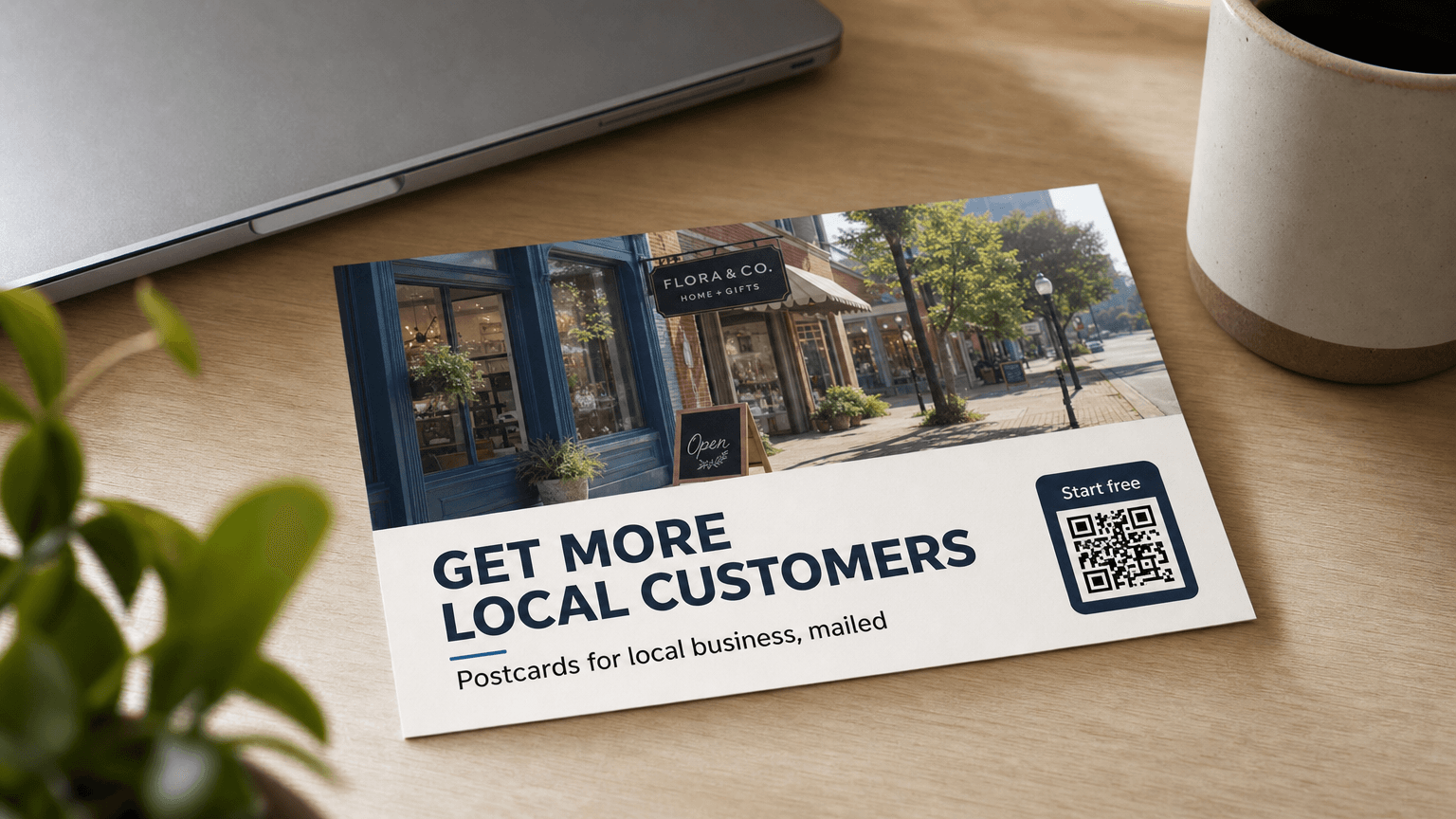
The key design elements: the practice name and logo prominently placed, a headline that leads with the benefit or offer rather than the practice name alone, a short supporting message, the practice address and phone, and a QR code that links directly to a booking page, new-patient form, or online intake.
Compliance matters more in professional services than in most other sectors. Medical and dental practices must avoid language that implies guaranteed health outcomes. Legal practices must not make specific promises about case results. Financial advisors are subject to regulatory advertising standards that vary by province and registration type. The right approach is to lead with the offer of a consultation, an introduction to the practice, or a welcome to the neighbourhood, and let the practice's professional reputation do the rest of the conversion work once the patient or client books.
Magic Mailer's AI generates postcard designs by reading the practice's own website for logo, brand colours, and business details. The practice owner reviews up to three AI-generated designs and selects the one to send. No designer is required, and the process from first login to approved design takes about 60 seconds.
Ready to Send Your First Campaign?
Magic Mailer uses AI to design, print, and mail professional postcards for your business in minutes, not weeks.
Try Magic Mailer FreeWant it set up in your CRM for you? book a meeting
Prefer to just describe it? build your whole campaign in one chat
Measuring ROI for a Professional Services Postcard Campaign
Direct mail ROI for a professional practice is traceable and, over time, produces a reliable cost-per-new-patient or cost-per-new-client number. The core method: unique QR codes per campaign, attributed to a dedicated landing page or booking URL, tracked through to the point where a new patient or client books their first appointment.
The ANA 2023 Response Rate Report benchmarks average cost per acquisition at US$19 for house lists and US$43 for prospect lists. For a dental practice where a new patient relationship is worth CA$500-1,500 annually for several years, or a law firm where a new client matter generates CA$2,000-10,000 in fees, even the higher end of that acquisition cost represents a strong return on investment.
For practices running seasonal campaigns, the timing of attribution matters. Tax season postcards mailed in February should be tracked against new client intakes through to April 30. New-mover welcome campaigns can be evaluated against bookings in the 30-60 days after send. Reactivation campaigns should track whether lapsed patients return within 90 days.
See postcard marketing cost for a detailed breakdown of how to model campaign economics before committing to a send volume.
Deepening Results with Personalisation
Personalisation increases response rates at every stage of the professional services funnel. Addressing the postcard to the household, tailoring the message to new movers versus established residents, and adjusting the offer based on whether the recipient is a new prospect or a lapsed patient all move conversion rates in the right direction. According to the Lob 2025 State of Direct Mail, 88% of marketers say personalised direct mail significantly improves response rates.
How Magic Mailer Runs Professional Services Campaigns
Magic Mailer handles design, targeting, printing, postage, and delivery in one platform. A practice owner enters the business name and website URL, and the AI produces up to three on-brand postcard designs. The owner selects a design, sets the audience, and approves. Everything else is handled end to end.
Pricing runs from CA$3.31 per piece at low volume down to CA$1.53 per piece at 5,000 or more pieces, printing and postage included. A Free Starter plan includes 1,000 build credits with no credit card required, giving any practice the ability to plan a campaign, see the local audience size, and preview designs before spending anything.
Every postcard can carry a QR code set at design time, linking to any URL: a booking system, a new-patient intake form, a seasonal offer landing page, or a specific service page on the practice website. The code is tracked through the Magic Mailer dashboard and requires no third-party tool.
For the full breakdown of how Magic Mailer serves each practice type, explore the dedicated guides: dentist direct mail marketing, law firm direct mail marketing, and medical practice direct mail. Each covers the specific campaign types, targeting approaches, compliance considerations, and offer structures that work best for that practice.
When you are ready to build and mail your first campaign, Magic Mailer for professional services walks through the full process from setup to send.
Frequently Asked Questions
Does direct mail work for professional service practices like dentists, lawyers, and accountants?+
Yes. Professional practices grow on local trust and recurring relationships, and direct mail is well-suited to both. The ANA 2023 Response Rate Report benchmarks house-list response rates at 5.3% and house-list ROI at 161%, with average cost per acquisition of US$19. For a practice where a single new patient or client relationship is worth hundreds or thousands of dollars, that acquisition cost is very favourable. Physical mail also builds credibility in ways digital advertising cannot: research from the USPS Office of Inspector General and Temple University found that physical mail drives stronger memory encoding and emotional response than digital alternatives.
Who should a professional practice target with direct mail?+
The primary audience is nearby households within the practice's realistic catchment area, typically 3-8 km depending on practice type and urban density. New movers within that area are a particularly high-value segment because a household that has recently relocated needs to establish all of its local provider relationships at once. For some practices, such as accounting firms or business law firms, nearby small business owners are a legitimate secondary audience for a separately framed campaign.
What types of postcard campaigns work best for professional services?+
New-patient and new-client acquisition campaigns with a clear offer (discounted first visit, free initial consultation) are the most common entry point. New-mover welcome campaigns convert at high rates because the audience is actively building their local provider list. Reactivation campaigns targeting lapsed patients or clients convert at even higher rates because the audience already knows the practice. Seasonal campaigns work well for accountants (tax season), dental clinics (back to school), and health clinics (flu season). Community awareness campaigns suit newly opened or expanded practices.
What compliance rules apply to professional services postcards?+
Medical and dental postcards must not imply guaranteed health outcomes or results. Legal practice postcards must not promise specific case outcomes. Financial advisor postcards are subject to provincial and national regulatory advertising standards that vary by registration type. The right approach across all practice types is to lead with the offer of a meeting, consultation, or introduction, and keep the messaging focused on accessibility, location, and welcome rather than outcomes. When in doubt, have a compliance-aware colleague review postcard copy before sending.
How much does direct mail for professional services cost with Magic Mailer?+
Magic Mailer postcards run from CA$3.31 per piece at low volume down to CA$1.53 per piece at 5,000 or more pieces, printing and postage included. A Free Starter plan includes 1,000 build credits with no credit card required, so any practice can plan a campaign, preview the local audience size, and see AI-generated postcard designs before committing to a send.
Sources
- ANA 2023 Response Rate Report: direct mail to house lists averages a 5.3% response rate; prospect lists average 2.9%; postcards used by 76% of marketers mailing house lists; house-list ROI averages 161%; cost per acquisition US$19 (house) vs US$43 (prospect). — ana.net
- USPS Office of Inspector General / Temple University, 'Enhancing the Value of Mail: The Human Response': physical mail drives stronger memory encoding, recall, and emotional response than digital advertising. — uspsoig.gov
- Lob 2024 State of Direct Mail: 84% of marketers rate direct mail their highest-ROI channel; 85% cite best response rates; 84% best conversion rates. — lob.com
- Lob 2025 State of Direct Mail: 88% say personalisation improves response rates; 90% say direct mail enhances digital channel performance. — lob.com
Ready to Send Your First Campaign?
Magic Mailer uses AI to design, print, and mail professional postcards for your business in minutes, not weeks.
Try Magic Mailer FreeWant it set up in your CRM for you? book a meeting
Prefer to just describe it? build your whole campaign in one chat