Key Takeaways
- Direct mail prospect lists average a 2.9% response rate and house lists average 5.3%, with house-list ROI benchmarking at 161%, per the ANA 2023 Response Rate Report.
- The primary audience for a gym or fitness studio is nearby households within a short radius, not the city at large. Targeting that neighbourhood is what makes postcard campaigns efficient.
- Six campaign types drive most gym direct mail results: membership intro offers, New Year pushes, boutique class promotions, win-back campaigns, grand openings, and corporate wellness.
- Personalisation and a dedicated QR code on every postcard are the two highest-leverage tools for improving response rates and attributing revenue back to the campaign.
- Magic Mailer handles design, printing, postage, and delivery for fitness postcards from CA$3.31 per piece at low volume to CA$1.53 per piece at 5,000+ pieces, all in one platform.
Running a gym, yoga studio, or wellness spa means competing for attention in the one place your future members actually live: the neighbourhood within a few kilometres of your front door. Social feeds scroll past, inbox promotions get deleted, and search ads reach people who may be 40 minutes away. A physical postcard lands on the kitchen counter of the household two streets over and stays there.
Direct mail for gyms and fitness businesses works precisely because the audience is local and the offer is tangible. This guide covers why direct mail outperforms most channels for fitness marketing, which campaign types produce results, how to build a hyperlocal audience, what makes a postcard worth keeping, and how to run the whole thing end to end with Magic Mailer.
Why Direct Mail Works for Fitness Businesses
Direct mail works for gyms and fitness studios because membership decisions are driven by proximity and trust, not just price. Nearby residents who receive a postcard from your studio already satisfy the first condition for joining: they live close enough to make a habit of it. Physical mail reinforces that trust in ways digital advertising cannot match.
Research commissioned by the USPS Office of Inspector General and conducted by Temple University found that physical mail drives stronger memory encoding, recall, and emotional response than digital equivalents. Postcards are not skipped or blocked; they are seen. That visibility translates directly into the recall that moves a household from "I should join a gym" to "there's that studio near the park."
The numbers back the channel more broadly. According to the Lob 2024 State of Direct Mail, 84% of marketers rate direct mail their highest-ROI channel, 85% cite it for best response rates, and 84% for best conversion rates. The ANA 2023 Response Rate Report puts average response rates at 5.3% for house lists and 2.9% for prospect lists, with house-list ROI averaging 161% and cost per acquisition as low as US$19.
For a gym owner comparing that against a boosted Instagram post that most users scroll past in under two seconds, the case for postcards is concrete.
The Neighbourhood Is Your Primary Audience
The households within a 3-5 km radius of your studio are your highest-value targets. These are the people who can realistically walk, cycle, or make a short drive to your location on a Tuesday morning or Thursday after work. Postcard targeting built around that radius reaches people for whom joining is genuinely feasible, not aspirational.
Corporate wellness is a legitimate secondary angle. Nearby offices may want group memberships, lunch-hour classes, or employee wellness packages. A separate campaign addressing those decision-makers with a different offer and message can complement your household push. But the neighbourhood comes first.
Ready to Send Your First Campaign?
Magic Mailer uses AI to design, print, and mail professional postcards for your business in minutes, not weeks.
Try Magic Mailer FreeWant it set up in your CRM for you? book a meeting
Prefer to just describe it? build your whole campaign in one chat
Campaign Types for Gyms and Fitness Studios
Gyms and fitness studios run several distinct campaign types across the year. Each has a different audience, timing, and conversion goal. Knowing which to run and when is the foundation of a postcard strategy that compounds rather than spikes.
| Campaign | Best Timing | Primary Goal |
|---|---|---|
| Membership intro / free trial | Year-round, especially post-summer | Convert nearby households to new members |
| New Year resolution push | November through January | Capture peak demand before it peaks |
| Boutique class or program launch | 4-6 weeks before launch date | Fill class capacity, drive trial bookings |
| Win-back lapsed members | 60-120 days after cancellation | Re-activate members who already know you |
| Grand opening / rebrand | 4-8 weeks before and after opening day | Build awareness in the surrounding neighbourhood |
| Corporate wellness | Q4 budget season and January | Sell group or employer memberships to nearby offices |
| Seasonal push (spring, summer) | 6-8 weeks before peak motivation windows | Sustain member acquisition between January surges |
Each of these deserves a tailored message and visual. A membership intro postcard showing a free first week works differently from a win-back piece that acknowledges a past member by name and offers a return discount. Personalisation is what separates a postcard that gets acted on from one that gets recycled.
Membership Intro and Free Trial Postcards
The most common gym postcard campaign introduces a specific, time-limited offer to households who have never been members. A free 7-day trial, a discounted first month, or a waived enrollment fee gives the recipient a reason to act now rather than sometime in the abstract future.
For a deep look at designing and mailing these campaigns, see gym membership postcards, which covers offer structure, postcard layout, and what to include in the call to action.
New Year Fitness Campaigns
January is the single largest acquisition window for gyms. The challenge is reaching nearby households before the resolution fades, not after. Direct mail campaigns mailed in November and December put a postcard in the household during the decision period, not during the regret period in February.
The full playbook for timing, copy, and offers is in New Year gym marketing.
Boutique and Class Promotions
Boutique fitness studios, yoga and Pilates spaces, CrossFit boxes, and cycling studios run on class capacity. A new program, a fresh instructor, or a seasonal schedule update is a natural reason to mail nearby households with a specific offer tied to that change.
How to position and mail these campaigns is covered in boutique fitness marketing.
Smart Local Targeting: Building Your Audience
Effective gym postcards reach the right households at the right radius, not every address in the city. Smart local targeting for fitness businesses works by identifying households around the studio's location and filtering for the demographics most likely to convert.
According to the Lob 2025 State of Direct Mail, 88% of marketers say personalisation improves response rates, and 90% say direct mail enhances digital channel performance. Both outcomes depend on targeting the right households to begin with. Sending to everyone in a postal code is less efficient than targeting the households within a walkable or short-drive radius where membership is actually practical.
Magic Mailer's smart local targeting builds the audience around the studio's address and lets the owner set the radius and household criteria before sending. The result is a list of nearby households who are genuinely proximate, not a broad geographic sweep that wastes budget on households 30 minutes away.
For studios interested in the corporate wellness angle, the same targeting approach can identify office buildings and employers within a short distance of the studio for a separate, B2B-framed campaign. The industries page shows the full range of business types Magic Mailer can reach.
Postcard Design and Personalisation
A gym postcard has about two seconds to communicate what the studio is, where it is, and what the offer is. Design and copy that fails any of those three things produces a postcard that goes in the recycling.
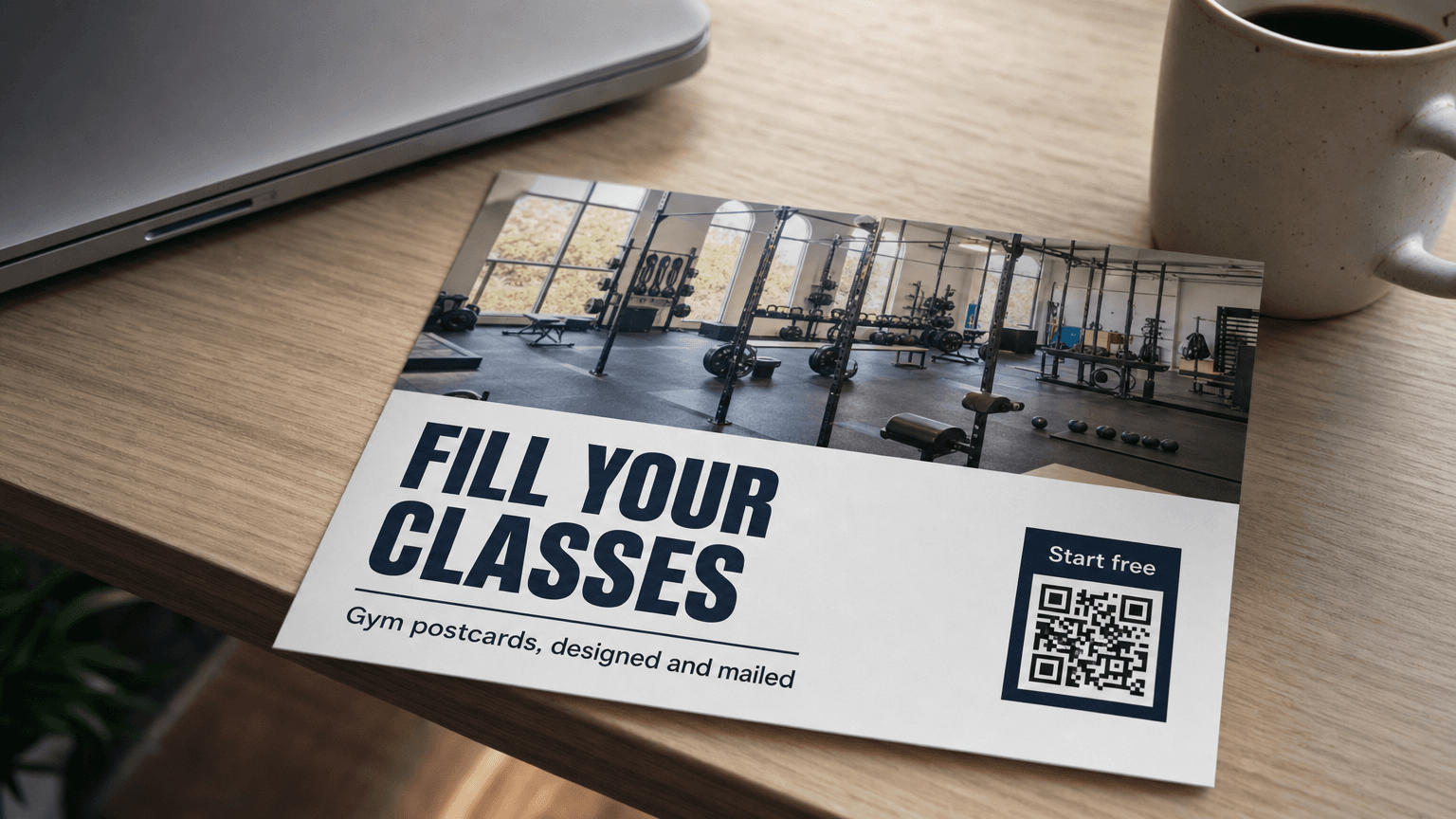
The best-performing fitness postcards share a few consistent traits: a bold headline that leads with the offer (not the gym's name), a clear image of the space or a class in session, the address and a QR code that goes directly to a booking page or free-trial signup, and a deadline that makes the offer time-sensitive.
Personalisation moves the conversion rate further. The ANA 2023 Response Rate Report notes that postcards are used by 76% of marketers mailing house lists, and the Lob 2025 State of Direct Mail confirms 88% say personalised mail significantly improves response rates. Addressing a postcard to the household, referencing the recipient's neighbourhood, or customising the offer based on whether the recipient is a new prospect or a lapsed member each increase the likelihood of a response.
Magic Mailer's AI pulls the studio's logo, brand colours, and business details from its website to generate on-brand postcard designs automatically. The owner reviews up to three AI-generated designs, selects the best, and approves the send. No designer, no print broker, no separate postage account.
Ready to Send Your First Campaign?
Magic Mailer uses AI to design, print, and mail professional postcards for your business in minutes, not weeks.
Try Magic Mailer FreeWant it set up in your CRM for you? book a meeting
Prefer to just describe it? build your whole campaign in one chat
How to Measure Direct Mail ROI for a Gym
Direct mail ROI for a fitness business is more measurable than most gym owners expect. The core equation: track how many people redeemed the postcard offer, calculate the lifetime value of those members, and compare that to the total campaign cost.
The ANA 2023 Response Rate Report benchmarks average cost per acquisition at US$19 for house lists and US$43 for prospect lists. A gym signing a member worth CA$600-1,200 annually at a CA$19-43 acquisition cost is running a channel most paid digital campaigns cannot approach.
Practically, measurement works through dedicated QR codes. Each campaign gets its own QR code linking to a unique landing page or booking URL. Scans from that code are attributed to the postcard campaign. When a free trial converts to a paid membership, that revenue traces back to the postcard. The Magic Mailer dashboard tracks campaign sends and lets the studio add a QR code at design time, linking to any URL: a Mindbody booking page, a gym management system, or a custom landing page.
For studios running multiple campaigns (New Year, spring, boutique class launch), each gets a distinct QR code so attribution stays clean. Over two or three campaign cycles, the studio builds a real cost-per-member number tied to direct mail, not estimated.
Complementing Digital with Physical
According to the Lob 2025 State of Direct Mail, 90% of marketers say direct mail enhances digital channel performance. For a gym, this looks like sending a postcard to nearby households and retargeting the same addresses with social ads in the weeks that follow. The postcard builds awareness and trust; the digital touchpoint converts. The combination outperforms either channel in isolation because the household has now seen the studio in two places before deciding.
How Magic Mailer Handles Gym Direct Mail End to End
Magic Mailer covers the full campaign in a single platform: targeting, design, print, postage, and delivery. A fitness studio owner enters the business name and website, the AI reads the brand and generates an outreach strategy and up to three postcard designs, the owner selects the design and audience, and the cards go to print and mail. The price runs from CA$3.31 per piece at low volume down to CA$1.53 per piece at 5,000 or more pieces, printing and postage included.
A Free Starter plan includes 1,000 build credits and requires no credit card, so a studio can plan the campaign, explore the audience size, and preview designs before committing to a send.
Postcards can carry a QR code to any URL: a free-trial signup, a class booking page, a seasonal offer landing page, or a specific membership tier page. The code is set during the design step, tracked through the dashboard, and requires no third-party tool.
For fitness businesses ready to run their first campaign or move a seasonal push from idea to mailbox, Magic Mailer for fitness and wellness has the full details on how the platform works for gyms, studios, and spas.
Frequently Asked Questions
Does direct mail work for gyms and fitness studios?+
Yes. Direct mail reaches nearby households with a physical offer that digital ads cannot replicate. The ANA 2023 Response Rate Report benchmarks average response rates at 5.3% for house lists and 2.9% for prospect lists, with house-list ROI averaging 161%. For a local gym, the primary audience is already geographically qualified: they live close enough to actually join.
What kind of postcards should a gym send?+
The most effective gym postcards lead with a specific, time-limited offer: a free trial week, a discounted first month, or a waived enrollment fee. They include a bold image of the space or a class, the studio address, and a QR code linking directly to a booking or signup page. According to the Lob 2025 State of Direct Mail, 88% of marketers say personalised mail significantly improves response rates, so addressing the household and tailoring the offer to new prospects versus lapsed members improves results.
When is the best time of year to mail gym postcards?+
January is the highest-demand window, but mailing in November and December positions your studio in front of nearby households during the decision period, before the peak passes. Spring is a secondary window as motivation rises heading into warmer months. Class launches, rebrands, and grand openings each create their own natural send windows. A steady cadence across the year outperforms a single annual campaign.
How do gyms measure the ROI of a postcard campaign?+
Use a unique QR code on each campaign that links to a dedicated booking or landing page. Scans from that code are attributed to the postcard. When a free trial converts to a paid membership, that revenue traces back to the campaign. The ANA 2023 Response Rate Report benchmarks average cost per acquisition at US$19 for house lists and US$43 for prospect lists, well below the lifetime value of most gym memberships.
How much does direct mail for gyms cost?+
Magic Mailer postcards for fitness businesses run from CA$3.31 per piece at low volume down to CA$1.53 per piece at 5,000 or more pieces, printing and postage included. A Free Starter plan includes 1,000 build credits with no credit card required, so a studio can plan the campaign and preview designs before committing to a send.
Sources
- ANA 2023 Response Rate Report: direct mail to house lists averages a 5.3% response rate; prospect lists average 2.9%; postcards used by 76% of marketers mailing house lists; house-list ROI averages 161%; cost per acquisition US$19 (house) vs US$43 (prospect). — ana.net
- USPS Office of Inspector General / Temple University, 'Enhancing the Value of Mail: The Human Response': physical mail drives stronger memory encoding, recall, and emotional response than digital advertising. — uspsoig.gov
- Lob 2024 State of Direct Mail: 84% of marketers rate direct mail their highest-ROI channel; 85% cite best response rates; 84% best conversion rates. — lob.com
- Lob 2025 State of Direct Mail: 88% say personalisation improves response rates; 90% say direct mail enhances digital channel performance. — lob.com
Ready to Send Your First Campaign?
Magic Mailer uses AI to design, print, and mail professional postcards for your business in minutes, not weeks.
Try Magic Mailer FreeWant it set up in your CRM for you? book a meeting
Prefer to just describe it? build your whole campaign in one chat