Key Takeaways
- Mail the neighbourhood two to three weeks before each motivation peak, not into it. A mid-December drop captures households forming their New Year commitments before the calendar flips.
- Physical mail drives stronger memory encoding and emotional response than digital, according to USPS OIG and Temple University research, which makes postcards a natural fit for high-intent seasonal windows.
- A seasonal campaign calendar with four annual drops (New Year, spring/summer prep, fall back-to-routine, holiday gifts) spreads acquisition effort across the year and smooths revenue.
- Resolution-season offers work best when they lower the first-commitment barrier: a 30-day trial pass, waived enrollment fees, or a bring-a-friend intro all outperform a generic discount.
- Smart local targeting focuses your budget on households within a practical commute radius, the people who can realistically make your studio part of their weekly routine.
- A 30-day retention postcard sent to new January members reduces the mid-February attrition spike by reinforcing the relationship at the highest-risk moment.
- Unique QR codes per campaign and offer-code tracking turn each seasonal drop into measurable, repeatable data rather than a one-time experiment.
January is the single biggest acquisition window in the fitness calendar, and most gyms squander it by waiting until the mood is already in the air. By the time you see competitor banners going up and social ads flooding feeds, the households in your neighbourhood have already started forming opinions about where they'll sign up. The studios that dominate the resolution rush are the ones that put a postcard on the doorstep first.
This guide covers the full seasonal timing playbook: when to drop mail for each motivation peak across the year, how to design offers that convert, how to target the right households around your location, and how to turn January joiners into members who are still paying in August.
Why Timing Beats Spend in Fitness Marketing
The highest-ROI fitness campaigns aren't the biggest ones. They're the ones that land in letterboxes at the exact moment a household is already in a decision mindset. Reaching the right neighbour at the right moment costs nothing extra but changes everything about response. Physical mail amplifies that timing advantage because it sits on the counter rather than disappearing into a scroll.
Digital ads reset to zero the moment someone closes a tab. A postcard on the kitchen counter stays in view for days. Research from USPS OIG and Temple University on the human response to mail found that physical mail drives stronger memory encoding, recall, and emotional response than digital channels. When a household that has been thinking about joining a gym spots a postcard from a studio three blocks away, the timing-plus-physical combination is a powerful one-two punch.
The ANA 2023 Response Rate Report puts house-list direct mail at a 5.3% response rate with a cost per acquisition of US$19, compared to US$43 for a cold prospect list. For a fitness studio where a single membership is worth hundreds or thousands of dollars annually, those economics make mail an obvious anchor for seasonal campaigns. According to Lob's 2024 State of Direct Mail, 84% of marketers rate direct mail their highest-ROI channel, and 85% cite it for best response rates across all channels they use.
The catch: the economics only hold when you reach people who are already primed to act. Timing is what creates that priming.
Ready to Send Your First Campaign?
Magic Mailer uses AI to design, print, and mail professional postcards for your business in minutes, not weeks.
Try Magic Mailer FreeWant it set up in your CRM for you? book a meeting
Prefer to just describe it? build your whole campaign in one chat
The Seasonal Campaign Calendar: When to Mail for Each Motivation Peak
Fitness motivation isn't evenly distributed across the year. There are four distinct peaks when households in your neighbourhood are naturally thinking about health and activity. Hitting each one requires mailing roughly two to three weeks ahead of the wave, not into it.
| Season | Motivation Peak | Ideal Drop Window | Campaign Angle |
|---|---|---|---|
| New Year | Late Dec - Jan | Mid to late December | Resolution kick-start, fresh start |
| Spring/Summer Prep | April - May | Mid March to early April | Beach-ready, outdoor energy |
| Back-to-Routine Fall | September | Mid to late August | Re-establish structure, family schedule |
| Holiday Gift | November - December | Late October to early November | Gift memberships, year-end treat |
New Year (drop mid-to-late December). This is the flagship window. Households start thinking about resolutions before the calendar flips. A postcard that arrives December 18-22 is sitting on the counter when someone makes their New Year commitment. Offer: a January-start membership with no enrollment fee, or a 30-day pass that lets a prospect test the studio before committing long-term.
Spring/summer prep (drop mid-March to early April). As temperatures rise, households that let their January membership lapse start thinking about it again. This window often has less competition than January, which means your card stands out more. Angle: outdoor class schedules, pool access if applicable, or a "get ready for summer" trial pass.
Back-to-routine fall (drop mid-to-late August). School schedules returning means parents in particular are mentally reorganising their week. A studio that offers early-morning or after-school-dropoff classes is speaking directly to a real household need. This window is consistently underused by fitness operators.
Holiday gift (drop late October to early November). Gift memberships and class packs convert strongly in this window. Households are already in gift-giving mode and a membership card is a tangible, personal gift that beats a generic retail item.
For a deeper look at direct mail strategy across gym types, see the full guide at Direct Mail for Gyms.
Designing the Right Offer for Resolution Season
Resolution-season offers work best when they lower the first commitment barrier without devaluing your membership. The household that picks up your January postcard is motivated but also wary of committing to something they might abandon. The right offer meets that psychology head-on.
Three offer structures that work for January campaigns:
The 30-day trial pass. A time-boxed pass removes the "what if I stop going" fear. The member experiences your studio with no long-term commitment. Your job during those 30 days is to make the transition to a full membership feel natural. Price it so it feels accessible, not so low that it attracts non-serious browsers.
No-enrollment-fee January start. Enrollment fees are a known friction point. Waiving the fee for memberships that start in January gives households a reason to act before February. The ongoing membership revenue makes the waived fee negligible in most cases.
Bring-a-friend intro. Resolution season is social. People make January commitments with a partner or friend. An offer structured around two people joining together increases your acquisition volume per card while also improving early retention, since members with a gym buddy show up more consistently.
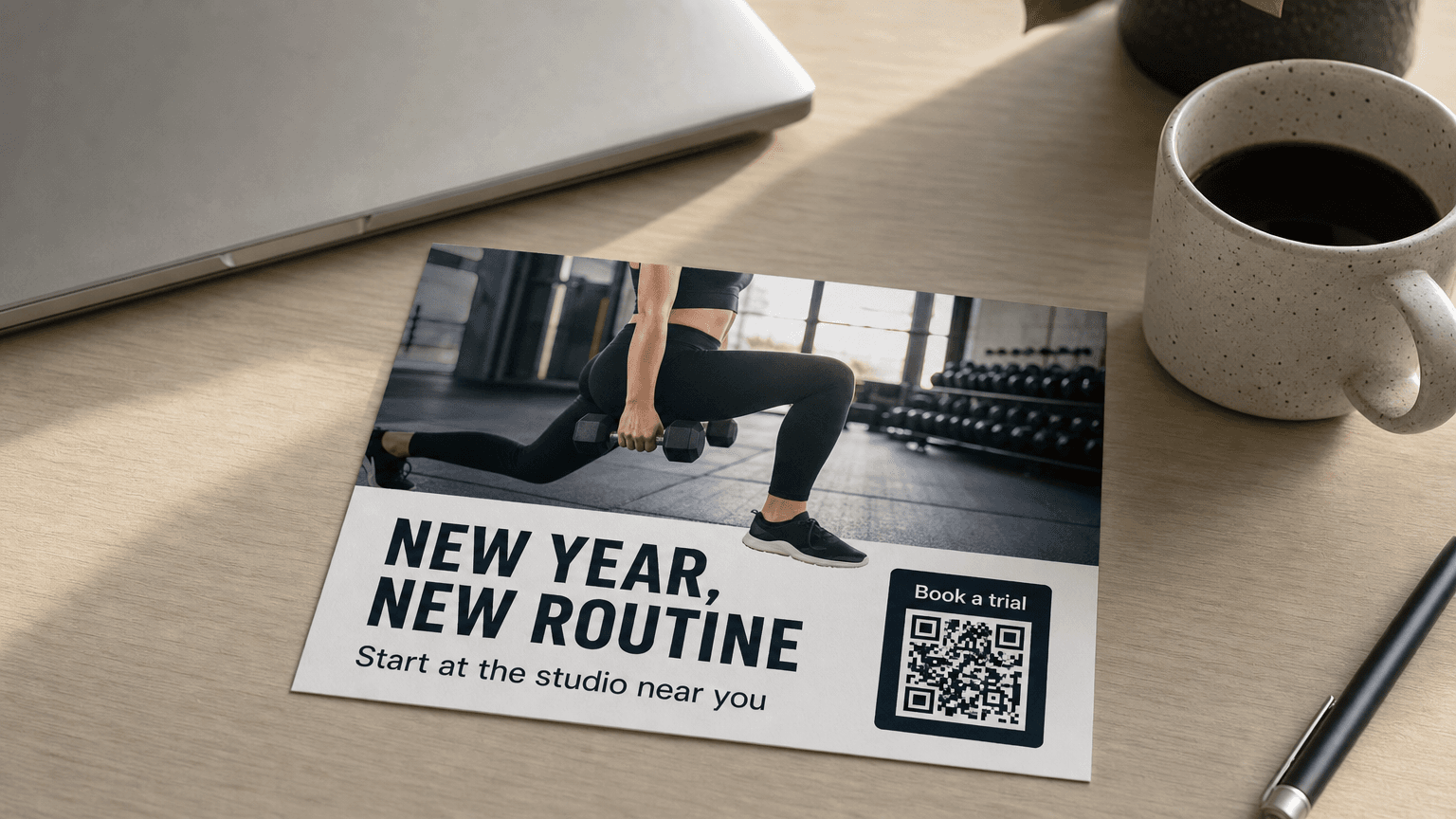
All three offers translate well to a postcard format. A clear headline, a single strong offer statement, and a QR code to a booking page or free-trial signup are all you need on the card itself. The QR code does the heavy lifting for conversion, taking the household from physical card to digital booking in one scan.
For more on postcard design and offer structure for gyms, the gym membership postcards guide covers the creative side in detail.
Reaching the Right Households with Smart Local Targeting
A resolution-season campaign works only if you're reaching households that are genuinely close enough to make your studio part of their routine. Someone two neighbourhoods over and twenty minutes away by car is unlikely to become a reliable member regardless of how good your offer is. Smart local targeting solves this by building your recipient list from households within a practical radius of your studio.
With Magic Mailer's smart local targeting, you define the area around your location, and the platform builds the mailing list automatically. You're not renting a generic list or manually importing addresses. The targeting reflects actual proximity to your studio, which means the households receiving your card could realistically walk or drive to you in a few minutes.
For January campaigns in a mid-size neighbourhood, a typical household audience in a 1-2 km radius might run 2,000-5,000 addresses. At Post Timely's pricing, a 2,000-card campaign runs from around CA$3.31 per piece at smaller volumes, dropping to CA$1.53 per piece at 5,000 pieces or more, with printing and postage included. There is no design fee to worry about on top, and the Free Starter plan includes 1,000 build credits with no credit card required.
For studios near an office district or mixed commercial-residential area, corporate wellness to nearby offices can be a secondary audience worth exploring. A lunchtime class program or after-work fitness pass is a natural pitch to office workers within walking distance. However, the primary audience for most gyms and studios remains the households in the surrounding neighbourhood.
Ready to Send Your First Campaign?
Magic Mailer uses AI to design, print, and mail professional postcards for your business in minutes, not weeks.
Try Magic Mailer FreeWant it set up in your CRM for you? book a meeting
Prefer to just describe it? build your whole campaign in one chat
Converting January Joiners into Long-Term Members
Acquiring a January member is only half the job. The resolution cohort has a well-known attrition pattern: a large share drops off by mid-February. A direct-mail campaign that brings in new members without a retention plan behind it produces a one-month revenue bump and nothing more. The most effective operators treat the acquisition campaign and the retention sequence as connected moves.
Lob's 2025 State of Direct Mail found that 88% of marketers say personalization improves response rates, and 90% say direct mail enhances digital channel performance. Those findings apply to retention as much as acquisition. A brief personalised postcard sent to new January members at the 30-day mark, congratulating them and presenting a milestone offer, reinforces the relationship at exactly the moment attrition risk is highest.
Other retention tactics that pair well with a postcard acquisition campaign:
- Week-one welcome sequence. A member who is greeted by name and shown the facility by a real person in week one is significantly more likely to return in week two. This is a staffing and culture decision, not a marketing one, but it is the highest-leverage retention move available.
- Class-booking QR codes. The resolution joiner who books a class before leaving the building in week one is forming a habit. Make class booking frictionless with a QR code on member materials that goes directly to the schedule.
- 30-day check-in postcard. As noted above, a physical card at the 30-day mark acknowledges the new member's commitment and provides a reason to stay engaged, whether that's a free guest pass, a milestone discount, or an invitation to a member event.
The postcard that brought them in is already proof that physical mail works with this audience. Use the same channel to keep them.
Measuring What Your Seasonal Campaign Delivers
Measurement is what separates a repeatable seasonal campaign from a one-time experiment. The metrics to track aren't complicated, but they need to be defined before the campaign drops so you can attribute results correctly.
QR code scans. Each postcard campaign should have a unique QR code pointing to a campaign-specific landing page or tracking URL. This gives you a direct read on how many households scanned, which is your top-of-funnel signal.
Offer redemptions. Track how many people used the offer code, booking link, or promo attached to the campaign. This is your conversion metric: the percentage of households that received the card and took the desired action.
Member source tagging. When a new member joins, ask how they heard about the studio. Keep the source tagging simple: postcard, social, referral, walk-in. Over three or four seasonal campaigns, this tells you which windows deliver the most durable members.
30-day and 90-day retention rates by cohort. Segment the January cohort from other acquisition cohorts and compare their 30-day and 90-day retention. If the postcard cohort retains better than average, that is a signal about audience quality: nearby-household targeting is delivering people who are genuinely close enough to make attendance a habit.
For a broader look at the fitness marketing channel and how it fits alongside other acquisition approaches, the Direct Mail for Fitness and Wellness page covers the full picture.
Putting the Playbook Together
The resolution rush rewards preparation, not reaction. Studios that mail the neighbourhood in mid-December, design a January offer that removes the first-commitment barrier, and follow up at the 30-day mark with a retention postcard will consistently outperform studios that spend more but mail later.
The mechanics are straightforward with the right tool: Magic Mailer lets you design a professional, on-brand postcard in around 60 seconds using your own logo and brand colours, build the audience from the households nearest to your studio using smart local targeting, and hand off printing, postage, and delivery entirely. The Free Starter plan includes 1,000 build credits and requires no credit card to begin.
Start with the December drop for January, measure the cohort through February, and by the time March arrives you will have enough data to plan the spring/summer prep campaign with real numbers behind it.
Frequently Asked Questions
When is the best time to mail postcards for a New Year gym promotion?+
Mid-to-late December is the ideal window. Households start forming resolution plans before the calendar changes, so a postcard arriving December 18-22 is on the counter when someone makes their January commitment. Mailing after January 1 means you are competing with studios that already planted the seed.
What offer converts best for a January gym postcard campaign?+
Offers that lower the first-commitment barrier tend to outperform flat discounts. A 30-day trial pass, a waived enrollment fee for January starts, or a bring-a-friend intro all address the resolution joiner's main concern: what if I stop going? A QR code on the card linking directly to a booking page removes friction at the conversion step.
How much does a gym postcard campaign cost with Post Timely?+
Pricing starts at CA$3.31 per piece for smaller volumes and drops to CA$1.53 per piece at 5,000 or more pieces, with printing and postage included. The Free Starter plan includes 1,000 build credits and requires no credit card.
How do gyms target the right households for a direct mail campaign?+
Smart local targeting builds the recipient list from households within a defined radius around the studio. This means the campaign reaches people who are close enough to realistically become regular members, rather than a broad generic list. No manual address importing or list purchasing is required.
How can gyms reduce the mid-February membership drop-off after a January campaign?+
A 30-day check-in postcard sent to new January members addresses attrition at the highest-risk moment. Pairing it with a week-one welcome experience and frictionless class booking through a QR code on member materials significantly improves the 30-day and 90-day retention rates for the resolution cohort.
Sources
- ANA 2023 Response Rate Report: direct mail to house lists achieves a 5.3% response rate, cost per acquisition of US$19, and house-list ROI of approximately 161%. — ana.net
- USPS OIG / Temple University, Enhancing the Value of Mail: The Human Response: physical mail drives stronger memory encoding, recall, and emotional response than digital channels. — uspsoig.gov
- Lob 2024 State of Direct Mail: 84% of marketers rate direct mail their highest-ROI channel; 85% cite best response rates; 84% cite best conversion rates. — lob.com
- Lob 2025 State of Direct Mail: 88% of marketers say personalization improves response rates; 90% say direct mail enhances digital channel performance. — lob.com
Ready to Send Your First Campaign?
Magic Mailer uses AI to design, print, and mail professional postcards for your business in minutes, not weeks.
Try Magic Mailer FreeWant it set up in your CRM for you? book a meeting
Prefer to just describe it? build your whole campaign in one chat