Key Takeaways
- A low-risk intro offer (first week free, no-enrollment-fee, founding-member rate) is the single most important element on a gym membership postcard because it removes the barrier to trying a new studio.
- Mail to the households within a 3-5 km radius of your studio: proximity to the gym is the strongest predictor of membership retention, making nearby residents your highest-value audience.
- A QR code linked to a campaign-specific landing page turns every postcard into a measurable conversion path; track scan rate, redemptions, trials attended, and cost per new member separately.
- A three-wave sequence spaced four to six weeks apart to the same household pool consistently outperforms a single large drop because membership consideration takes multiple touchpoints.
- At CA$1.53 per piece for 5,000+ pieces (printing and postage included), the cost per new member via direct mail often undercuts digital lead generation, which requires additional follow-up to convert an inquiry to a paid member.
- The two highest-response windows for fitness postcards are late December (targeting January intent) and late August (targeting the back-to-routine surge); plan drops to arrive in those final weeks.
- Magic Mailer handles design, targeting, printing, postage, and delivery end to end, removing the operational friction that causes most independent studios to skip direct mail entirely.
A new gym or studio lives and dies by how many people within a few kilometres know it exists and feel confident enough to walk through the door. Digital ads reach a broad population, many of whom will never visit. A printed postcard lands in the hands of the exact households around your location, where it sits on a counter, gets passed to a partner, and triggers a decision in a way a skippable ad never can. The USPS Office of Inspector General and Temple University found that physical mail drives stronger memory encoding and emotional response than digital channels, which is why gym membership postcards remain one of the highest-converting tools in local fitness marketing.
This guide covers what makes a membership intro offer convert, who to mail it to, what to put on the card, when to send it, what it costs, and how to measure whether it is working.
Why an Intro Offer Is the Engine of a Membership Postcard
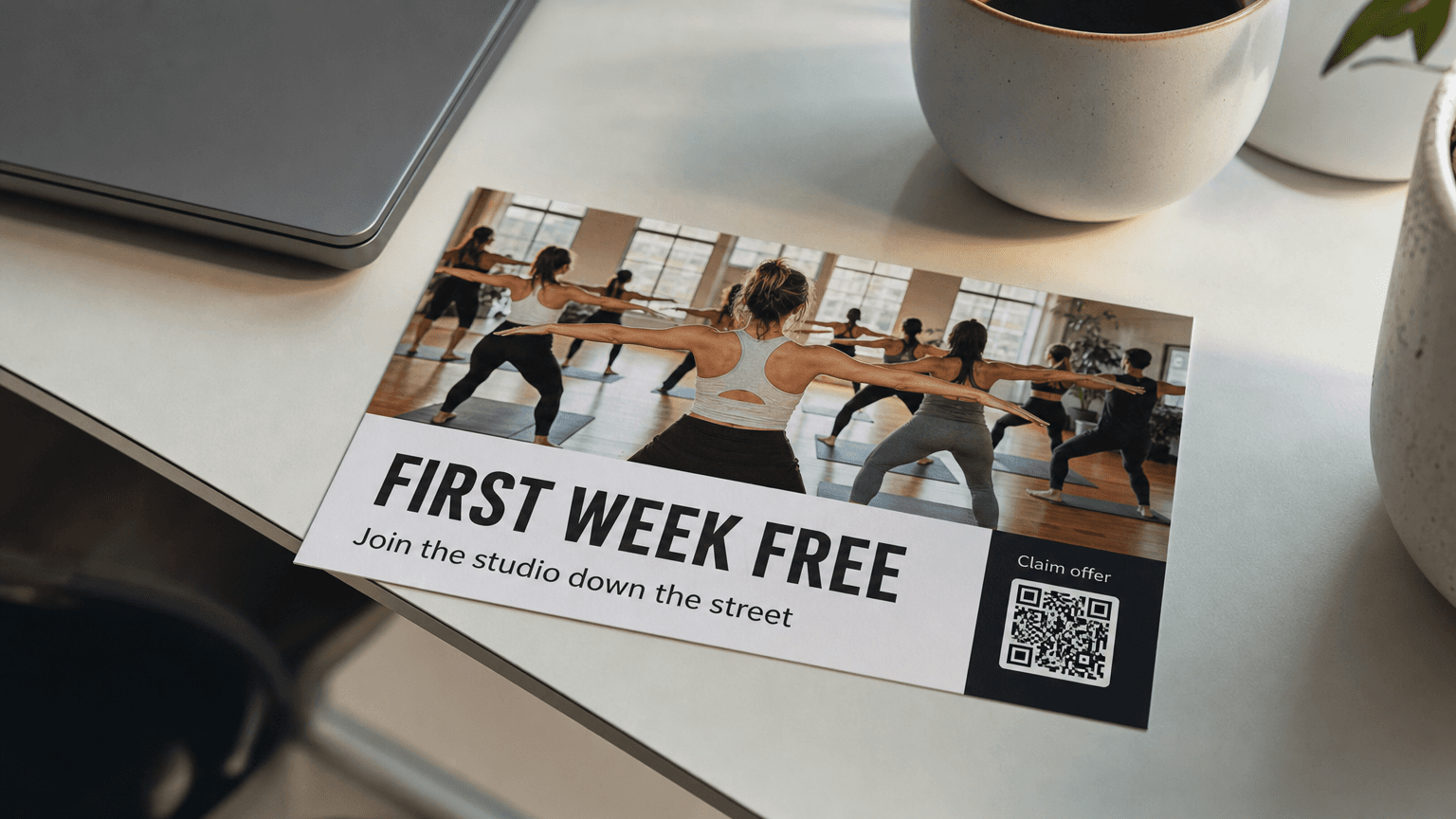
A gym membership postcard converts best when it leads with a low-risk, time-limited intro offer that removes the biggest barrier to joining: uncertainty. A first week free, a no-enrollment-fee founding-member rate, or a complimentary trial class lowers the psychological cost to near zero so the recipient only needs to decide to show up once.
The numbers back this up. According to the ANA 2023 Response Rate Report, direct mail to prospect lists achieves a 2.9% response rate on average, while house lists reach 5.3%. For a fitness studio, prospect lists are nearby households that have never visited, so the 2.9% baseline is the realistic starting point. On a mailing of 1,000 households, that is roughly 29 people who take action. An intro offer that smooths conversion through a trial and into a paid membership lifts that economics picture considerably from the baseline cost-per-acquisition ANA benchmarks.
The offer structure that tends to perform is: one clear benefit ("First week free"), one deadline or scarcity element ("For new members joining before [date]"), and one action step linked to a QR code. Everything else on the card is supporting context.
Who to Mail: Nearby Households Are Your Core Audience
Your primary audience is the households physically close to your studio, not a demographic segment or interest category. Someone who lives a 10-minute walk or a 5-minute drive away is far more likely to become a regular member than someone across town, because convenience is the single biggest predictor of gym membership retention and the primary reason people keep attending.
Magic Mailer builds your recipient list using smart local targeting: you define a radius or draw a zone around your studio address and the tool identifies the households in that area. You do not need to purchase or manage a separate mailing list. For most neighbourhood gyms and boutique studios, a 3-5 km radius gives a workable population of several thousand households without the waste of mailing too broadly.
Secondary audiences worth layering in include nearby office buildings for lunchtime or before-work memberships and residents of specific apartment towers or new developments where younger adults are moving in. But always anchor the campaign on the residential neighbourhood first. A studio that fills its 6 a.m. and 6 p.m. classes with people who live nearby has a far stickier membership base than one that depends on a long commute.
For a deeper look at how direct mail fits into a full fitness marketing strategy, see Direct Mail for Gyms and Fitness Studios.
Ready to Send Your First Campaign?
Magic Mailer uses AI to design, print, and mail professional postcards for your business in minutes, not weeks.
Try Magic Mailer FreeWant it set up in your CRM for you? book a meeting
Prefer to just describe it? build your whole campaign in one chat
What to Put on the Card: Offer, QR, Schedule
A well-designed gym membership postcard carries three core elements: the intro offer in a headline that a recipient reads in under three seconds, a QR code that links to a campaign-specific landing page, and a brief schedule or service menu that confirms the studio is relevant to their lifestyle. Everything else on the card is secondary.
The front of the card should do three things: stop the recipient from dropping it, communicate the offer in under three seconds, and drive them to scan a QR code. Use a bold headline with the offer ("First Week Free for New Members"), a short subheadline that names the studio and what makes it different ("Calgary's Only Women-Only Strength Studio"), and the QR code that links directly to a trial signup page or class schedule. A vivid photo of the studio floor or a class in action helps more than stock imagery.
The back of the card can carry slightly more detail: the studio address, hours, a brief class schedule or service menu, and a second mention of the expiry date on the intro offer. Keep paragraphs to two or three sentences maximum. White space is not wasted space; it makes the key information easier to absorb.
The QR code is a critical measurement tool as well as a conversion path. Link it to a landing page specific to this campaign, distinct from your general website homepage, so every scan is attributable to the postcard. The landing page should mirror the offer on the card and have one call to action: book a trial, claim the free week, or reserve a founding-member spot.
Magic Mailer embeds a QR code pointing to any URL you specify when you approve your design. You can update the destination URL later without reprinting the card.
Timing, Frequency, and the Mailing Calendar
Residents in your neighbourhood make fitness decisions at predictable moments. January is the strongest month for new membership inquiries across every fitness category. September carries a back-to-routine surge that often rivals January. A postcard arriving in the last week of December or the last week of August lands at exactly the right moment.
Beyond seasonal peaks, a single mailing rarely saturates a neighbourhood. The Lob 2024 State of Direct Mail found that 84% of marketers rate direct mail their highest-ROI channel, and a consistent presence across multiple touches produces compounding returns. A three-touch sequence spaced four to six weeks apart to the same household pool outperforms a single large drop because membership consideration takes time: a household receives the first card, notices the studio exists, and then acts on the second or third card when the timing aligns with a trigger like a gym contract expiring or a New Year resolution.
A practical calendar for a studio launching or growing membership:
| Mailing | Timing | Offer Focus | Expected Action |
|---|---|---|---|
| Wave 1 | Late December or late August | First week free, founding-member rate | Awareness + trial booking |
| Wave 2 | 5 weeks later | No-enrollment-fee for the next 30 days | Conversion from trial to membership |
| Wave 3 | 5 weeks after Wave 2 | Refer-a-friend: bring a neighbour free | Retention + referral |
This sequence is deliverable to the same 1,000-2,000 households for a total campaign budget well within reach of an independent studio, as the pricing section below shows.
Postcard Pricing and Cost-Per-New-Member Math
Magic Mailer pricing in Canada runs from CA$3.31 per piece at low volumes down to CA$1.53 per piece at 5,000 or more pieces, with printing and postage included. A Free Starter plan includes 1,000 build credits and requires no credit card, so you can design and preview before spending anything.
Here is how the math works at two common scales:
| Campaign Scale | Volume | Cost Per Piece | Total Spend | 2.9% Response (29/1,000) | Estimated Trials | Estimated New Members (60% trial-to-member) | Cost Per New Member |
|---|---|---|---|---|---|---|---|
| Neighbourhood launch | 1,000 pieces | CA$3.31 | CA$3,310 | 29 responses | 29 trials | ~17 members | CA$195 |
| District send | 5,000 pieces | CA$1.53 | CA$7,650 | 145 responses | 145 trials | ~87 members | CA$88 |
These numbers use conservative ANA 2023 benchmarks for prospect mail (2.9% response). If your intro offer is strong and your neighbourhood is well matched to your studio type, real-world responses often exceed that floor. A founding-member campaign for a studio opening in a residential area with no direct nearby competitor can see response rates of 4-6%.
Direct mail postcards with a specific offer in hand tend to drive higher-quality foot traffic than digital lead generation, where the conversion from online inquiry to paid membership typically requires additional follow-up steps. The cost-per-member comparison favours the physical format precisely because the offer arrives already in the prospect's hands.
Ready to Send Your First Campaign?
Magic Mailer uses AI to design, print, and mail professional postcards for your business in minutes, not weeks.
Try Magic Mailer FreeWant it set up in your CRM for you? book a meeting
Prefer to just describe it? build your whole campaign in one chat
How to Measure: QR Scans, Redemptions, and Trials Booked
A gym membership postcard campaign is fully measurable when you link the QR code to a campaign-specific page, which separates operators who scale direct mail from those who mail once and never know whether it worked. Four metrics, tracked in order, tell the complete story from awareness through to paid membership.
QR scan rate is the top-of-funnel signal. Every scan is a household that saw the card, read the offer, and took an action. A campaign-specific landing page (not your homepage) makes this clean to track in any web analytics platform. Target: 1-3% scan rate of pieces mailed as a minimum viable benchmark.
Offer redemptions are the mid-funnel conversion metric. How many people who scanned actually booked a trial, claimed the free week, or registered for the founding-member rate? A well-designed landing page with one clear action should convert 30-50% of scanners to redemptions. If it is converting lower, test changing the headline or reducing the number of form fields.
Trials attended versus trials booked matters because no-shows are real. Studios typically see 70-80% show rates for trial bookings when a confirmation text or email is sent. Count only attended trials when calculating cost per acquisition.
Cost per new member is the metric that decides whether to scale the campaign. Divide total mailing spend by the number of attendees who converted to a paid membership. Track this separately per wave so you can see whether the second or third touch in a sequence is more efficient than the first.
For more ideas on building momentum around a seasonal push, the New Year Gym Marketing guide covers January-specific campaign tactics that pair well with a neighbourhood postcard sequence.
Putting It Together: From Design to Delivery in One Session
Magic Mailer removes the four steps most studios never get past: hiring a designer, sourcing a print vendor, building a mailing list, and coordinating postage. You bring the intro offer and the QR destination URL; the tool generates a branded design in about 60 seconds, you approve it, and it handles print and delivery.
For a boutique gym or fitness studio running on a tight team, that end-to-end automation is the difference between a campaign that happens and one that keeps getting deferred. Direct mail that reaches the neighbourhood consistently, two or three times a year, compounds in brand recognition and membership conversion in a way that a single one-off mailing never matches.
See the full Magic Mailer for Fitness and Wellness page for campaign templates, pricing, and a walkthrough of the design flow specific to gyms and studios.
Frequently Asked Questions
How many households should I mail my gym membership postcards to?+
Start with the 1,000-2,000 households closest to your studio, which typically covers a walkable or short-drive radius. This keeps cost per piece manageable at CA$3.31 and gives you a clean test group. Once you see your redemption rate, scale to 5,000+ to bring the cost per piece down to CA$1.53.
What intro offer works best on a gym membership postcard?+
A first week free or a no-enrollment-fee founding-member rate consistently outperforms percentage discounts because recipients instantly understand the value without doing math. Pair the offer with a clear expiry date (30 days from the expected delivery window) to create urgency.
How do I track whether my gym postcards are generating memberships?+
Link the QR code on the card to a campaign-specific landing page (not your homepage) and track four metrics: QR scans, offer redemptions, trials attended, and paid memberships started. Divide total mailing spend by the number of new members to get your cost per acquisition for the campaign.
How often should a gym send postcards to the surrounding neighbourhood?+
A three-touch sequence spaced four to six weeks apart drives better results than a single mailing. Run one sequence in December-February for the January peak and another in August-October for the back-to-routine surge. That gives you roughly six touchpoints per year to the same household pool.
What does it cost to run a gym membership postcard campaign in Canada?+
Magic Mailer pricing in Canada runs from CA$3.31 per piece at low volumes to CA$1.53 per piece at 5,000 or more pieces, with printing and postage included. A 1,000-piece neighbourhood campaign costs approximately CA$3,310. At a 2.9% response rate and 60% trial-to-member conversion, that works out to roughly CA$195 per new member.
Sources
- ANA 2023 Response Rate Report: direct mail to prospect lists achieves ~2.9% response rate; house lists ~5.3%; cost per acquisition US$43 (prospect) vs US$19 (house); house-list ROI ~161%. — ana.net
- USPS OIG / Temple University, 'Enhancing the Value of Mail: The Human Response': physical mail drives stronger memory encoding, recall, and emotional response than digital. — uspsoig.gov
- Lob 2024 State of Direct Mail: 84% of marketers rate direct mail their highest-ROI channel; 85% cite best response rates; 84% best conversion rates. — lob.com
Ready to Send Your First Campaign?
Magic Mailer uses AI to design, print, and mail professional postcards for your business in minutes, not weeks.
Try Magic Mailer FreeWant it set up in your CRM for you? book a meeting
Prefer to just describe it? build your whole campaign in one chat