Key Takeaways
- Commercial HVAC clients (property managers, restaurants, clinics, offices) add recurring maintenance contracts alongside the homeowner work won through neighbourhood drops.
- Tools like Magic Mailer use smart local targeting to identify and mail nearby commercial businesses across 20 categories, with printing and postage included from CA$1.53 per piece.
- Pre-season timing matters: mail four to six weeks before summer cooling season (target late March or April) and before winter heating season (target late September or October).
- The ANA's 2023 benchmark puts direct mail prospect response at 2.9% and house-list response at 5.3%. Two commercial contracts from a 500-piece drop can recover the full campaign cost.
- A QR code linking to a dedicated booking page, combined with a call-tracking number, gives you clean attribution from postcard to signed contract.
Homeowners are the classic HVAC audience, and a neighbourhood drop reaches them efficiently. Commercial clients are a different category entirely. A single property manager overseeing six office suites or a restaurant group with three locations can mean annual maintenance contracts, multiple rooftop units, and repeat emergency calls billed at premium rates. Direct mail is the channel that reaches these decision-makers before a competitor does.
This guide walks through how to reach homeowners with a neighbourhood drop and win commercial accounts nearby, how to build a targeted list with tools like Magic Mailer, what offers convert, how to design a postcard that books calls, when to mail, and how to measure results.
Magic Mailer identifies who you should reach and builds the target list for you, whether that is the businesses near you or the neighbourhoods around you, then designs and mails the postcard.
Why Commercial Clients Outperform Residential Calls
Commercial HVAC clients offer predictable, recurring revenue through maintenance contracts, multiple units per property, and emergency service agreements, a strong complement to the homeowner work you win through neighbourhood drops.
A homeowner calls when something breaks. A property manager signs a preventive maintenance agreement and calls every season. The economics look completely different on paper:
- A residential tune-up might run CA$150-250, one time.
- An annual maintenance plan for a small office with two rooftop units runs CA$800-2,000 per year, with emergency service markups on top.
- A restaurant with commercial kitchen exhaust and HVAC integrated into one system needs quarterly filter changes, coil cleanings, and refrigerant checks, recurring, billable work.
The ANA 2023 Response Rate Report benchmarks direct mail response at 5.3% for house lists (existing contacts) and 2.9% for prospect lists. If you mail 500 postcards to commercial properties near your shop and 15 respond at a 2.9% rate, and five of those convert to annual contracts, your per-piece cost at CA$1.90 per mailer (around the 500-unit tier) produces contracts worth thousands annually. The ANA also reports a 161% ROI benchmark for direct mail house lists, a figure that holds when commercial contract value is factored in.
The targeting logic matters here. Residential mail goes to neighborhoods. Commercial mail goes to decision-makers: building owners, office managers, restaurant operators, medical clinic administrators, gym facility coordinators. These people control budgets and sign contracts.
Building Your Commercial Target List
A quality commercial prospect list combines geographic radius, business category, and property type, and the right tool automates most of that work in minutes.
Manually assembling a list of nearby commercial properties is the slow path: pulling map results by category, cross-referencing addresses, removing duplicates, formatting for a print shop. Magic Mailer handles this through smart local targeting integration across 20 industry categories. From your business address, you set a radius and select the categories that match your ideal HVAC client:
- Property management companies
- Office buildings and co-working spaces
- Restaurants and cafes
- Retail shops and strip malls
- Medical and dental clinics
- Gyms and fitness studios
- Hotels and hospitality
The platform surfaces nearby businesses in those categories with mailing addresses, ready to receive your postcard. This removes the list-building bottleneck that stops most HVAC companies from even starting a commercial outreach campaign.
For your own house list, past commercial clients, service call addresses, inspection leads, upload those separately. The ANA benchmarks show house lists outperform prospect lists on response rate, so segment and prioritize accordingly.
A few targeting tips:
| Property Type | Why They Need You | Best Offer |
|---|---|---|
| Property managers | Multiple units, one contract | Annual multi-unit maintenance plan |
| Restaurants | Grease buildup, code compliance | Pre-season inspection and cleaning |
| Medical clinics | Air quality, regulatory uptime | 24/7 emergency priority plan |
| Offices (50+ employees) | Comfort complaints, energy costs | Pre-summer cooling tune-up |
| Gyms | High-occupancy heat load | Seasonal startup and filter program |
Crafting an Offer That Books Commercial Calls
The right commercial HVAC offer lowers the risk of saying yes, a time-limited inspection, a bundled plan, or an emergency contact arrangement removes the friction between receiving your postcard and picking up the phone.
Three offer types consistently convert for commercial HVAC outreach:
1. Pre-Season Tune-Up Special A fixed-price inspection and tune-up before summer cooling or winter heating season gives the recipient a clear, low-commitment reason to call. Price it as a standalone: CA$199-299 for a commercial unit inspection, filter swap, and written report. Frame it as protecting their system before peak demand, not as upselling a contract.
2. Annual Maintenance Plan For property managers and larger operators, lead with the plan itself. Two visits per year, priority scheduling, discounted parts, 24-hour emergency response. Pricing typically starts around CA$600-800 per unit annually for light commercial. Present the math: a planned maintenance visit costs less than an emergency compressor replacement in August.
3. 24/7 Emergency Contact Card Restaurants and medical clinics cannot afford downtime. A postcard that doubles as an emergency contact card, your direct number, service guarantee, average response time, positions you as the provider to call when the system fails at midnight. This is a relationship offer, not a price offer, and it works particularly well with high-stakes operations.
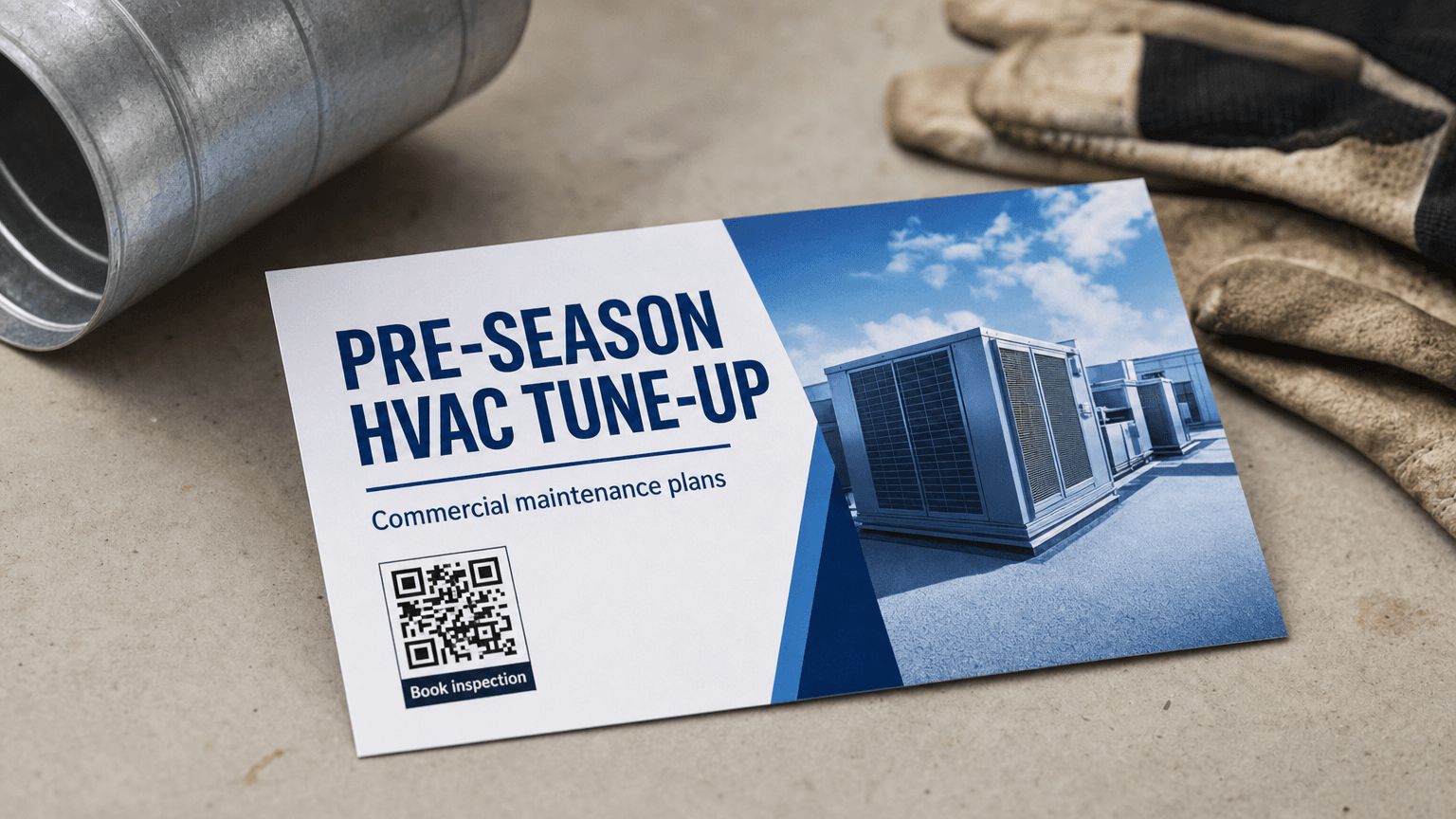
Whichever offer you choose, keep it singular. One clear ask per postcard. The QR code on the card should go directly to a booking page or quote request form, not your homepage.
Ready to Send Your First Campaign?
Magic Mailer uses AI to design, print, and mail professional postcards for your business in minutes, not weeks.
Try Magic Mailer FreeWant it set up in your CRM for you? book a meeting
Prefer to just describe it? build your whole campaign in one chat
Postcard Design and QR Code Setup
A commercial HVAC postcard needs to look like it came from an established operation, carry a specific offer, and make the next step frictionless, a scannable QR code to a booking page does all three.
Magic Mailer's AI brand extraction pulls your logo, colors, and business details to build an on-brand postcard without a designer. The platform handles layout, printing, and postage, pricing runs from CA$3.31 per piece at single quantities down to CA$1.53 per piece at 5,000 units, with all production and delivery included.
For the card itself, apply these principles:
Front panel: Business name, a clear headline ("Pre-Season Commercial HVAC Tune-Up, CA$249"), a short credibility line (years in service, certifications, number of commercial clients), and the QR code.
Back panel: Three bullet points on what the offer includes, one testimonial or trust signal (for example, "Trusted by 40+ commercial properties in [city]"), your phone number in large type, and the QR code repeated.
The QR code should link to a dedicated landing page, not your homepage, with a short form: business name, number of units, preferred callback time. Lob's 2025 State of Direct Mail reports that 88% of marketers say personalization improves direct mail performance, and 90% say direct mail enhances their digital campaign results. A QR code that bridges the physical card to a digital booking flow captures both effects.
On postcard size: a 6x9 or 6x11 format gives you enough space to carry the offer details without crowding. For commercial recipients who may share the card with a facilities team, a larger format survives a desk pile better than a standard 4x6.
Seasonal Timing: When to Drop
HVAC direct mail performs best when it arrives four to six weeks before the season that makes your offer urgent, giving commercial operators time to schedule before their systems are under load.
Two primary windows:
Spring drop (late March to mid-April): Targets pre-summer cooling season. Property managers scheduling rooftop unit inspections, restaurants preparing for summer kitchen heat loads, offices wanting AC confirmed before staff returns from spring break. Mail by the third week of April at the latest.
Fall drop (late September to mid-October): Targets pre-winter heating season. Office buildings, medical clinics, and retail operations want furnace and heat pump inspections before November. In Canada, this window closes quickly, mail by Thanksgiving.
A two-drop annual cadence means you reach the same commercial prospect list twice per year. Lob's 2024 data identifies direct mail among the 84% highest-ROI channels when used consistently, frequency matters as much as timing.
For house lists (past commercial clients), a third mid-year touchpoint, a reminder about filter changes or an emergency service plan renewal, reinforces your presence without a hard sell.
If you serve a cold-climate market, add a late-January drop targeting restaurants and food service operations for commercial refrigeration and ventilation checks. This fills the gap between the two main HVAC seasons.
Measuring Booked Calls and Contract Conversions
Tracking direct mail ROI for commercial HVAC means tying postcards to phone calls, quote requests, and signed contracts, not only counting responses.
Set up measurement before you mail:
Dedicated phone number: Assign a call-tracking number (via services like CallRail or a Google Voice line) used only on the postcard. Every inbound call from that number traces back to the campaign.
QR landing page analytics: The dedicated booking page from your QR code shows scan volume, form submissions, and conversion rate. Compare this against mail quantity to calculate response rate.
CRM tagging: When a commercial lead comes in, tag their source as the specific campaign (for example, "Spring 2026 Commercial Drop"). Track through to quote sent, contract signed, and first-year contract value.
A straightforward tracking table:
| Metric | What It Tells You |
|---|---|
| Response rate (calls + QR scans / pieces mailed) | List and offer quality |
| Quote conversion rate (quotes / responses) | Sales process fit |
| Contract conversion rate (contracts / quotes) | Offer and pricing fit |
| Average contract value | Revenue per acquired client |
| Cost per acquisition (total spend / contracts signed) | Campaign ROI |
The USPS OIG and Temple University research on physical mail recall supports the case for measuring over multiple touchpoints, recipients engage with physical mail across a longer window than digital ads, so attribution should account for calls that come in two or three weeks after the drop.
Benchmark a successful commercial HVAC campaign at 2-4% response on prospect lists and 5-8% on house lists, based on ANA figures. If your response falls below 1%, the issue is usually list quality or offer clarity before postcard design.
For companies running 500-piece drops, the math is accessible: at CA$1.90 per piece, a 500-card drop costs approximately CA$950 all-in. Two commercial maintenance contracts at CA$900 each recovers the spend in the first year, with annual renewals delivering profit in subsequent years.
Ready to Send Your First Campaign?
Magic Mailer uses AI to design, print, and mail professional postcards for your business in minutes, not weeks.
Try Magic Mailer FreeWant it set up in your CRM for you? book a meeting
Prefer to just describe it? build your whole campaign in one chat
Getting Started with Your First Drop
For HVAC companies new to commercial direct mail, a 300-500 piece drop to the nearest commercial properties in two or three high-value categories, property managers and medical clinics, for example, gives you a testable baseline without significant risk.
Build the list, set the offer, confirm the booking page is live, assign a tracking number, and schedule your print date to arrive three to four weeks before the season. Review the direct mail ROI guide and the postcard design guide for additional depth on each step.
The broader playbook for home-service businesses using direct mail is covered at the direct mail for home services hub, including how other trades approach commercial targeting. To see how HVAC companies across Canada use Magic Mailer to automate their commercial outreach, the industries overview shows active verticals and typical campaign setups.
Frequently Asked Questions
What types of commercial clients are best for HVAC direct mail?+
Property managers (multiple units, single decision-maker), restaurants (grease buildup, code compliance), medical clinics (air quality uptime), and offices over 50 employees tend to convert best because they already budget for preventive maintenance and have high downtime costs.
How many postcards should an HVAC company mail to start?+
A 300 to 500 piece drop to two or three nearby commercial categories is a workable test. At CA$1.90 per piece in that volume range, total spend stays under CA$1,000 and two converted maintenance contracts typically recover the cost in year one.
When is the best time to mail HVAC postcards to commercial clients?+
Mail four to six weeks before peak seasons: late March to mid-April for pre-summer cooling, and late September to mid-October for pre-winter heating. This gives property managers and facilities teams time to schedule before systems are under full load.
What offer works best on a commercial HVAC postcard?+
A single, specific offer performs better than a general service menu. Pre-season tune-up specials with fixed pricing, annual maintenance plan summaries, and 24/7 emergency contact arrangements each work well. Pick one per card and include a QR code to a booking page.
How do I track whether my HVAC direct mail campaign worked?+
Use a dedicated call-tracking number printed only on the postcard, a unique QR landing page with form analytics, and CRM tagging for every lead sourced from the campaign. Track response rate, quote conversion, contract conversion, and average contract value to calculate true cost per acquisition.
Sources
- ANA 2023 Response Rate Report: 2.9% prospect response rate, 5.3% house list response rate, 161% house list ROI benchmark for direct mail. — ana.net
- USPS OIG / Temple University, Enhancing the Value of Mail: The Human Response, on physical mail recall and engagement duration. — uspsoig.gov
- Lob 2024 State of Direct Mail: direct mail identified among the 84% highest-ROI channels when used consistently. — lob.com
- Lob 2025 State of Direct Mail: 88% of marketers say personalization improves direct mail performance; 90% say direct mail enhances digital campaign results. — lob.com
Ready to Send Your First Campaign?
Magic Mailer uses AI to design, print, and mail professional postcards for your business in minutes, not weeks.
Try Magic Mailer FreeWant it set up in your CRM for you? book a meeting
Prefer to just describe it? build your whole campaign in one chat