Key Takeaways
- House-list direct mail averages a 5.3% response rate and 161% ROI per the ANA 2023 Response Rate Report, benchmarks that exceed most digital channels.
- Magic Mailer builds your audience either way: the nearby businesses (offices, gyms, salons, schools) whose teams dine out, or the households around you through a neighbourhood drop.
- The four highest-value use cases are weekday lunch specials, catering menus, grand-opening announcements, and private-dining or event-space bookings.
- Post Timely's Magic Mailer handles business list-building, AI postcard design, printing, and postage from one self-serve workflow, with per-postcard pricing from CA$3.31 down to CA$1.53 at volume.
- A QR code on the postcard bridges the physical piece to online ordering, reservations, or catering inquiries, making each send trackable through your digital systems.
Magic Mailer identifies who you should reach and builds the target list for you, whether that is the businesses near you or the neighbourhoods around you, then designs and mails the postcard.
Why Direct Mail Works for Restaurants
Direct mail consistently outperforms digital channels on the metrics that matter most for local businesses: response rate, conversion rate, and return on investment. Per the ANA 2023 Response Rate Report, house-list direct mail averages a 5.3% response rate and delivers an average ROI of 161%, compared to 44% for house-list email. For prospect lists, the average response rate is 2.9% with a 34% ROI. Physical mail also produces stronger emotional response and easier recall than digital advertising, according to research published by the USPS Office of Inspector General in partnership with Temple University. For a restaurant competing against dozens of digital ads every day, a postcard that lands on a desk or front counter carries a different kind of weight.
The Lob State of Direct Mail 2024 report found that 84% of marketers now rank direct mail as their highest-ROI channel, up from 67% in prior years. That shift reflects what restaurant operators are beginning to discover: when you put a well-designed postcard in front of the right people, it moves them to act.
The B2B Angle: Why Targeting Nearby Businesses Beats Guesswork
A restaurant has two strong audiences within reach: the workforce nearby and the households around you. It is the workforce that already exists within walking or driving distance. Nearby offices, gyms, salons, schools, and workplaces represent a predictable, repeatable pool of potential customers who need to eat lunch, plan team catering orders, and book private events. Targeting nearby businesses puts your postcard in front of a decision-maker, while a neighbourhood drop reaches the residents who live close enough to become regulars.
Reaching nearby businesses changes the math on direct mail for restaurants in three important ways.
First, the audience is self-selecting. An office manager who receives a catering menu for a nearby restaurant has a concrete, recurring reason to act on it. A gym that gets a postcard about weekday lunch specials can share it with members. The relevance of the offer is baked into the targeting.
Second, the conversion cycle is shorter. A business that needs lunch catering for a meeting this week will not wait long to call or scan a QR code. The urgency is real.
Third, the lifetime value is higher. A single office that places one catering order per month is worth far more than a household that visits once. Winning a recurring business customer through one postcard can deliver returns that compound over months.
Post Timely's(/magic-mailer/direct-mail-restaurants) finds those nearby businesses through smart local targeting across 20 industries, then builds and mails your postcard automatically. You pick the area, enter your restaurant name and website, and the platform extracts your branding and generates an AI-powered strategy. You choose your business targets, review up to three postcard designs, and approve the send at checkout.
Core Use Cases
The B2B targeting model opens up four distinct campaign types, each with a specific offer and audience.
Weekday lunch specials to nearby offices. The office lunch market is one of the most consistent revenue streams a restaurant can capture. A postcard mailed to offices within a 10-minute walk, featuring a clear lunch combo price and a QR code linking to online ordering, gives office workers a reason to choose your restaurant over whatever they ordered yesterday. See the restaurant lunch specials direct mail guide for offer and timing guidance.
Catering menus to local businesses. Corporate catering is high-ticket and recurring. A postcard that leads with your catering minimum, menu highlights, and a QR code to a catering inquiry form reaches the people who actually book catering, which is usually an office manager, executive assistant, or operations lead. The restaurant catering direct mail guide covers how to frame the offer and what details to include.
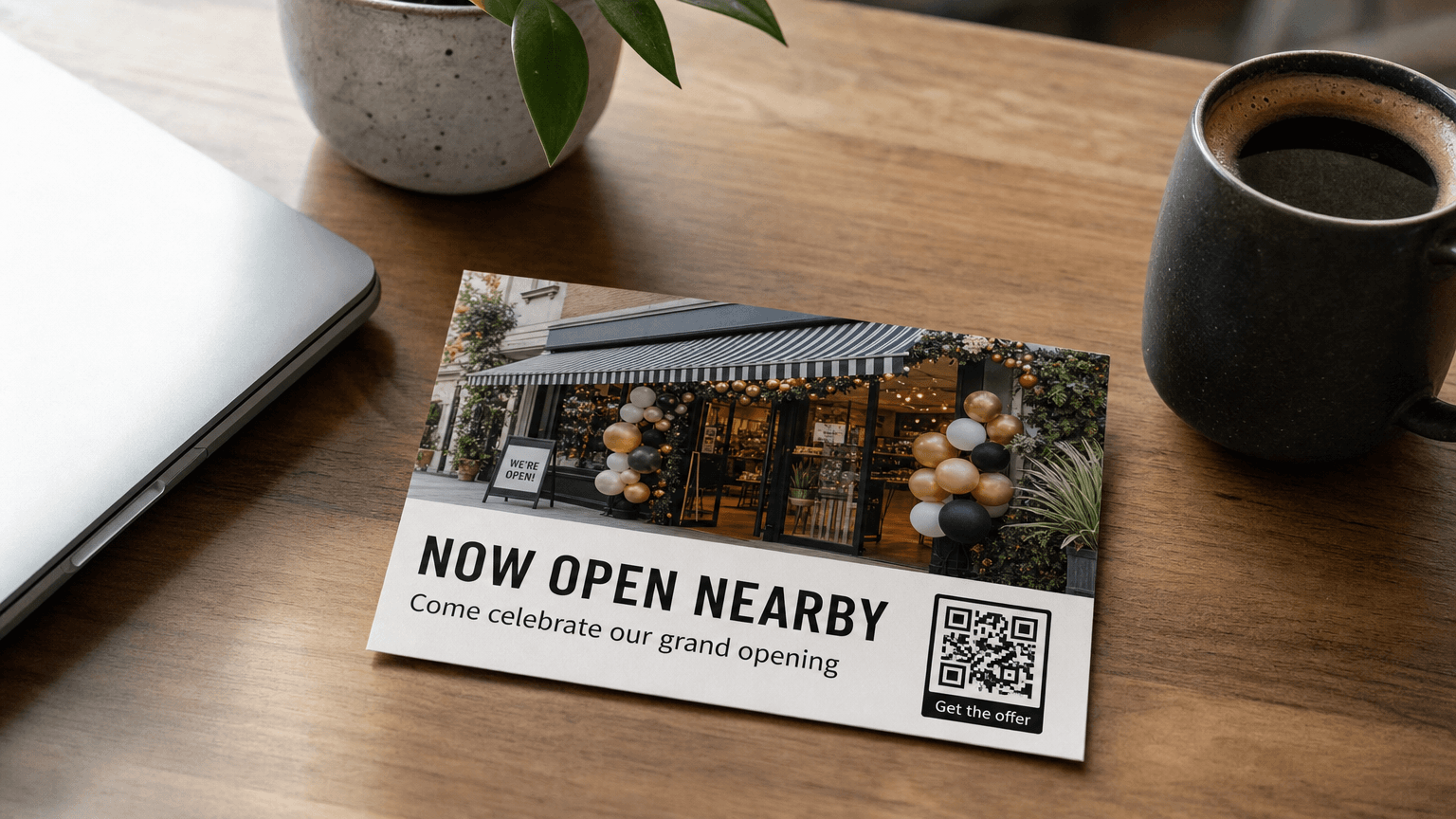
Grand-opening announcements to the surrounding business community. A new restaurant has one window to make a first impression on the local business district. A postcard mailed to every office, salon, gym, and retail shop within a defined radius, carrying a grand-opening offer and a QR code to your menu, turns neighbors into first customers before the word-of-mouth cycle even starts. The restaurant grand opening direct mail guide walks through timing and offer structure.
Event-space and private-dining bookings. If your restaurant has a private room or can host buyouts, the businesses around you are your most likely customers. Holiday parties, team dinners, client lunches, and milestone celebrations all happen at restaurants. A targeted postcard to nearby employers, featuring your private dining capacity and a QR code to a booking form, reaches those buyers before they start searching online.
Ready to Send Your First Campaign?
Magic Mailer uses AI to design, print, and mail professional postcards for your business in minutes, not weeks.
Try Magic Mailer FreeWant it set up in your CRM for you? book a meeting
Prefer to just describe it? build your whole campaign in one chat
How the Postcard Format Works
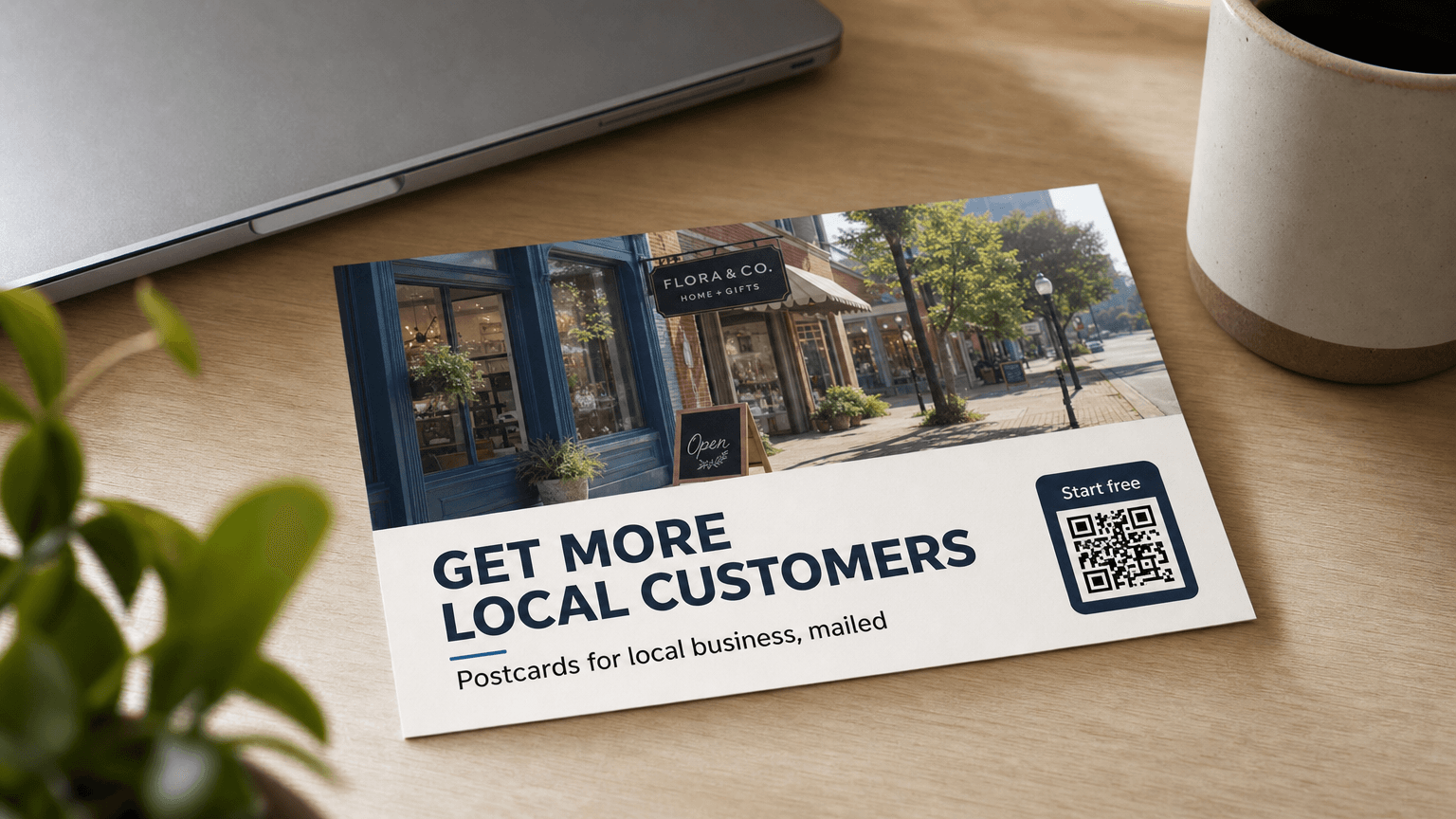
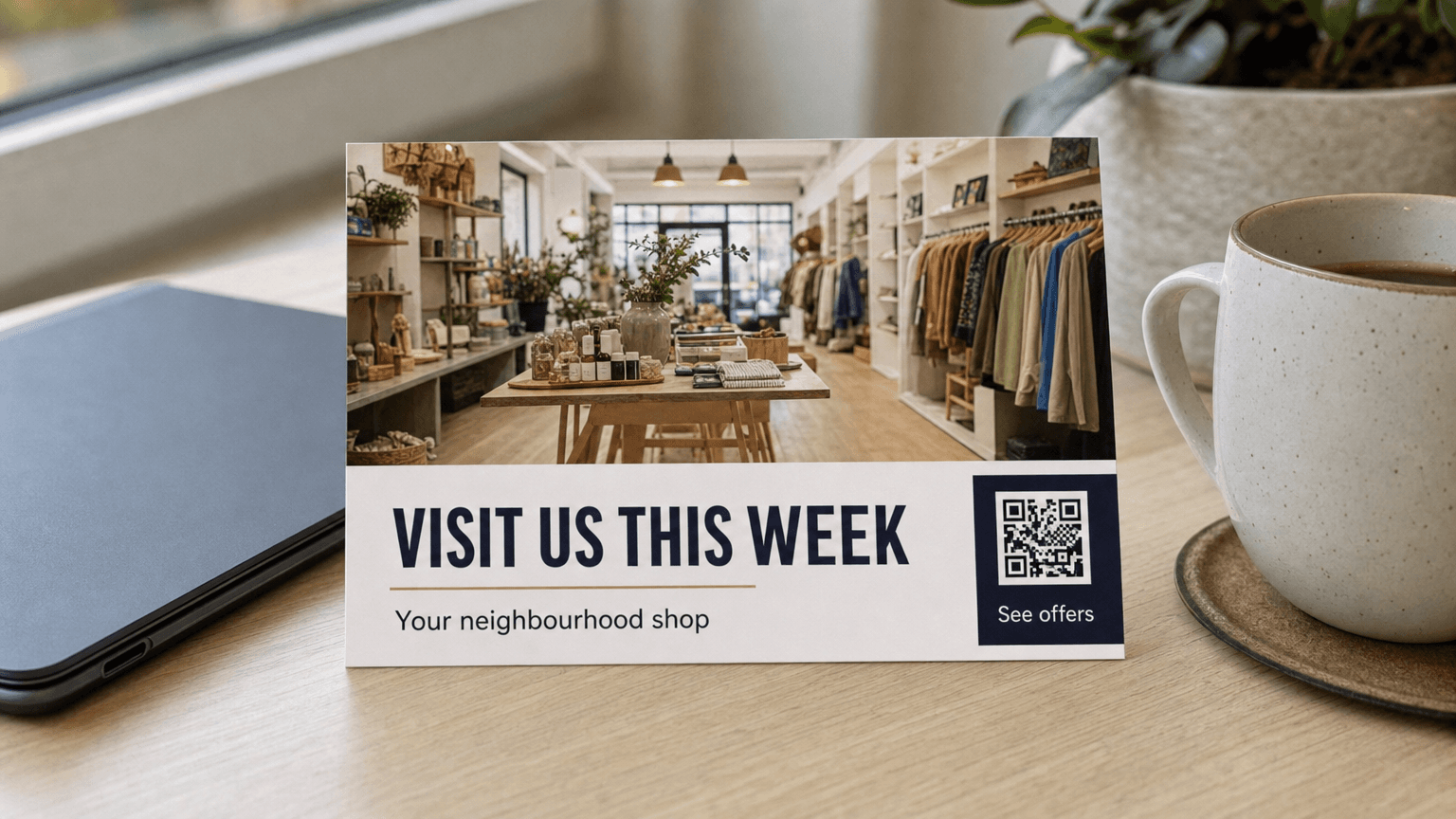
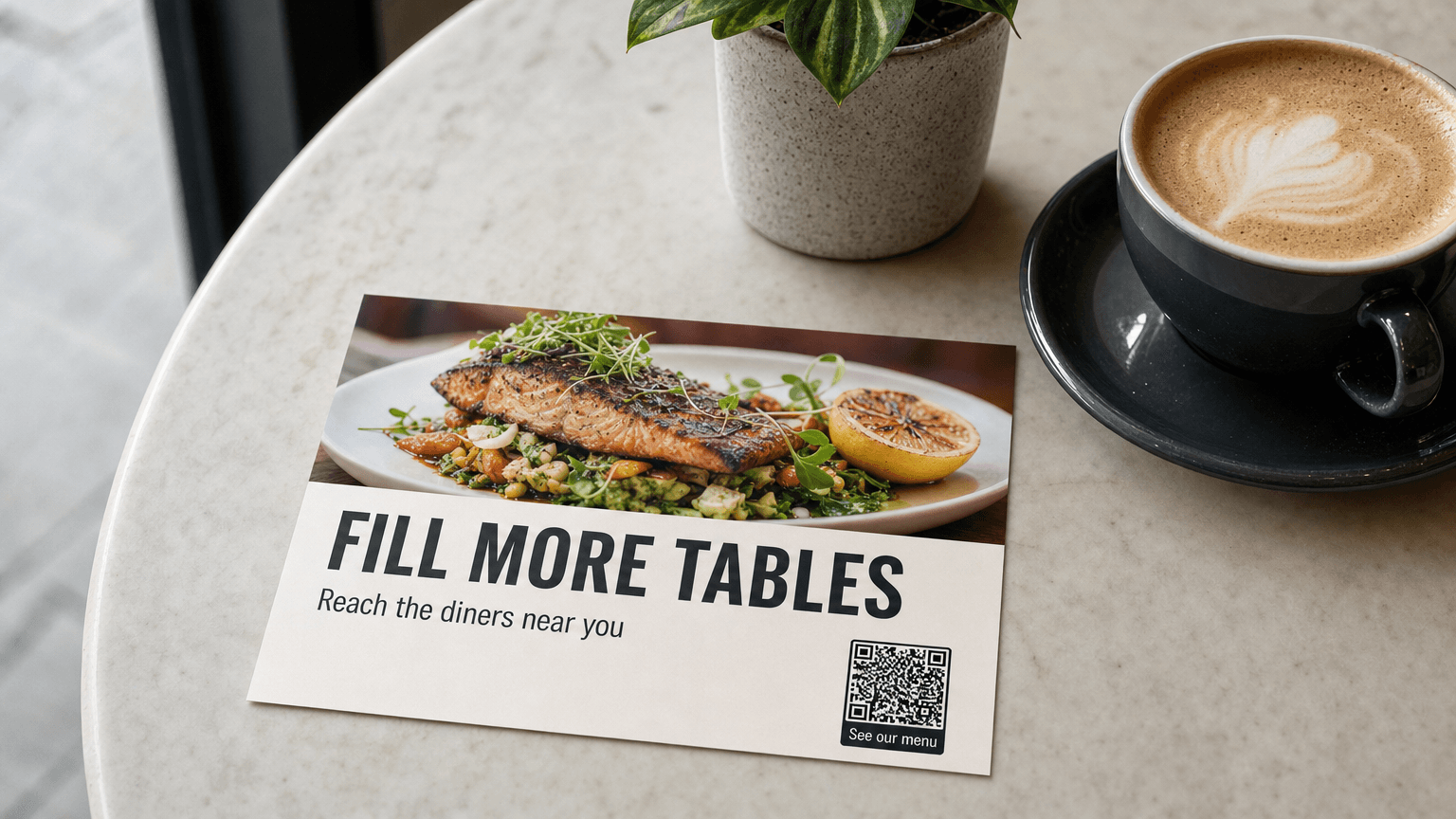
A restaurant postcard does one job: get the recipient to take one action. That action is scanning the QR code, calling the number, or walking in. Every design decision should serve that goal, and the strongest pieces communicate the offer in under five seconds of attention.
The most effective restaurant postcards follow a structure that is quick to absorb at a glance.
| Element | Purpose | Best Practice |
|---|---|---|
| Headline | Capture attention with the offer | Lead with the benefit, not the restaurant name |
| Hero image | Make the food or space look compelling | Use a high-quality image from your website or a professional shoot |
| Offer details | Give a reason to act now | Include a specific discount, combo price, or free item with a deadline |
| QR code | Bridge print to digital | Link to online ordering, reservations, catering inquiry, or your menu |
| Restaurant name and logo | Build brand recognition | Keep it secondary to the offer |
| Address and hours | Remove friction | Include only if relevant to the campaign |
Magic Mailer extracts your branding automatically from your restaurant website, including your color palette, logo, and any imagery available at the URL you provide. The platform then generates up to three postcard design variations using your brand assets, which you review before approving the send. You are not working from a blank template or waiting on a designer.
The QR code is a first-class element, not an afterthought. It links to whatever URL you specify, whether that is your online ordering system, your catering inquiry form, your OpenTable or Resy page, or your full menu. Recipients who scan it are expressing intent. That intent is trackable through your dashboard.
Pricing and How to Get Started
Direct mail pricing for restaurants scales with volume. Post Timely's Magic Mailer uses per-postcard pricing that includes printing and postage, with no hidden setup fees. A single card runs CA$3.31, and the per-card rate falls to CA$1.53 at volumes of 5,000 cards and above.
| Volume | Price per Postcard (CA$) |
|---|---|
| 1 card | CA$3.31 |
| 5,000+ cards | CA$1.53 |
All prices are in Canadian dollars and include printing, postage, and delivery. There is no minimum order beyond a single card. For postcard marketing cost benchmarks and ROI modeling, the cost-per-acquisition benchmarks from the ANA 2023 Response Rate Report are useful context: house-list direct mail averages approximately US$19 per acquired customer, while prospect-list campaigns average approximately US$43.
The Free Starter plan includes 1,000 build credits with no credit card required. Build credits cover the AI strategy generation, brand extraction, and postcard design phases, so you can see exactly what your campaign will look like before you commit to printing and mailing.
Getting started takes four steps.
- Enter your restaurant name, website URL, and target area in Magic Mailer.
- Review the AI-generated strategy, which recommends offer types, target industries, and send timing based on your location and business type.
- Choose your target businesses from the smart local targeting-sourced list across 20 industries.
- Review up to three postcard designs, make any edits, and approve the send at checkout.
There is no print vendor to coordinate, no list broker to hire, and no designer to brief. The workflow is self-contained.
Ready to Send Your First Campaign?
Magic Mailer uses AI to design, print, and mail professional postcards for your business in minutes, not weeks.
Try Magic Mailer FreeWant it set up in your CRM for you? book a meeting
Prefer to just describe it? build your whole campaign in one chat
How Direct Mail Pairs With Your Digital Presence
Direct mail does not replace digital marketing for restaurants. It amplifies it. The physical postcard drives people to digital touchpoints they were not actively searching for, which is the gap that search ads and social posts cannot fill on their own.
Per the Lob State of Direct Mail 2025 report, 90% of marketers say direct mail enhances the performance of their digital channels, and 79% of top-performing campaigns use direct mail as part of a multichannel approach. The QR code is the mechanism that makes this connection concrete.
When a restaurant postcard lands on an office desk, the QR code gives the recipient an immediate path to act. If it links to an online ordering page, that click is trackable. If it links to a reservation system, the booking is attributable. If it links to a catering inquiry form, the lead is captured. The physical piece creates awareness and urgency; the digital destination closes the loop.
Personalization amplifies this further. The Lob 2025 report found that 88% of marketers say personalization significantly improves direct mail response rates. In the restaurant context, personalization means matching the offer to the audience: a catering postcard sent to law firms and accounting offices within a half-mile carries a different message than a lunch-special card sent to gyms and fitness studios.
For a broader look at how direct mail ROI benchmarks apply across industries, the direct mail ROI guide breaks down the ANA data by channel and list type. If you are evaluating the postcard format against other print options, the postcard design guide covers design principles and format choices.
What to Expect From a Restaurant Direct Mail Campaign
Benchmarks are not guarantees, and results vary based on offer strength, list quality, timing, and the competitive environment in your area. That said, the published averages give a useful planning baseline for any restaurant evaluating the channel for the first time.
Prospect-list campaigns, which is what most restaurant campaigns targeting nearby businesses will be, average a 2.9% response rate and a 34% ROI per the ANA 2023 Response Rate Report. For a 500-card send to nearby offices, a 2.9% average response rate works out to roughly 14 to 15 responses. If your average order value for a catering inquiry or recurring lunch customer is CA$200 or more, the math becomes favorable quickly.
The stronger lever is repeating the campaign. Direct mail response rates improve with frequency, because familiarity builds trust. A business that sees your postcard three times over six months is more likely to convert than one that sees it once. The Lob 2024 data showing 84% of marketers ranking direct mail as their highest-ROI channel reflects sustained programs, not one-off sends.
The most effective restaurant operators treat direct mail as a scheduled channel, not a one-time tactic. A quarterly catering postcard to the same office park, a seasonal lunch-special card before major work periods, and a grand-opening send when a new location launches together create a presence that compounds over time.
For restaurants that have relied entirely on delivery apps, social ads, and search, direct mail to the business community is a channel that operates outside the auction dynamics of digital advertising. There is no cost-per-click to bid on, no algorithm to satisfy, and no feed to compete in. A postcard arrives, sits on a desk, and gets read at the recipient's pace. That is a different kind of attention, and for restaurants with a clear offer and a nearby business audience, it is worth putting to work.
Explore what a campaign would look like for your restaurant at(/magic-mailer/direct-mail-restaurants), or browse the full list of industries and use cases at Post Timely Industries.
Frequently Asked Questions
What response rate can restaurants expect from direct mail?+
Per the ANA 2023 Response Rate Report, prospect-list direct mail campaigns average a 2.9% response rate and 34% ROI. House-list campaigns, where you mail existing customers, average 5.3% and 161% ROI. These are industry benchmarks, not guarantees, and results vary based on offer, list quality, and timing.
Who should a restaurant target with direct mail?+
The most productive audiences for restaurant direct mail are nearby businesses: offices, gyms, salons, schools, and workplaces whose employees need lunch options, catering services, and event venues. Post Timely's Magic Mailer identifies these businesses through smart local targeting across 20 industries within your chosen radius.
How much does restaurant direct mail cost in Canada?+
Post Timely's Magic Mailer prices postcards in Canadian dollars from CA$3.31 for a single card down to CA$1.53 per card at volumes of 5,000 or more. All prices include printing and postage. There is no minimum order beyond a single card, and a Free Starter plan with 1,000 build credits is available with no credit card required.
What should a restaurant postcard include?+
An effective restaurant postcard needs a headline focused on the offer, a compelling food or space image, specific offer details with a clear action such as a lunch combo price or catering minimum, a QR code linking to online ordering or a reservation page, and your restaurant name and logo. Keep the design focused on one action for the recipient to take.
Does direct mail work alongside digital marketing for restaurants?+
Yes. Per the Lob State of Direct Mail 2025 report, 90% of marketers say direct mail enhances their digital channel performance. The QR code on a restaurant postcard drives recipients directly to online ordering, reservation systems, or catering inquiry forms, making the physical piece measurable through your existing digital tools.
Sources
- ANA Response Rate Report 2023 — ana.net
- USPS OIG / Temple University, Enhancing the Value of Mail: The Human Response — uspsoig.gov
- Lob State of Direct Mail 2024 — lob.com
- Lob State of Direct Mail 2025 — lob.com
Ready to Send Your First Campaign?
Magic Mailer uses AI to design, print, and mail professional postcards for your business in minutes, not weeks.
Try Magic Mailer FreeWant it set up in your CRM for you? book a meeting
Prefer to just describe it? build your whole campaign in one chat